Try the sheet here, on the example
The sheet is open below with sample numbers. Change any white cell and watch the results update, or press the blank-copy button to type your own data from scratch. Nothing you type leaves your browser.
Example from the sheet
| المادة | ساعات مخططة | ساعات فعلية | نسبة التنفيذ | الهدف الأسبوعي | الفرق عن الهدف | الحالة |
|---|---|---|---|---|---|---|
| رياضيات | 4.00 | 3.50 | 87.5% | 5.00 | -1.50 | أقل من الهدف |
| فيزياء | 4.25 | 3.00 | 70.6% | 4.00 | -1.00 | أقل من المخطط |
| لغة عربية | 2.00 | 1.83 | 91.7% | 2.00 | -0.17 | أقل من الهدف |
| إنجليزي | 2.50 | 2.25 | 90.0% | 3.00 | -0.75 | أقل من الهدف |
Example from the “ملخص الأسبوع” tab (Arabic), with the numbers and formulas that are in the file.
What is inside
- “الإعدادات” (Settings): The date of the first day of the week you want summarised, and the percentage below which you count as falling short.
- “المواد” (Subjects): Each subject's name and its weekly target in hours, up to 15 subjects.
- “الجدول” (Schedule): One row per study block: date, subject, planned and actual minutes, and whether it was done. The day name and the difference fill in automatically. It holds up to 1,000 blocks.
- “ملخص الأسبوع” (Weekly summary): For each subject, the planned and actual hours, completion rate, gap against the target and status. For each day, the planned and actual minutes. It also shows the week's totals.
The file opens on a start tab (“ابدأ هنا”, Start here) that explains how to use it.
What makes it different
The sheet compares what you planned with what you actually studied, not just what you intend to study. You can see which subject is getting less time than it needs before time runs short.
How to use it
- In the “المواد” (Subjects) tab, enter your subjects and each subject's target in hours per week.
- In the “الإعدادات” (Settings) tab, enter the date of the first day of the week you want summarised, and the percentage below which you count as falling short.
- In the “الجدول” (Schedule) tab, record each study block: date, subject and planned minutes. The day name appears by itself.
- After studying, enter the actual minutes and choose “نعم” (yes) or “لا” (no) in the done column.
- Open “ملخص الأسبوع” (Weekly summary) to see, for each subject, your planned and actual hours, completion rate and gap against the target, and for each day what you studied.
Before you start:
- “ملخص الأسبوع” (Weekly summary) covers seven days starting from the date in “الإعدادات” (Settings). To summarise another week, change the date.
- Blocks outside those seven days stay in the “الجدول” (Schedule) and are left out of the summary.
- “أقل من المخطط” appears when your actual hours are below the set percentage of your plan, and “أقل من الهدف” when you met the plan but did not reach the subject's target.
- The sheet holds 15 subjects and 1,000 study blocks.
Free cheat sheet for this field
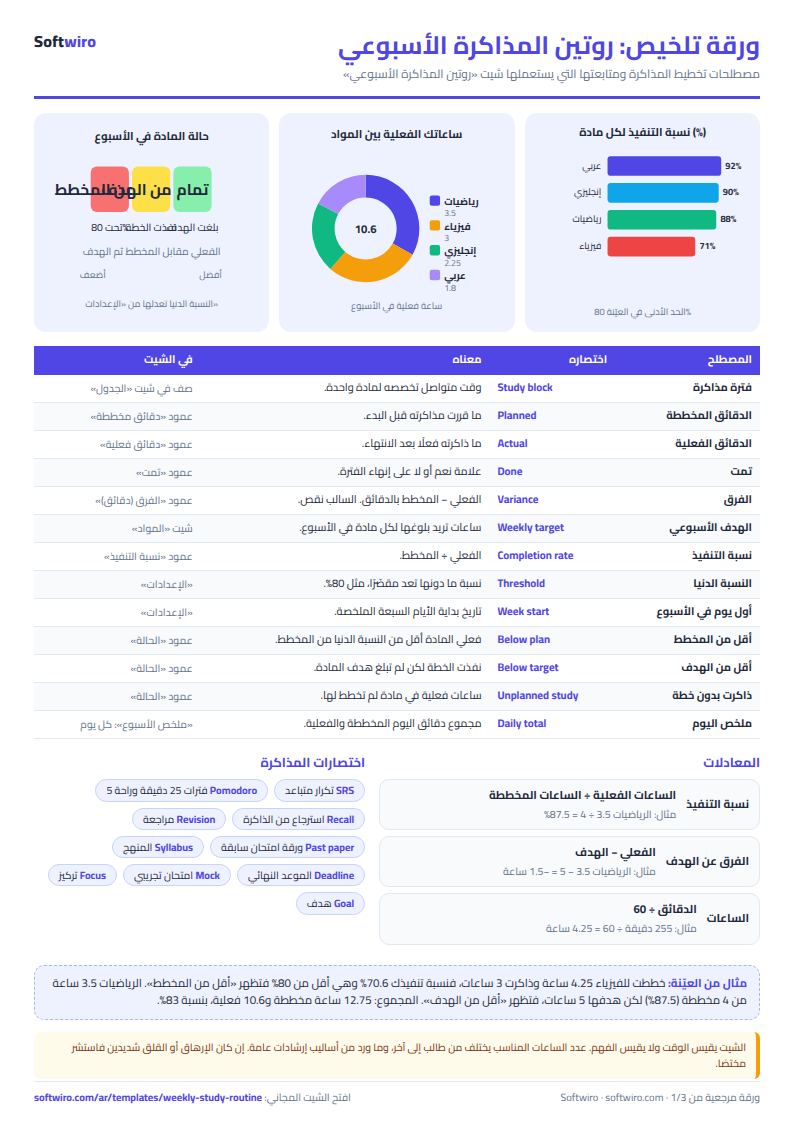
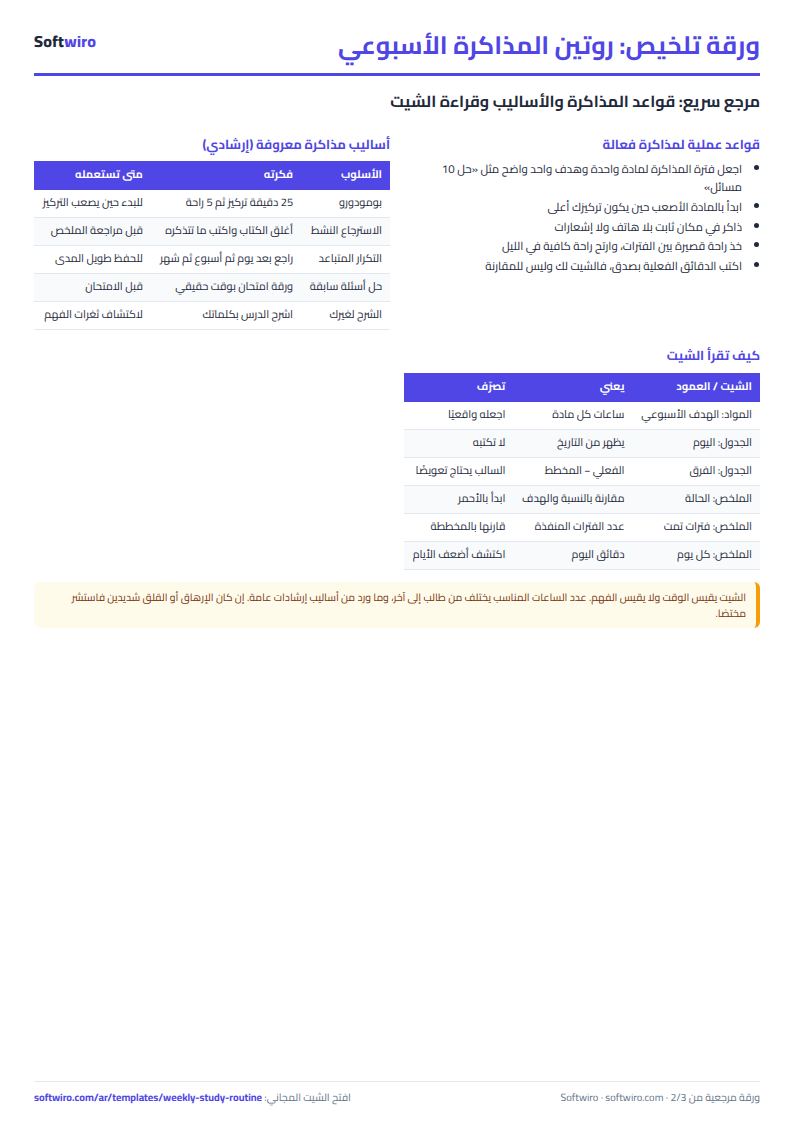
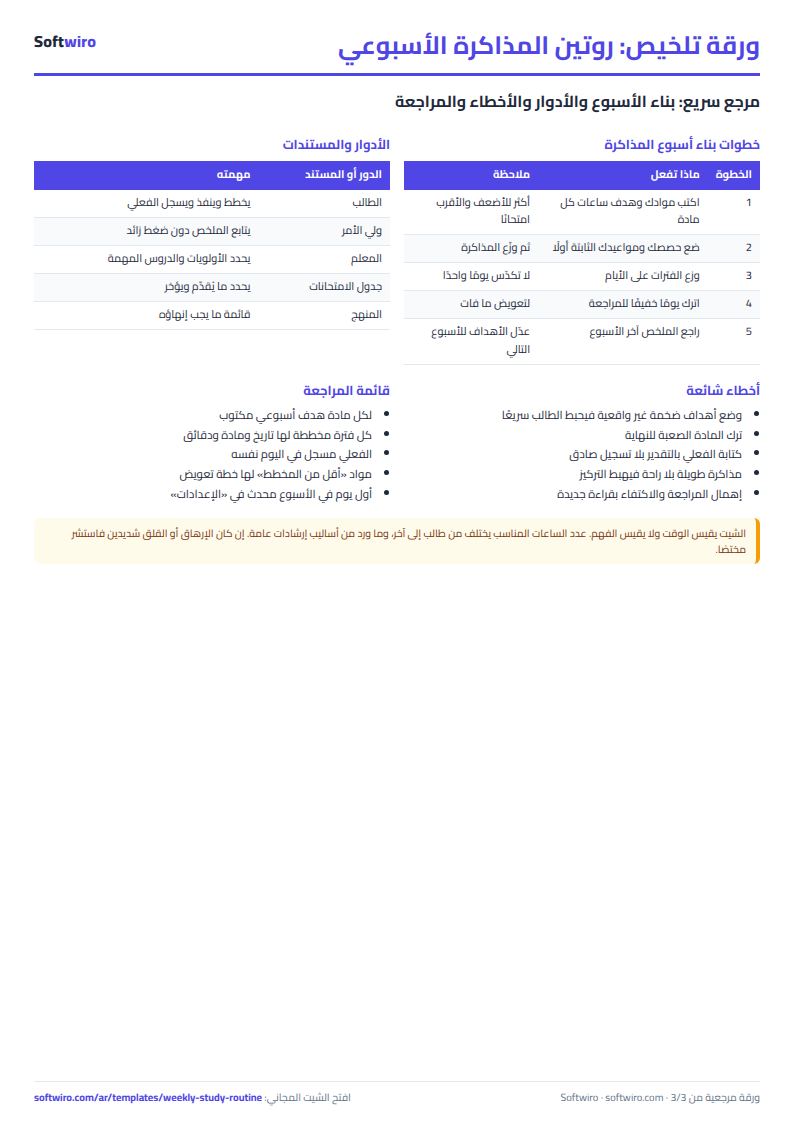
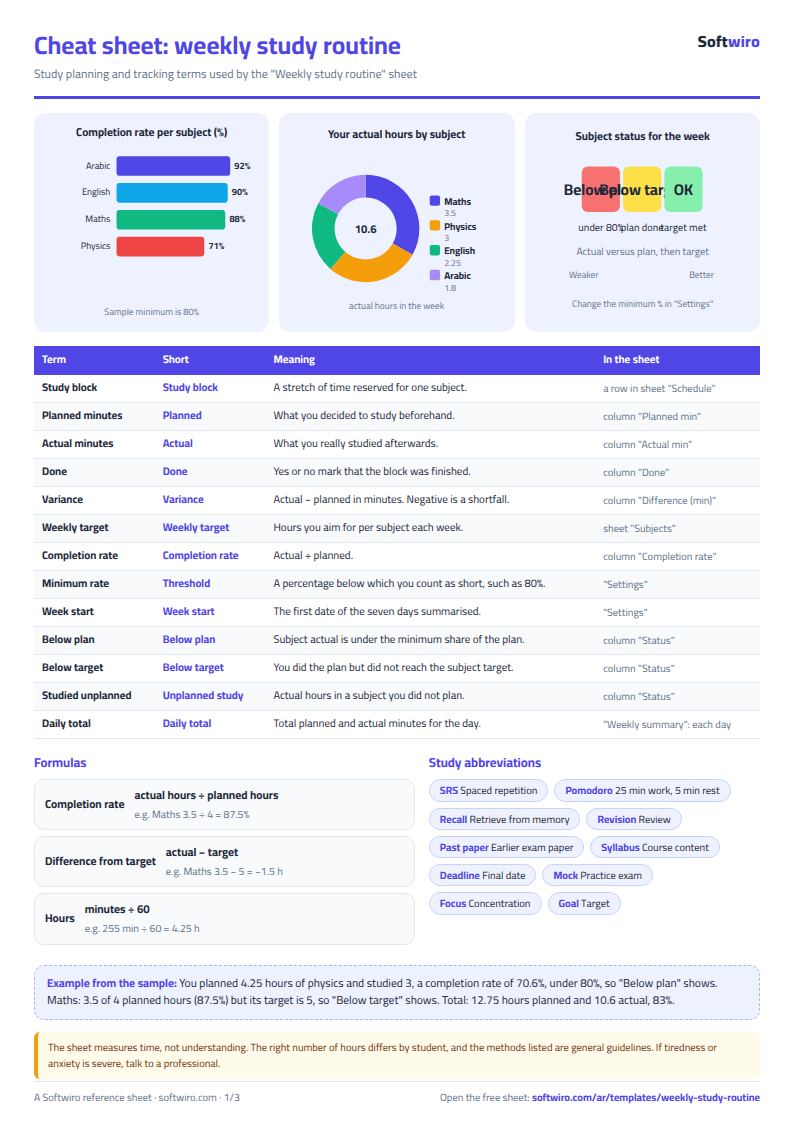
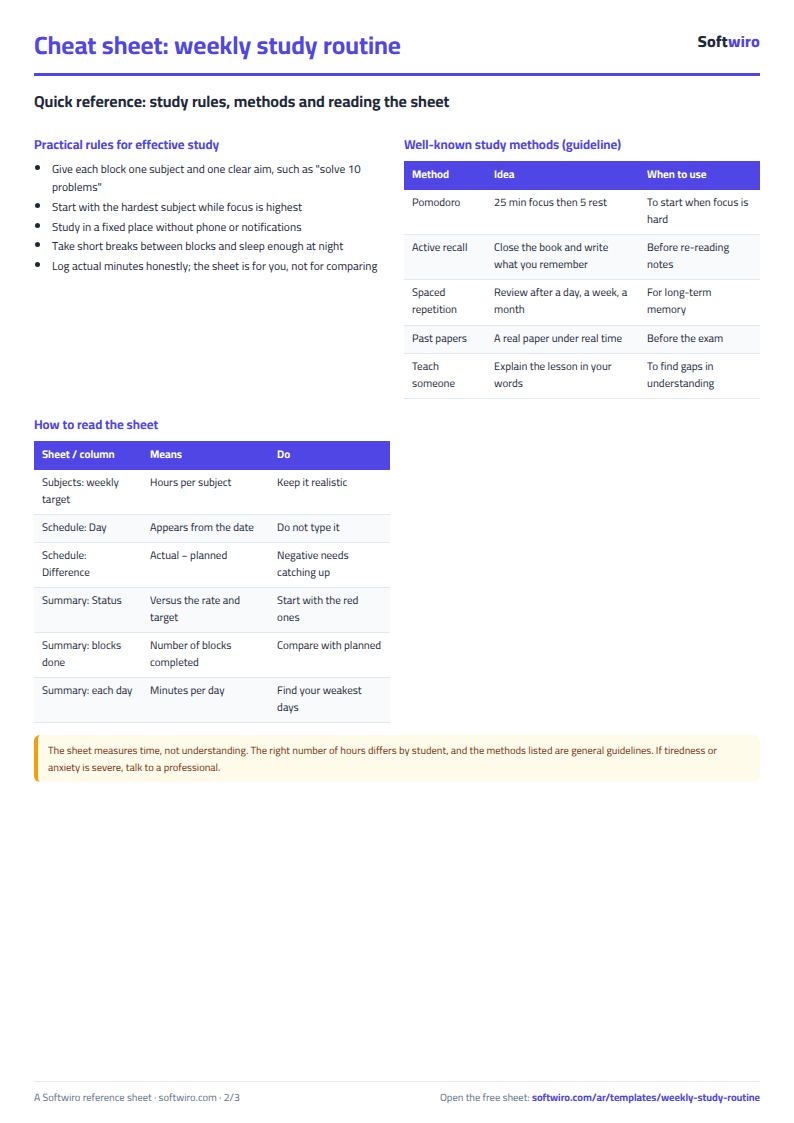
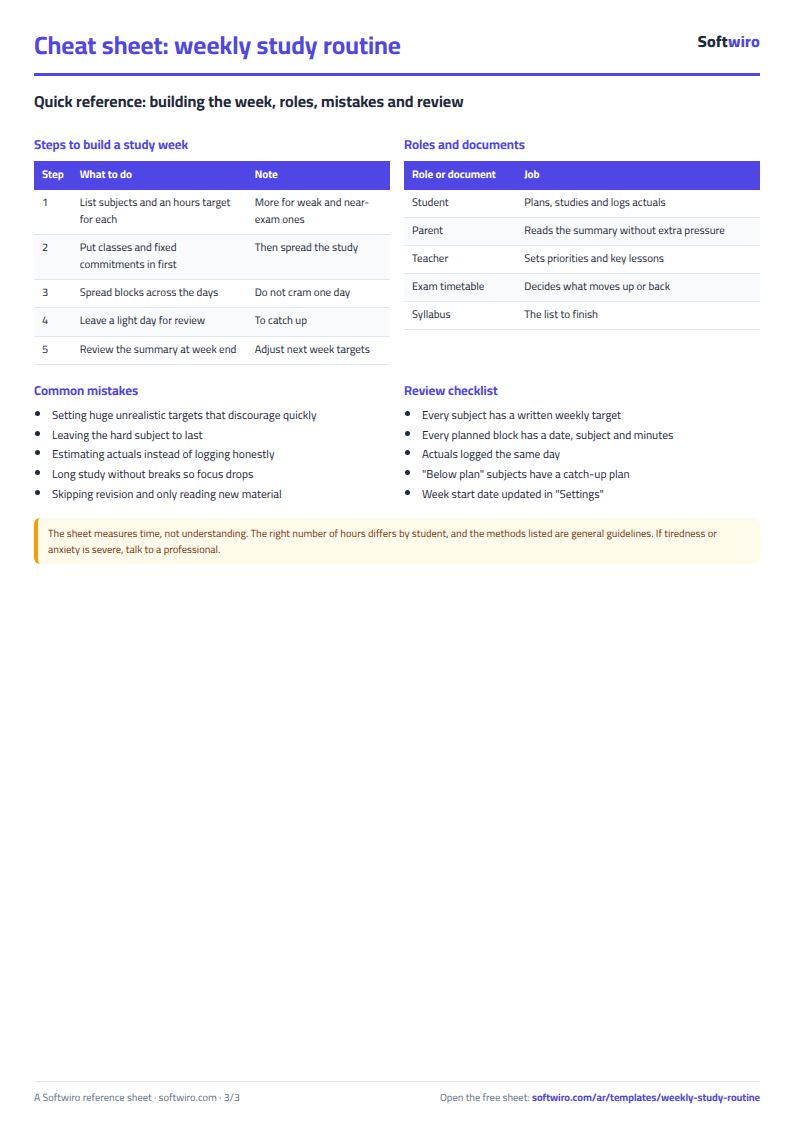
Terms, abbreviations, tables and diagrams over several pages, in Arabic and English. Download it as a PDF or images, including a phone-size version.
Still running this on Excel?
This sheet depends on your own self-assessment. In Bayango the school textbook is turned into quizzes, your weak points are identified from your results, and your study plan changes as your results accumulate.
| In this sheet | In Smart Study Platform |
|---|---|
| You judge for yourself how well you understood the lesson. | You take the school textbook as a PDF and it is automatically turned into quizzes, mind maps, flashcards and educational games. |
| The plan stays fixed until you change it by hand. | It analyzes your results as you practice, identifies your weak points, and builds you a personal study plan that changes as your results accumulate. |
| You study alone, and putting it off is easy. | Live study groups, one-on-one duels and a leaderboard, so revision becomes a group activity with a bit of competition. |
| The teacher tracks homework across papers and scattered groups. | Tools for teachers and administrators to follow homework and classes across multiple grades and subjects. |
Frequently asked questions
How do I make a weekly study timetable in Excel?
List your subjects and each one's target in hours. Then record each study block with its date, subject and planned minutes, and enter the actual minutes after you study. The sheet works out the hours for each subject and your completion rate, and compares them with your weekly target.
What is the difference between “أقل من المخطط” (below plan) and “أقل من الهدف” (below target)?
“أقل من المخطط” means your actual hours are below the percentage of your plan that you set (for example 80%). “أقل من الهدف” means you carried out your plan, but the total still does not reach the subject's weekly target.
Can I use it for a week other than the current one?
Yes. Change the first-day date in “الإعدادات” (Settings) and the sheet summarises the seven days starting from it. The other blocks stay in the schedule.
Is the template free?
Yes, with no sign-up and no email address. Use it, edit it and share it as you like.
Does it work in Google Sheets and on mobile?
The sheet uses formulas supported by Excel 2016 and later, Google Sheets and LibreOffice, so you can upload it to Google Drive and open it with Google Sheets on a computer or a phone.
What is the difference between the white and the gray cells?
You type in the white cells; the gray cells are calculated automatically. Don't type in a gray cell, or you will erase its formula.
Can I use the sheet from an AI assistant?
Yes. Add our MCP server (URL https://softwiro.com/api/mcp, no key needed) to your assistant and ask it to do the calculation in this template. The numbers come from the sheet's own formulas, and we do not store your data. The steps and a ready-made prompt are in this article: https://softwiro.com/blog/mcp-excel-templates-ai-agent-guide.html
All the templates in this group: Free study summaries: rules, formulas and self-tests
More free templates for: Schools and students
More free templates
- Gradebook Template for Excel (Weighted Categories, Letter Grades)
- Student attendance sheet
- Study planner and lesson tracker
- Nursery and school fees tracker (Excel)
- Tutoring center manager (Excel)
- School class timetable (Excel)
- Exam schedule with committees and invigilators (Excel)
- Homework and behavior tracker for teachers (Excel)
- School bus subscriptions tracker (Excel)
- University applications tracker (Excel)
- Complete nursery management sheet
- Private school management sheet
- Lending library management sheet
- Graduation project manager sheet: tasks, team, phases and deliverables
- Online store orders and profit sheet
- Real estate leads and units tracker
- Installments and collection tracker
- Rental portfolio tracker: properties, units, tenants and contracts
- Pharmacy expiry and stock tracking sheet
- Rent collection tracker for properties
- Business expenses and monthly budget sheet
- Lead and deal pipeline tracker