Try the sheet here, on the example
The sheet is open below with sample numbers. Change any white cell and watch the results update, or press the blank-copy button to type your own data from scratch. Nothing you type leaves your browser.
Example from the sheet
| اسم الأصل | الفئة | آخر صيانة دورية | الصيانة القادمة | الحالة | إجمالي التكلفة |
|---|---|---|---|---|---|
| مصعد البرج أ | مصاعد | 46246 | 46338 | قريب خلال 30 يوم | 5,200.00 |
| مصعد البرج ب | مصاعد | 46270 | 46361 | منتظم | 1,500.00 |
| مولد كهرباء 500 ك.ف.أ | مولدات | 46132 | 46315 | متأخر | 6,550.00 |
| طلمبات المياه الرئيسية | طلمبات المياه | 46175 | 46358 | منتظم | 900.00 |
| طلمبة رفع الصرف | طلمبات المياه | 46305 | 46428 | منتظم | 600.00 |
| شبكة الحريق والطفايات | مكافحة الحريق | 46054 | 46419 | منتظم | 2,500.00 |
Example from the “الأصول” tab (Arabic), with the numbers and formulas that are in the file.
What is inside
- "الإعدادات" (Settings): The review date (today's date) against which status is measured, the month whose cost you want, and the list of asset categories.
- "الأصول" (Assets): One row per asset: code, name, category, location, supplier, installation date and maintenance every how many months. The sheet calculates the last periodic maintenance, the next maintenance, status, days to the due date and total cost, and colors overdue rows red.
- "سجل الصيانة" (Maintenance log): Each visit with its date, asset code, type (periodic, breakdown or emergency), cost, supplier and a note. It fills in the asset name and category, and warns you about an unregistered code.
- "الملخص" (Summary): The number of overdue, due-soon and on-schedule assets, the cost of the chosen month, cost by category, and the five most expensive assets.
The file opens on a start tab (“ابدأ هنا”, Start here) that explains how to use it.
What makes it different
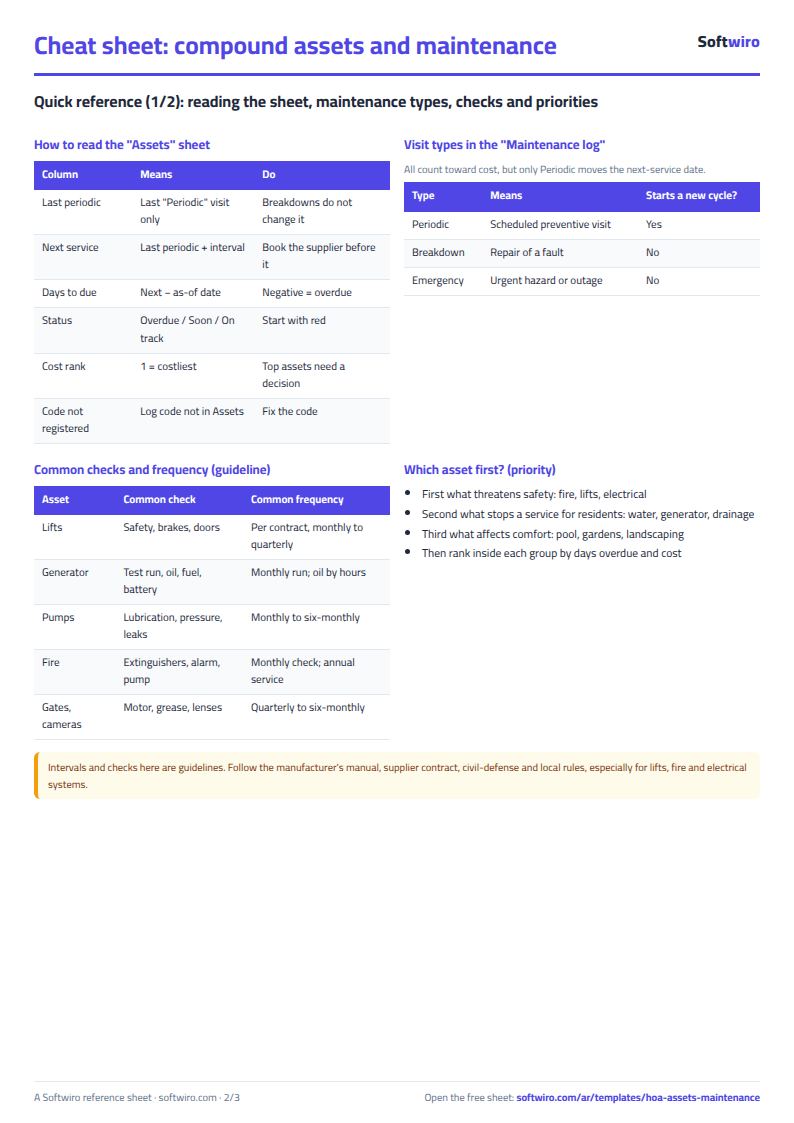
It holds 500 assets and 2000 visits. The next maintenance is calculated from the last "periodic" visit only: breakdowns and emergencies count toward cost but do not start a new cycle. An asset with no maintenance recorded is calculated from its installation date.
How to use it
- In the "الإعدادات" (Settings) sheet, enter the review date (today's date) and the month whose cost you want, and edit the asset category list if you wish.
- In the "الأصول" (Assets) sheet, record each asset: its code, name, category, location, supplier, installation date and how many months between maintenance.
- In the "سجل الصيانة" (Maintenance log) sheet, record each visit: date, asset code, type (periodic, breakdown or emergency), cost, supplier and a note.
- In "الأصول" (Assets) the sheet fills in the last periodic maintenance, the next maintenance date, the status and the total cost automatically.
- Overdue rows turn red and due-soon rows turn yellow, so start with the overdue ones.
- Open "الملخص" (Summary) to see the number overdue and due soon, the month's cost, the categories and the five most expensive assets.
Before you start:
- The numbers and assets in the file are illustrative examples for an imaginary compound. Delete them and enter your own data.
- Last maintenance = the date of the last "periodic" visit only. Breakdowns and emergencies count toward cost and do not start a new cycle.
- Next maintenance date = last periodic maintenance + the maintenance interval in months. If no periodic maintenance has been recorded yet, it is calculated from the installation date.
- Status: "overdue" if the date is before the review date, "due within 30 days" if the date falls within 30 days of it (including the thirtieth day), otherwise "on schedule". The 30-day window is fixed.
- Status is measured against the review date in the settings, not the date you open the file, so change it each time.
- The month's cost = maintenance visits dated within the chosen month, of all types.
- The sheet holds 500 assets and 2000 visits. If a code is entered in the log that is not in "الأصول" (Assets), "unregistered code" appears beside it.
- When two assets have equal cost in the ranking, the one earlier in the asset list comes first.
Free cheat sheet for this field
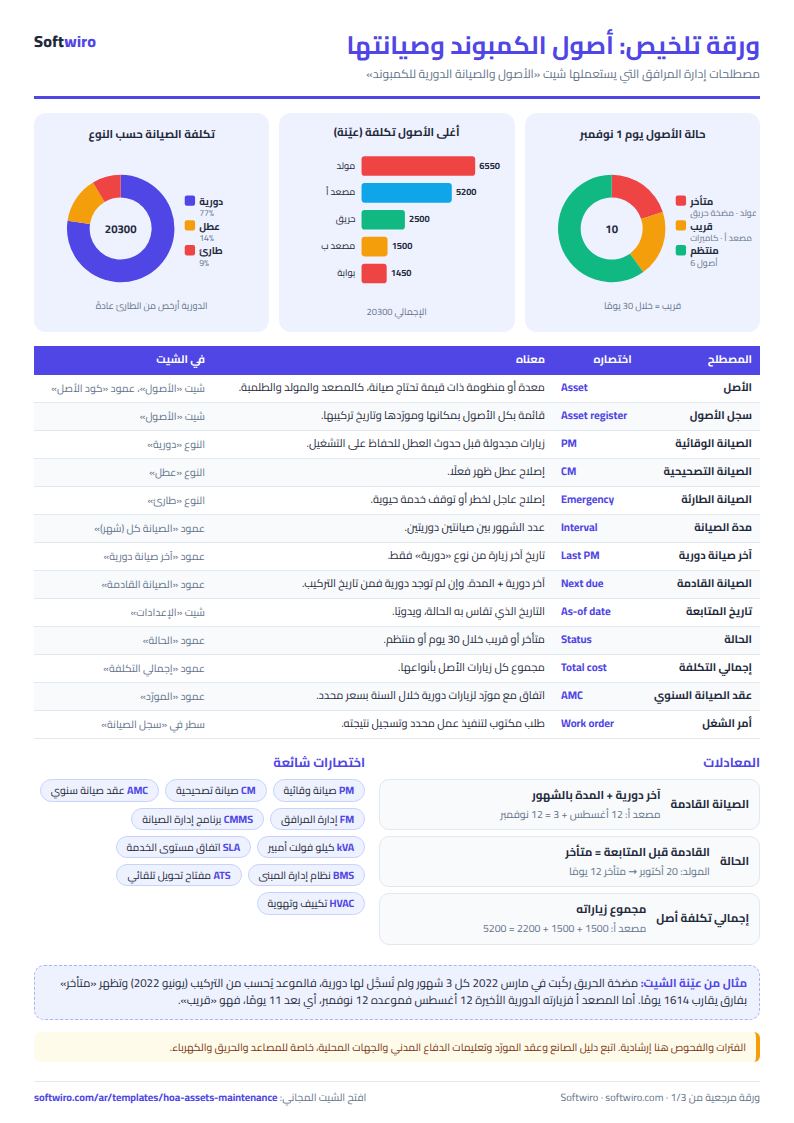
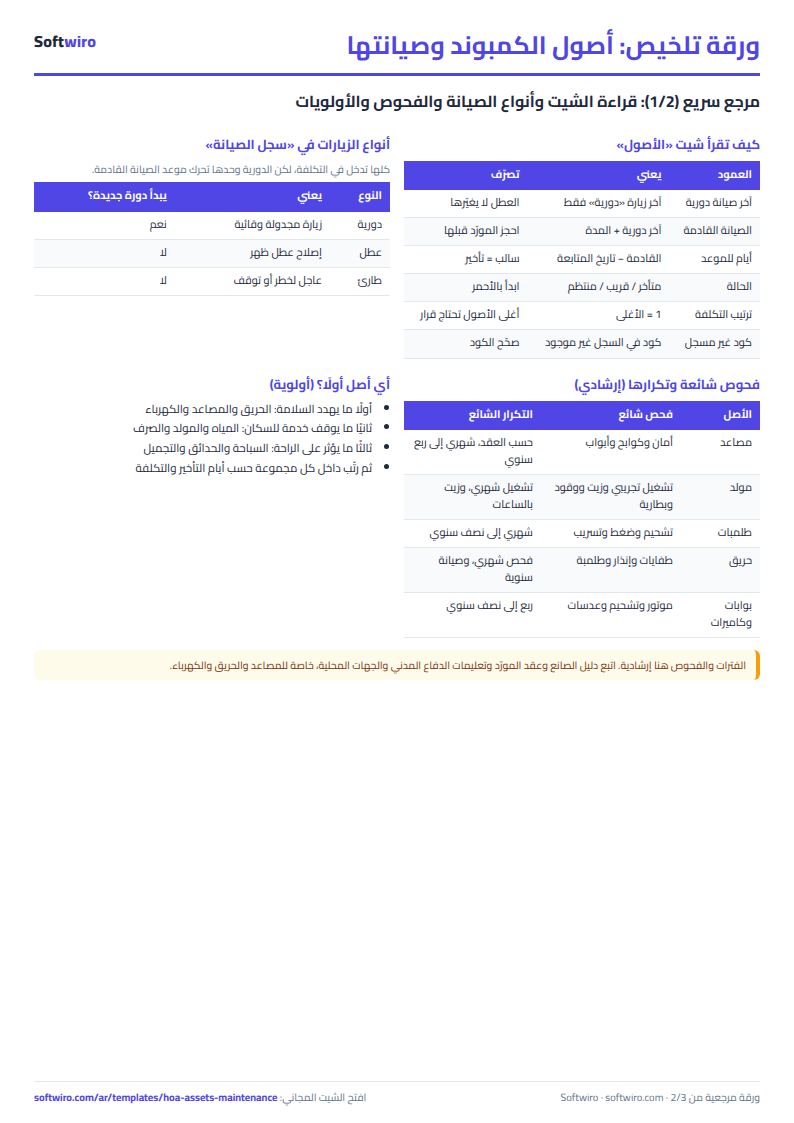
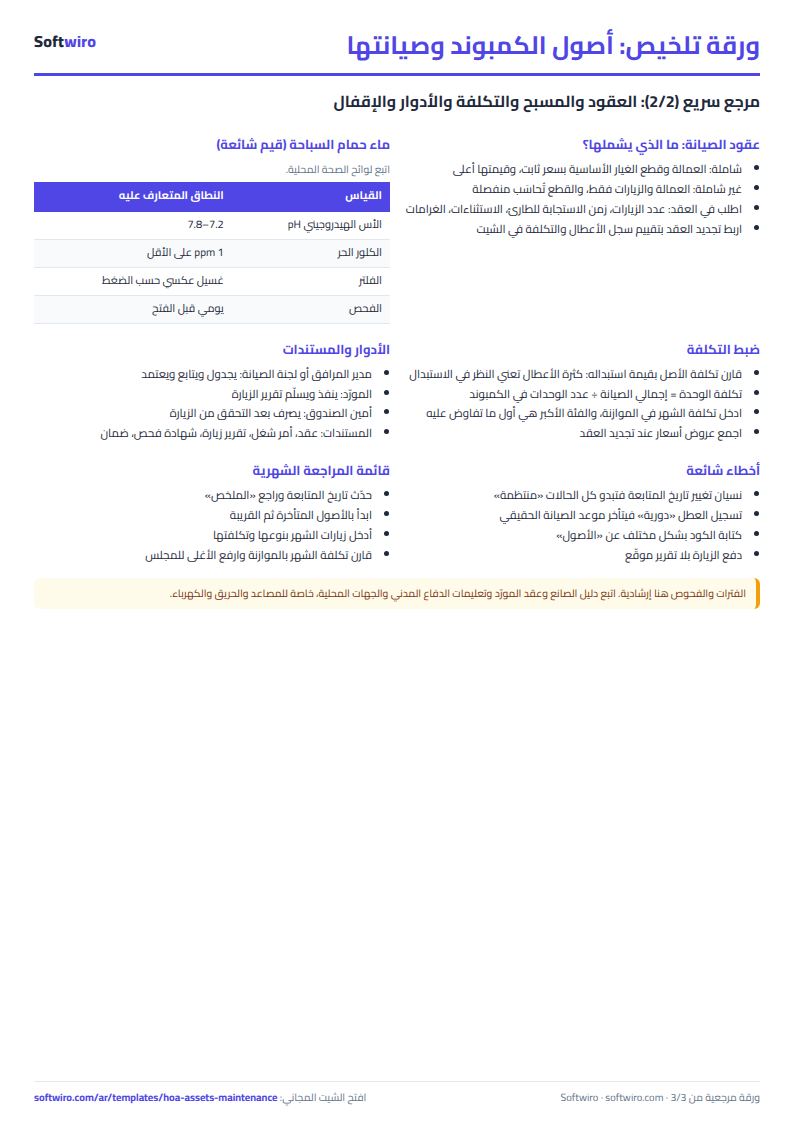
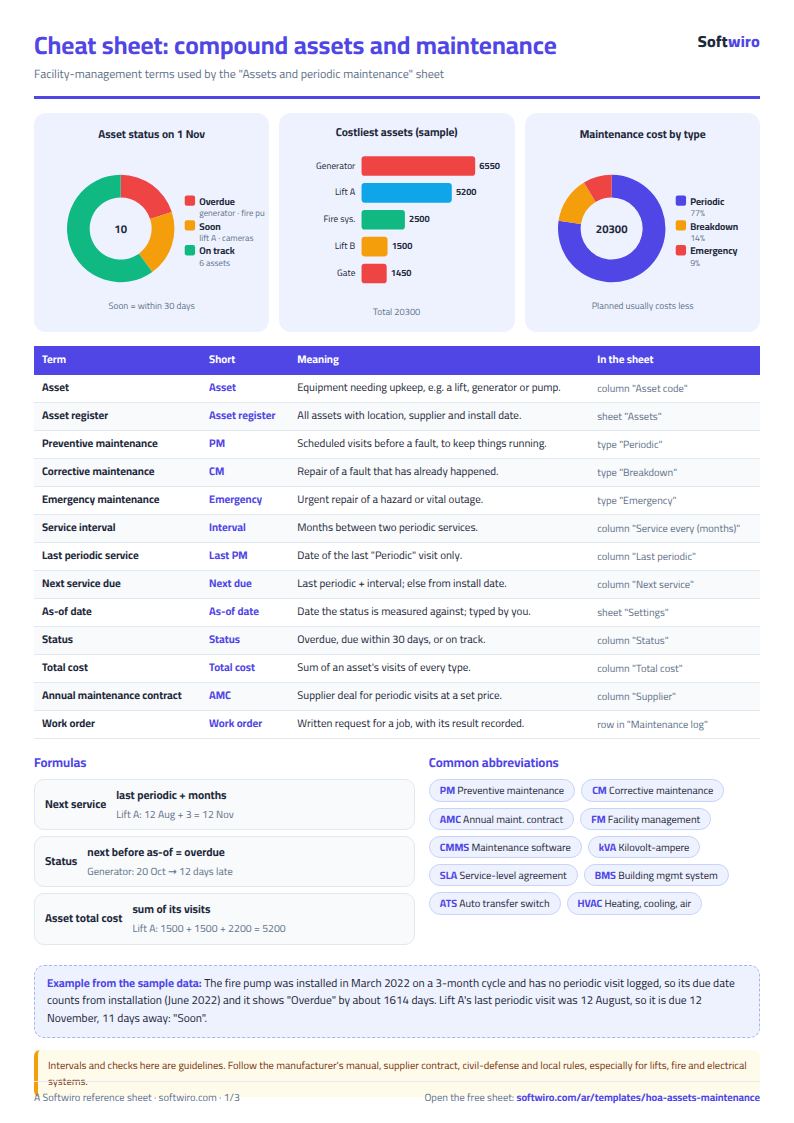
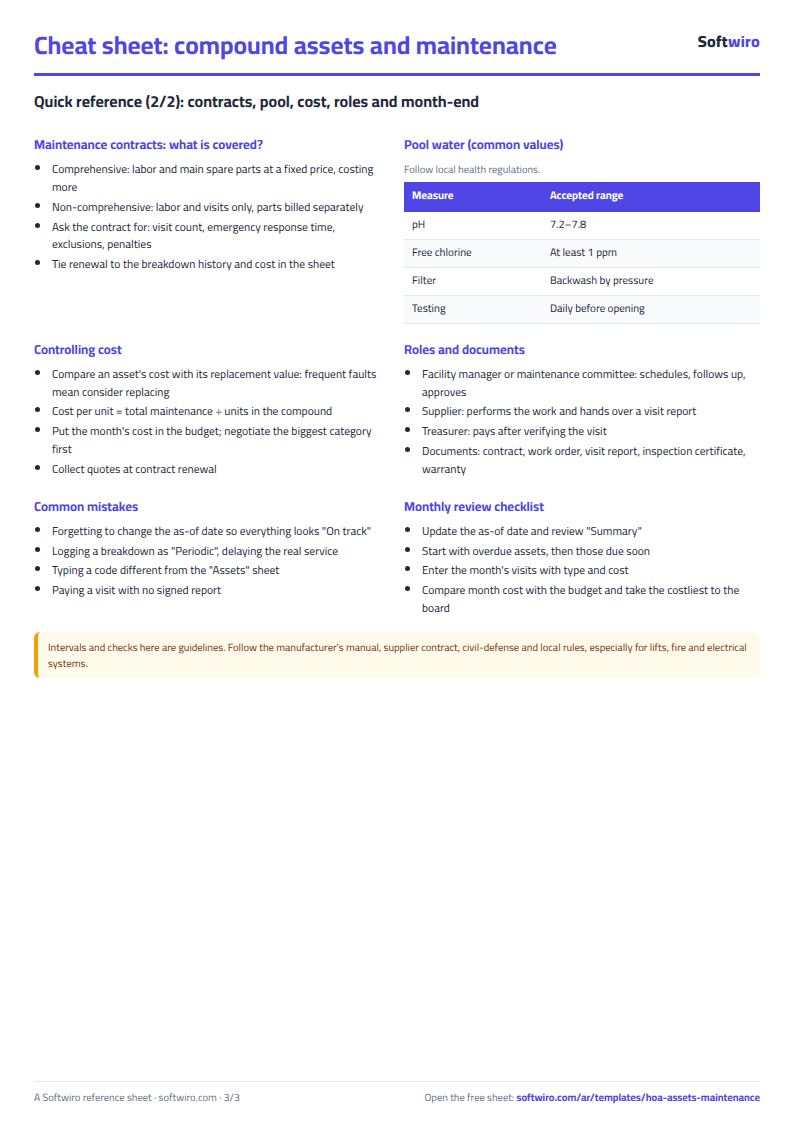
Terms, abbreviations, tables and diagrams over several pages, in Arabic and English. Download it as a PDF or images, including a phone-size version.
Still running this on Excel?
This sheet suits a start and a limited amount of data. If your way of working grows, or you need more than one person working on it at the same time, Softwiro can build you a program that fits the way you work.
| In this sheet | In Custom Software from Softwiro |
|---|---|
| One file that one person edits at a time, and copies reach you on WhatsApp. | A program with a login for each user and permissions you define, and everyone sees the same data. |
| You type everything and check the numbers by hand. | We design the screens around your work steps, so each person records only what concerns them. |
| Columns and formulas are fixed as the sheet was designed. | We build what you need: reports, alerts and screens your way. |
| Backups and security are your own responsibility. | The program runs on a secured server with regular backups. |
Frequently asked questions
How is an asset's status calculated?
Next maintenance date = last periodic maintenance + the interval in months. If the date is before the review date in the settings, it is "overdue"; if it falls within 30 days, it is "due soon"; otherwise "on schedule".
Does a breakdown change the next maintenance date?
No. Breakdowns and emergencies are counted as cost on the asset only, and the date moves only with a visit of the "periodic" type.
Why does nothing change when I open the file on another day?
Status is measured against the review date written in the settings, not today's date, so change it each time you review.
Is the template free?
Yes, with no sign-up and no email address. Use it, edit it and share it as you like.
Does it work in Google Sheets and on mobile?
The sheet uses formulas supported by Excel 2016 and later, Google Sheets and LibreOffice, so you can upload it to Google Drive and open it with Google Sheets on a computer or a phone.
What is the difference between the white and the gray cells?
You type in the white cells; the gray cells are calculated automatically. Don't type in a gray cell, or you will erase its formula.
Can I use the sheet from an AI assistant?
Yes. Add our MCP server (URL https://softwiro.com/api/mcp, no key needed) to your assistant and ask it to do the calculation in this template. The numbers come from the sheet's own formulas, and we do not store your data. The steps and a ready-made prompt are in this article: https://softwiro.com/blog/mcp-excel-templates-ai-agent-guide.html
All the templates in this group: Compound and owners' association sheets: dues, maintenance and property
More free templates for: Owners associations and compounds
More free templates
- Owners' association dues collection tracker
- Owners' association budget and expenses sheet
- Reserve and emergency fund sheet for owners' associations
- Maintenance requests and complaints log for owners' associations
- Service contracts and suppliers tracker for owners' associations
- Owners association meetings and decisions tracker
- Shared electricity and water bill splitter for building units
- Residents, units and vehicles register for an owners' association
- Monthly transparency report for owners' associations
- Gate and security sheet
- Compound shared facilities booking sheet
- Building maintenance sheet: flat fees, expenses, elevator and pump
- Beauty salon bookings tracker (Excel)
- Car workshop job orders tracker (Excel)
- Nursery and school fees tracker (Excel)
- Tutoring center manager (Excel)
- Poultry farm cycle tracker (Excel)
- Crop season expenses and revenue tracker (Excel)
- Racing pigeon loft sheet
- Wedding and event budget planner (Excel)