Try the sheet here, on the example
The sheet is open below with sample numbers. Change any white cell and watch the results update, or press the blank-copy button to type your own data from scratch. Nothing you type leaves your browser.
Example from the sheet
| الأسبوع | المقبوضات | المدفوعات | الصافي | الرصيد الختامي | الحالة |
|---|---|---|---|---|---|
| أسبوع 1 | 25,000.00 | 61,500.00 | -36,500.00 | 73,500.00 | |
| أسبوع 2 | 57,000.00 | 12,700.00 | 44,300.00 | 117,800.00 | |
| أسبوع 3 | 30,000.00 | 0.00 | 30,000.00 | 147,800.00 | |
| أسبوع 4 | 52,000.00 | 103,000.00 | -51,000.00 | 96,800.00 | |
| أسبوع 5 | 33,500.00 | 20,200.00 | 13,300.00 | 110,100.00 | |
| أسبوع 6 | 15,000.00 | 27,800.00 | -12,800.00 | 97,300.00 | |
| أسبوع 7 | 81,000.00 | 79,800.00 | 1,200.00 | 98,500.00 | |
| أسبوع 8 | 10,000.00 | 74,500.00 | -64,500.00 | 34,000.00 | تحت الحد |
| أسبوع 9 | 37,000.00 | 32,300.00 | 4,700.00 | 38,700.00 | تحت الحد |
| أسبوع 10 | 60,000.00 | 56,500.00 | 3,500.00 | 42,200.00 | تحت الحد |
| أسبوع 11 | 54,000.00 | 3,000.00 | 51,000.00 | 93,200.00 | |
| أسبوع 12 | 36,000.00 | 11,200.00 | 24,800.00 | 118,000.00 | |
| أسبوع 13 | 0.00 | 65,000.00 | -65,000.00 | 53,000.00 | تحت الحد |
Example from the “ملخص التدفق” tab (Arabic), with the numbers and formulas that are in the file.
What is inside
- "ملخص التدفق" (Cash Flow Summary): The lowest forecast balance and its week, the first week and first month below the minimum and when they start, the shortfall at the lowest point, what is still to collect from customers and still to pay to suppliers and how much of each is overdue, with a weekly table, a monthly table and four charts.
- "توقع 13 أسبوع" (13-Week Forecast): For each week: opening balance, receipts (customer collections, cash sales and other income), payments (suppliers, salaries, rent, installments, taxes and expenses), net cash flow, closing balance and a "تحت الحد" (Below minimum) alert, then the actual and variance for weeks that have ended.
- "توقع 12 شهر" (12-Month Forecast): The same layout over 12 months from the forecast start date, reading from the same sheets.
- "مستحقات العملاء" (Customer Receivables): One invoice per line with its due date, amount and amount collected. The sheet calculates the remaining balance and the expected collection date after adding the delay days, and a status of overdue ("متأخر"), upcoming ("قادم") or collected ("محصّل"). It holds 200 invoices.
- "مستحقات الموردين" (Supplier Payables): Supplier invoices handled the same way, so the remaining balance goes into payments on its due date. It holds 200 invoices.
- "بنود أخرى متوقعة" (Other Expected Items): Whatever does not come from invoices: cash sales, other income, salaries, rent, loan installments, taxes and expenses, each with a date, amount and a category from a list. It holds 300 items.
- "الفعلي" (Actuals): A log of what you actually received and paid, with date and category. The sheet compares it with the forecast for weeks and months that have ended. It holds 500 transactions.
- "الإعدادات" (Settings): Opening balance, forecast start date, minimum cash, collection delay days, today's date, the number of weeks and months that have ended, and the list of cash flow categories, whose names you can edit.
The file opens on a start tab (“ابدأ هنا”, Start here) that explains how to use it.
What makes it different
Due dates build the forecast: each customer or supplier invoice lands in the week and month when you expect to receive or pay it, and overdue unpaid invoices move to the first period that has not ended. So you see weeks ahead that your balance will fall below the minimum, not on the day the cash runs out.
How to use it
- In the "الإعدادات" (Settings) sheet, enter the opening balance, the forecast start date (preferably the first day of a month), the minimum cash, today's date, and the number of weeks and months that have actually ended.
- In "مستحقات العملاء" (Customer Receivables), enter each invoice not fully collected with its due date, amount and amount collected. In "مستحقات الموردين" (Supplier Payables), enter supplier invoices the same way.
- In "بنود أخرى متوقعة" (Other Expected Items), enter expected cash sales, other income, salaries, rent, installments, taxes and expenses, each with its date.
- Open "توقع 13 أسبوع" (13-Week Forecast) and "توقع 12 شهر" (12-Month Forecast) to see receipts, payments and the closing balance for each period, and the "تحت الحد" (Below minimum) alert when the balance falls under the minimum.
- Each week, record what actually happened in the "الفعلي" (Actuals) sheet and increase the weeks ended in Settings, and the variance from the forecast appears. Open "ملخص التدفق" (Cash Flow Summary) to see the lowest balance and the first period with a shortfall.
Before you start:
- Customer receivables: the "collection delay days" from Settings are added to the due date to get the expected collection date. Overdue unpaid invoices move to the first period that has not ended.
- Periods that have ended take the full invoice amount as it was forecast, and upcoming periods take only the remaining balance, so the variance between forecast and actual is correct. Delete invoices that were paid before the forecast start date.
- Closing balance = opening balance + receipts - payments. "تحت الحد" (Below minimum) appears when the balance is lower than the minimum cash in Settings.
- Other items are chosen from the category list in Settings (you can edit the names). The "تحصيلات العملاء" (Customer collections) and "سداد الموردين" (Supplier payments) categories come only from the two receivables and payables sheets.
- The sheet holds 200 customer invoices, 200 supplier invoices, 300 expected items and 500 actual transactions. Actual vs forecast appears only for weeks and months that have ended.
- Figures and names are made-up examples, and the tax items include only a general line: apply the rules of your local law.
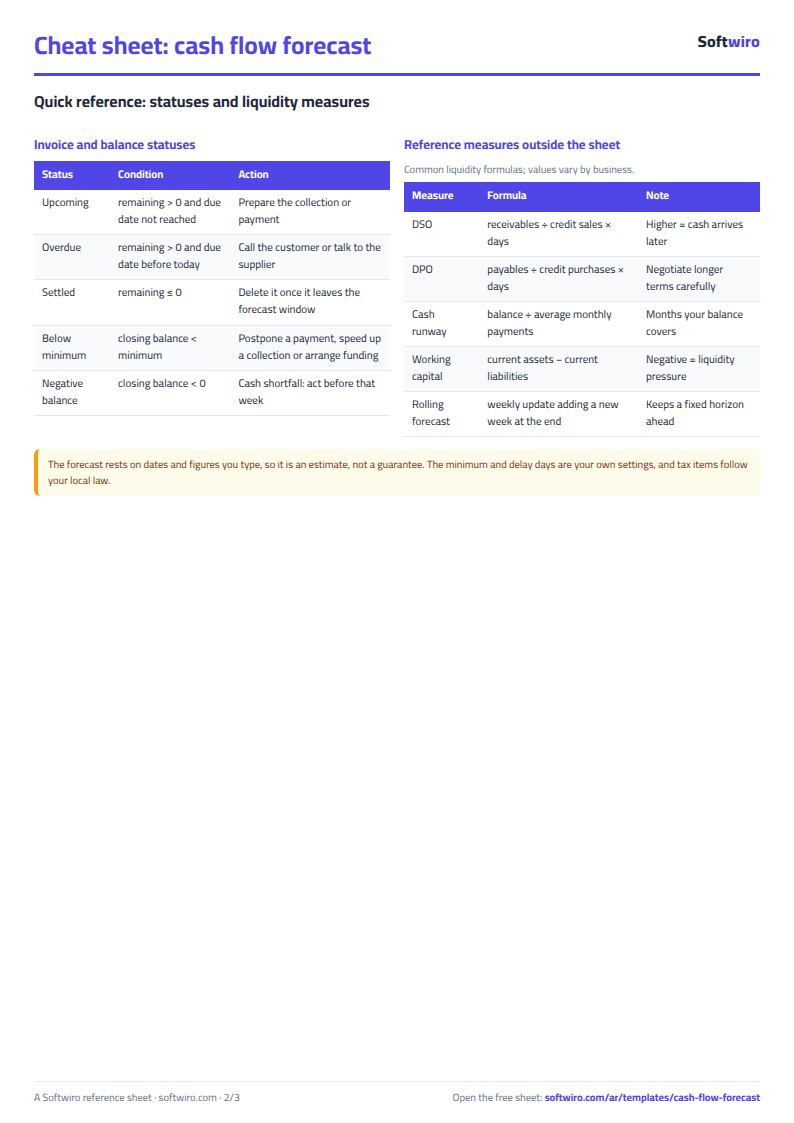
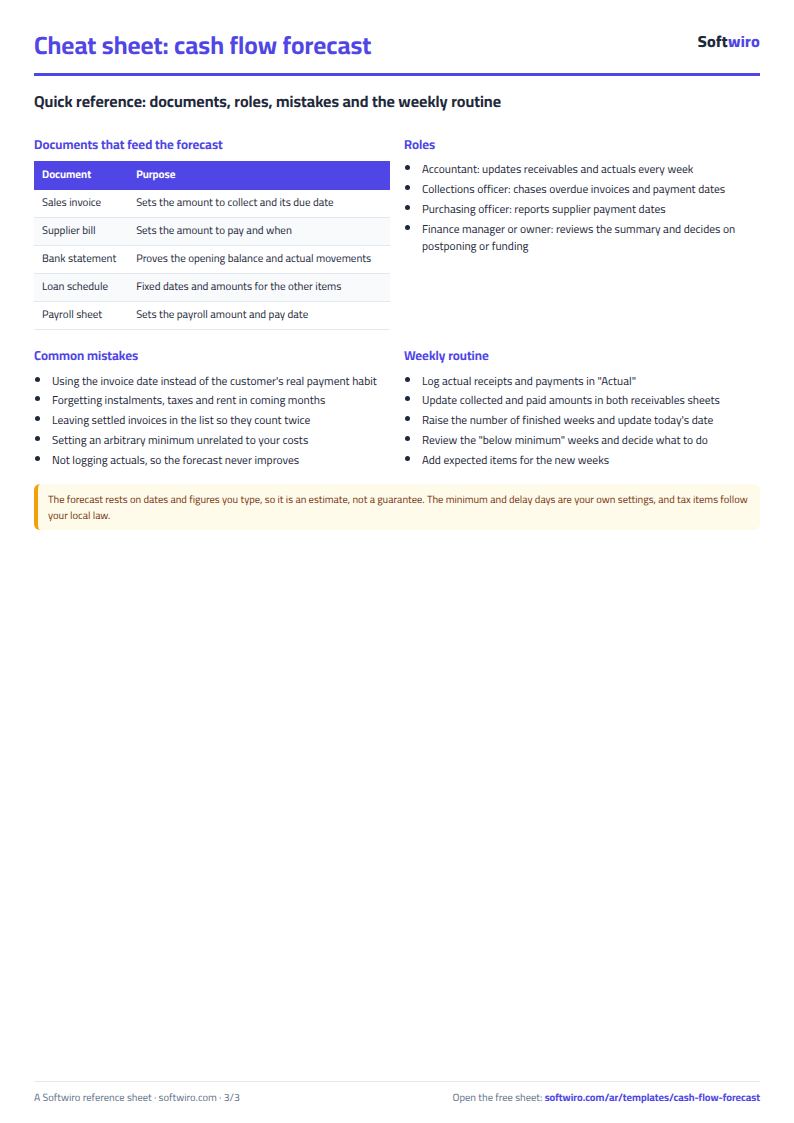
Free cheat sheet for this field
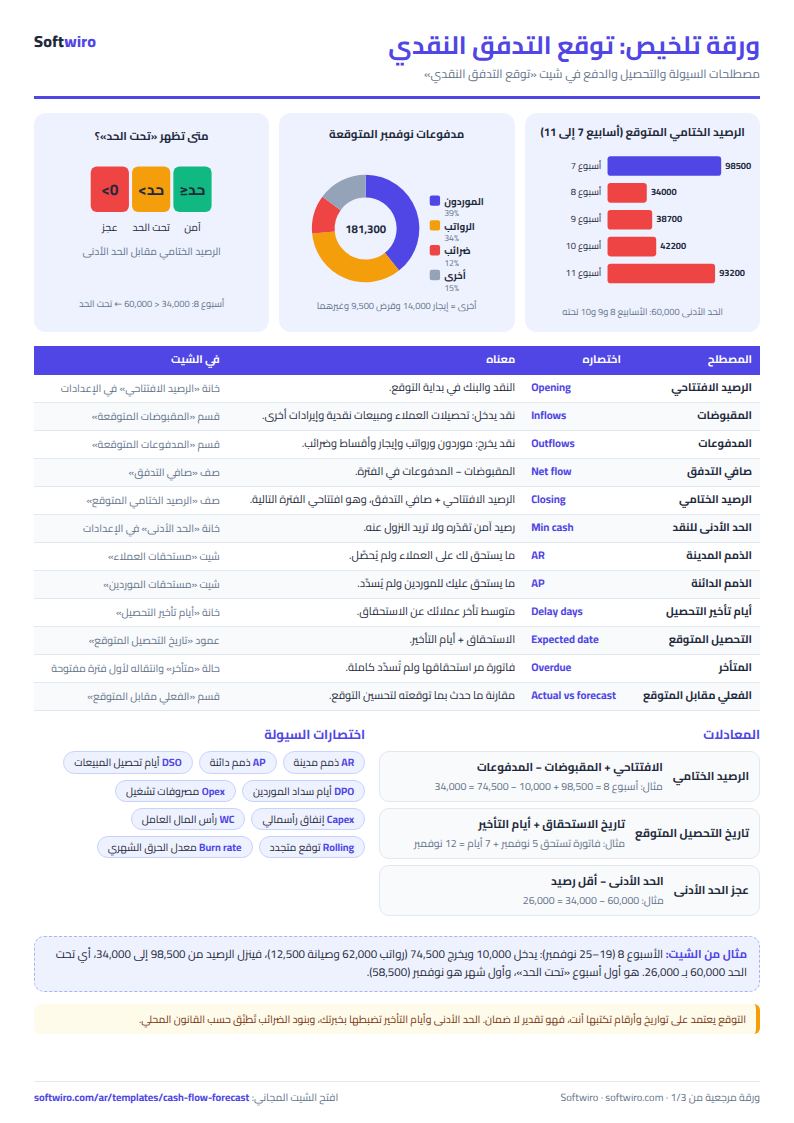
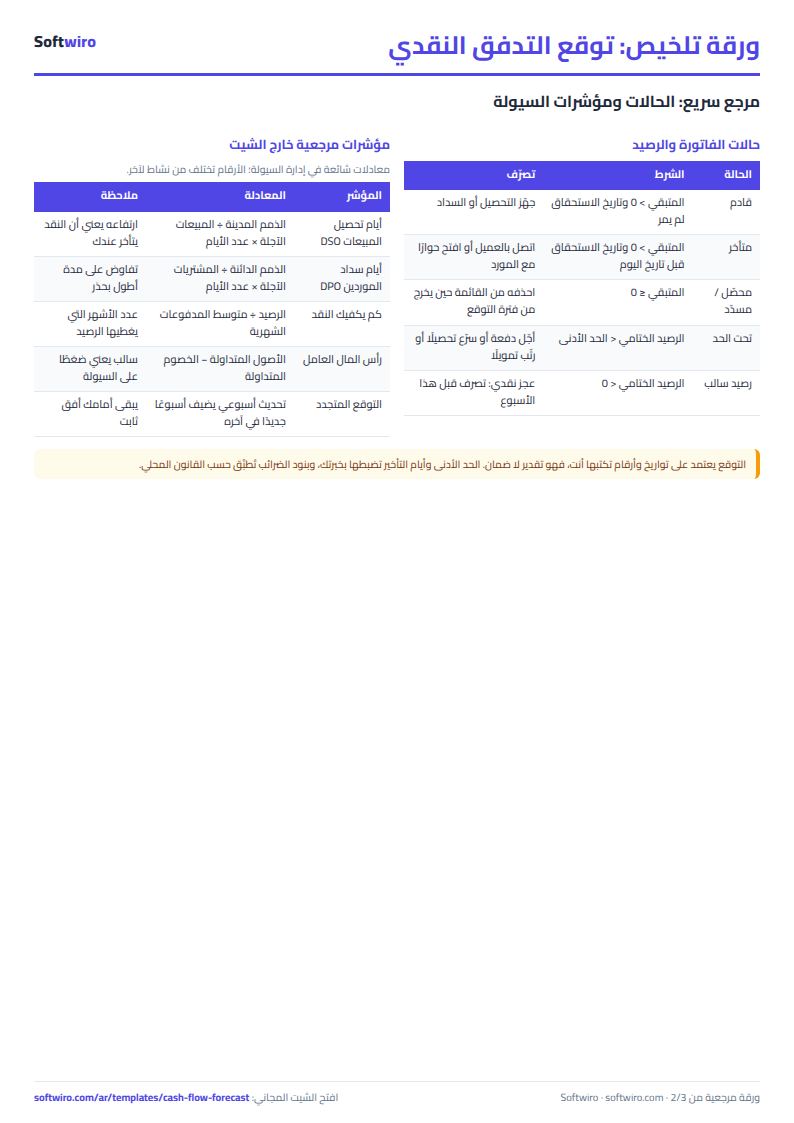
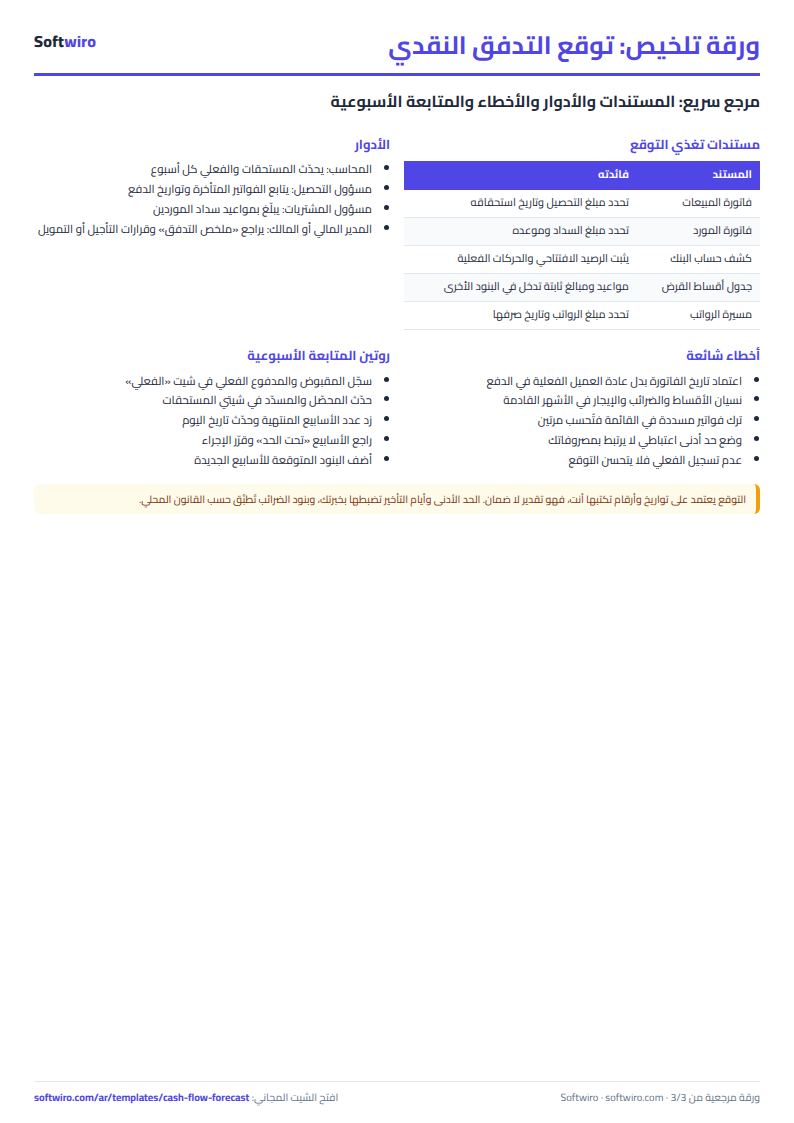
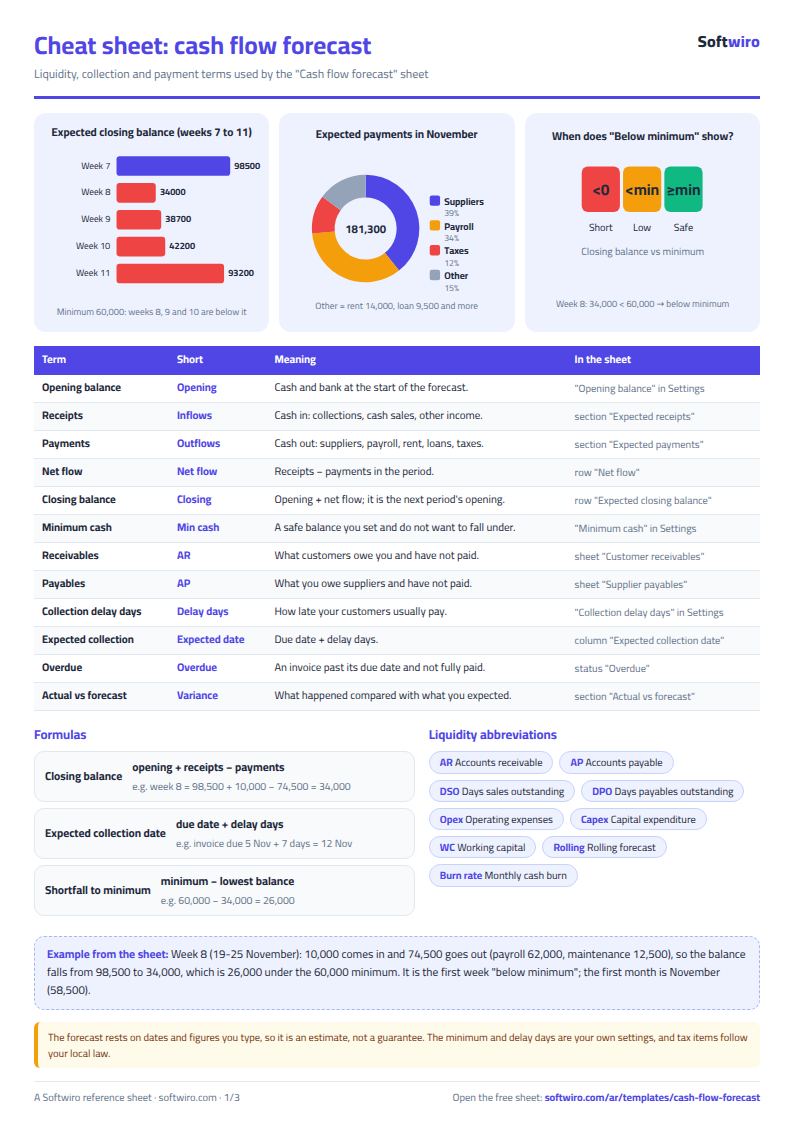
Terms, abbreviations, tables and diagrams over several pages, in Arabic and English. Download it as a PDF or images, including a phone-size version.
Still running this on Excel?
This sheet needs someone to copy every invoice and payment into it. In Accountwiro an invoice and a payment are recorded the moment they happen, and the customer's balance shows in a single statement of account.
| In this sheet | In Accountwiro |
|---|---|
| You copy every invoice and payment into the sheet by hand. | It shows the customer's invoices, payments and outstanding balance in a single statement of account. |
| Invoices are typed or copied by hand. | It creates an invoice by scanning a barcode or searching by product name, calculates discounts and taxes, and sends it to the customer over WhatsApp. |
| Stock shortages are discovered late. | It updates quantities after every sale and alerts you when a product drops below the required level. |
| Anyone who opens the sheet sees every number. | Permissions per user: the sales employee issues invoices, and the warehouse employee manages stock without access to financial data. |
Frequently asked questions
What is the difference between a 13-week and a 12-month forecast?
The weekly forecast is precise and short-term. It suits tracking liquidity each week and deciding which day to postpone a payment or speed up a collection. The monthly forecast is broader and suits planning salaries, rent, taxes and loans over the year. The sheet shows both from the same data.
How does the sheet know when I will collect from a customer?
You enter the invoice due date, and the sheet adds the "collection delay days" you set in Settings to calculate the expected collection date. An overdue invoice that has not been collected goes into the first week or month that has not ended.
What does "below minimum" mean?
It appears when the forecast closing balance for a week or month is lower than the "minimum cash" you enter in Settings. That is a figure you estimate yourself, such as one month of expenses or payroll. The cash flow summary shows the first week and first month below the minimum and the size of the shortfall.
How do I compare actual with forecast?
Record what you received and paid in the "الفعلي" (Actuals) sheet, then increase "weeks ended" and "months ended" in Settings. For those periods the sheet shows actual receipts, actual payments and actual balance, and their difference from the forecast.
Is the template free?
Yes, with no sign-up and no email address. Use it, edit it and share it as you like.
Does it work in Google Sheets and on mobile?
The sheet uses formulas supported by Excel 2016 and later, Google Sheets and LibreOffice, so you can upload it to Google Drive and open it with Google Sheets on a computer or a phone.
What is the difference between the white and the gray cells?
You type in the white cells; the gray cells are calculated automatically. Don't type in a gray cell, or you will erase its formula.
Can I use the sheet from an AI assistant?
Yes. Add our MCP server (URL https://softwiro.com/api/mcp, no key needed) to your assistant and ask it to do the calculation in this template. The numbers come from the sheet's own formulas, and we do not store your data. The steps and a ready-made prompt are in this article: https://softwiro.com/blog/mcp-excel-templates-ai-agent-guide.html
More free templates for: Accounting
More free templates
- Journal entries, trial balance and financial statements sheet
- Business expenses and monthly budget sheet
- Annual budget by department: plan vs actual
- Fixed assets register and depreciation sheet
- Accounting rules and equations summary sheet: double entry, statements and financial ratios
- Project budget vs actual sheet
- Simple daily expense sheet (phone-first)
- Multi-warehouse and branch inventory sheet with transfers
- Periodic stock count and count-difference reconciliation sheet
- Restaurant and cafe inventory and waste sheet
- Spare parts inventory sheet
- Barcode, batch and expiry inventory sheet
- Padel and 5-a-side court booking sheet (hourly)