You want to know today whether your cash will cover next month's payroll and supplier bills, and in which week your balance could drop below the level you consider safe. The free cash flow forecast sheet answers that: you type your balance, your customer and supplier invoices and your regular items, and it lays out 13 weeks and 12 months of expected cash and warns you before the gap arrives.
The problem it solves
Profit on paper is not cash in the account. You can sell a lot on credit, then payroll, rent and tax fall due before customers pay. The opposite also happens: a supplier must be paid before you collect. Most small business owners know today's balance but not the balance six weeks from now. A forecast buys you time to negotiate a payment date, chase a collection or postpone a purchase before the problem becomes urgent.
How the sheet works, step by step
- In Settings you type the opening balance (cash and bank together), the forecast start date, the minimum cash you do not want to fall below, and how many days your customers usually pay late.
- In Customer receivables you list every invoice not fully collected: due date, amount and what was collected. The sheet adds the delay days to estimate the week you will probably be paid.
- In Supplier payables you list their bills the same way, and they enter the payments on their due date.
- In Other expected items you type what invoices do not cover: cash sales, payroll, rent, loan instalments, taxes and fees (follow your local law) and running costs.
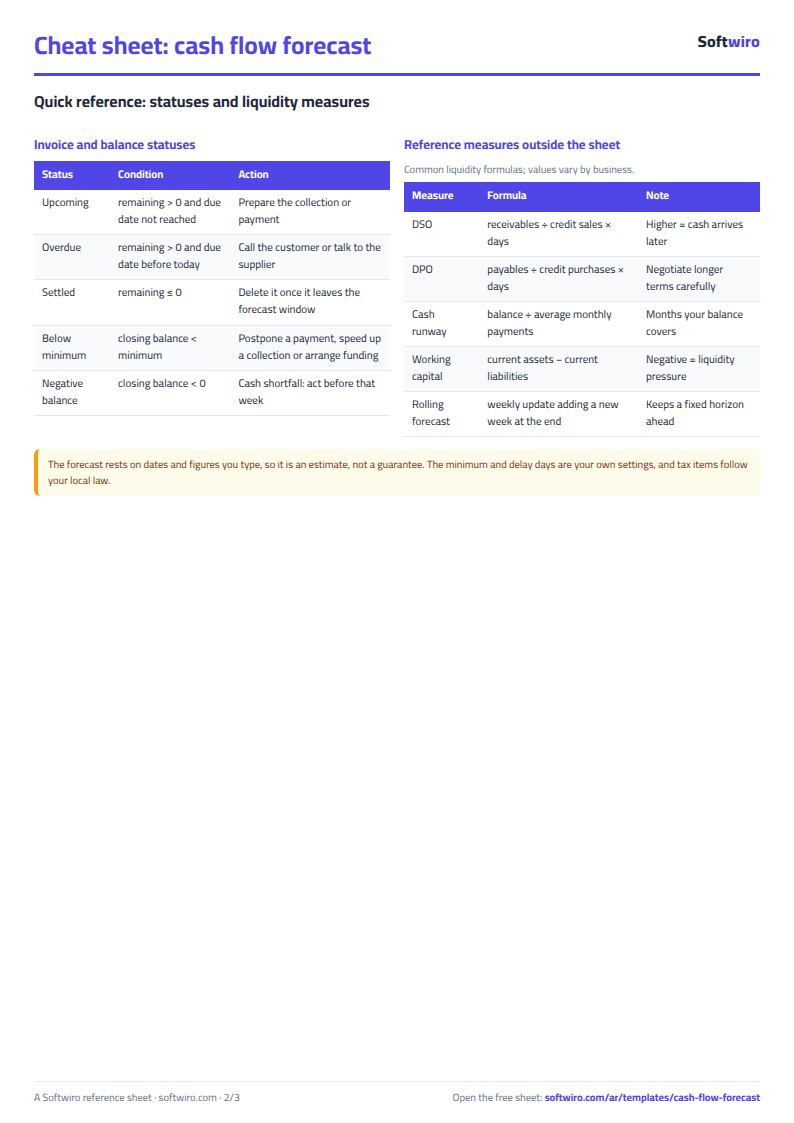
- The sheet assembles all of it into 13-week forecast and 12-month forecast: opening balance + receipts - payments = closing balance for each period, and it writes "below minimum" wherever the balance falls under your limit.
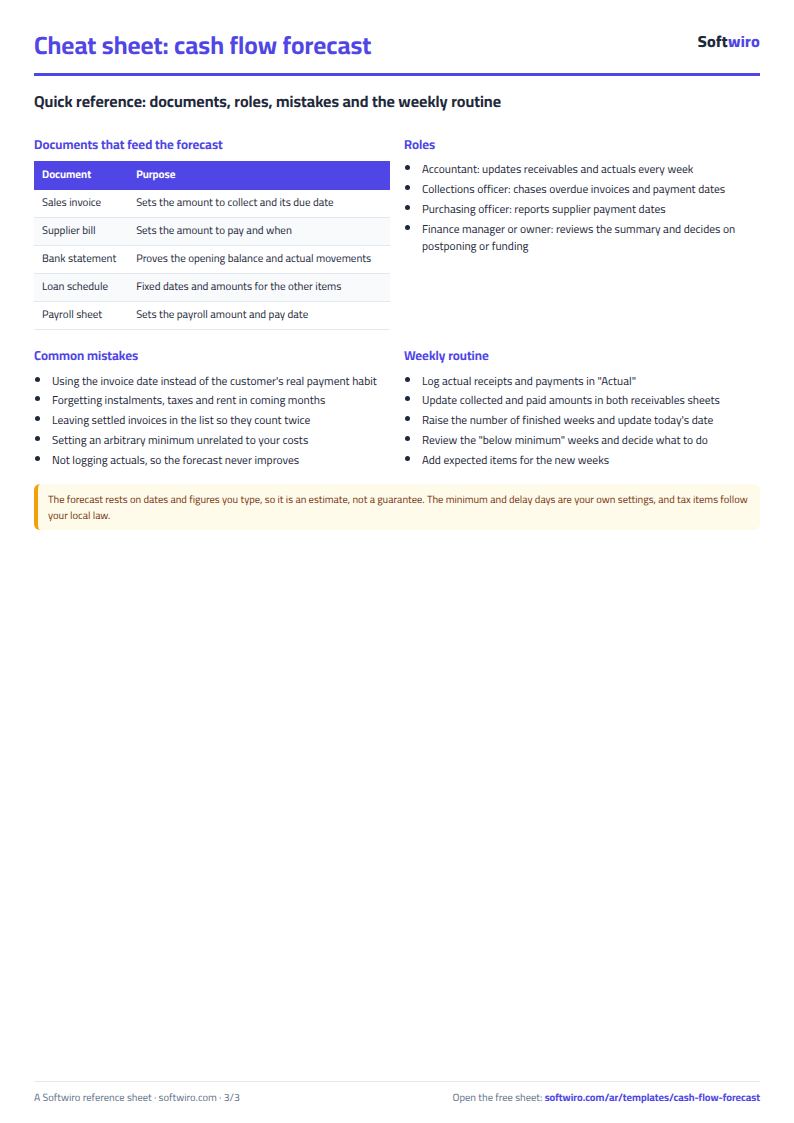
- Each week you log what you really received and paid in Actual, raise the number of finished weeks in Settings, and the sheet compares actual with forecast.
What each sheet holds
- Cash flow summary: the lowest expected balance and its week, the first week and first month below the minimum, the shortfall, what customers still owe you and you owe suppliers (and how much is overdue), with four charts.
- 13-week and 12-month forecasts: receipts and payments line by line, net flow and closing balance, then actual and variance for the finished periods.
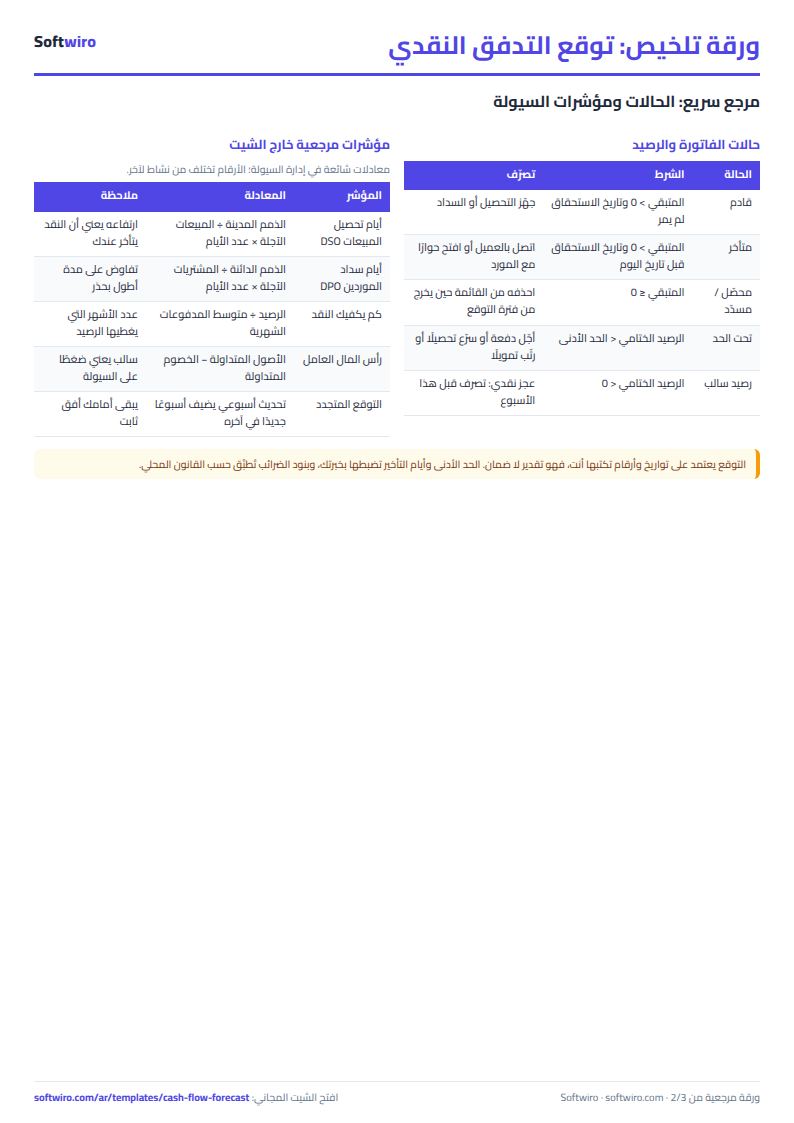
- Customer receivables and supplier payables: one invoice per row with the remaining amount, expected date and a status of overdue, upcoming or settled.
- Other expected items and Actual: two logs with categories from a list, and a warning if a category is not in Settings.
- Settings: the numbers that drive the whole forecast.
Walk-through on the sample numbers
This is sample data inside the sheet, not a real company. Opening balance 110,000, minimum 60,000, forecast starting 1 October 2026, today 13 November, with six weeks and one month finished:
- Week 1: forecast closing was 73,500 but the actual was 48,500, which is 25,000 lower, because the invoice from Al-Safa Factory (25,000) was not collected on time.
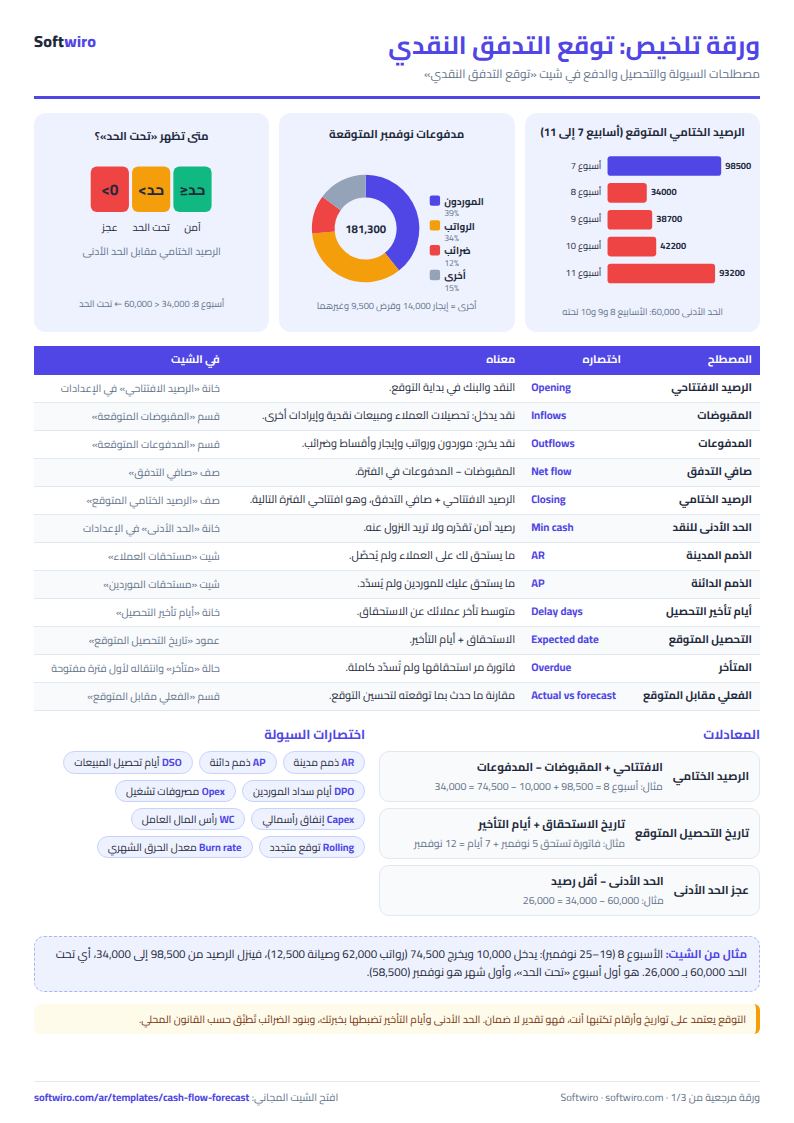
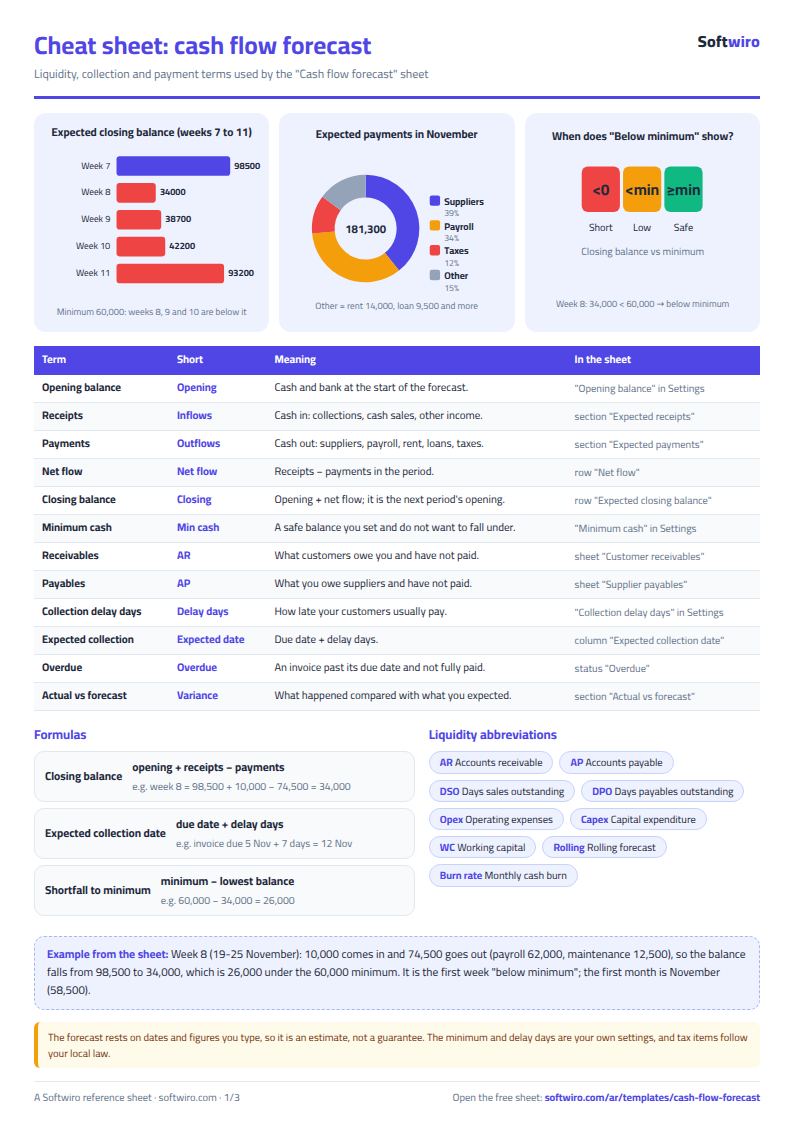
- Week 7 (12-18 November): expected receipts 81,000, including the overdue 25,000 which the sheet moves automatically into the first period that has not ended. Payments are 79,800, including a generic tax item of 21,000. Closing balance 98,500.
- Week 8 (19-25 November): only 10,000 comes in and 74,500 goes out (payroll 62,000 and a maintenance bill 12,500), so the balance drops to 34,000, which is 26,000 under the minimum. That is the first week "below minimum"; it stays below in weeks 9 and 10 (38,700 and 42,200), recovers, and dips again in week 13 at 53,000: four weeks in total.
- By month: October closes at 111,800, November falls to 58,500, December to 40,500 and January to 49,800 before February recovers to 89,100. The first month below the minimum is November, and three months are below.
- Receivables and payables: customers still owe 769,000, of which 81,000 is overdue against today's date; suppliers are owed 375,800, of which 14,800 is overdue.
The practical reading: do not wait for week 8. Collect the overdue 81,000 now, ask the maintenance supplier for another week, and check whether the tax item can be postponed or paid in instalments under your local law.
Common mistakes
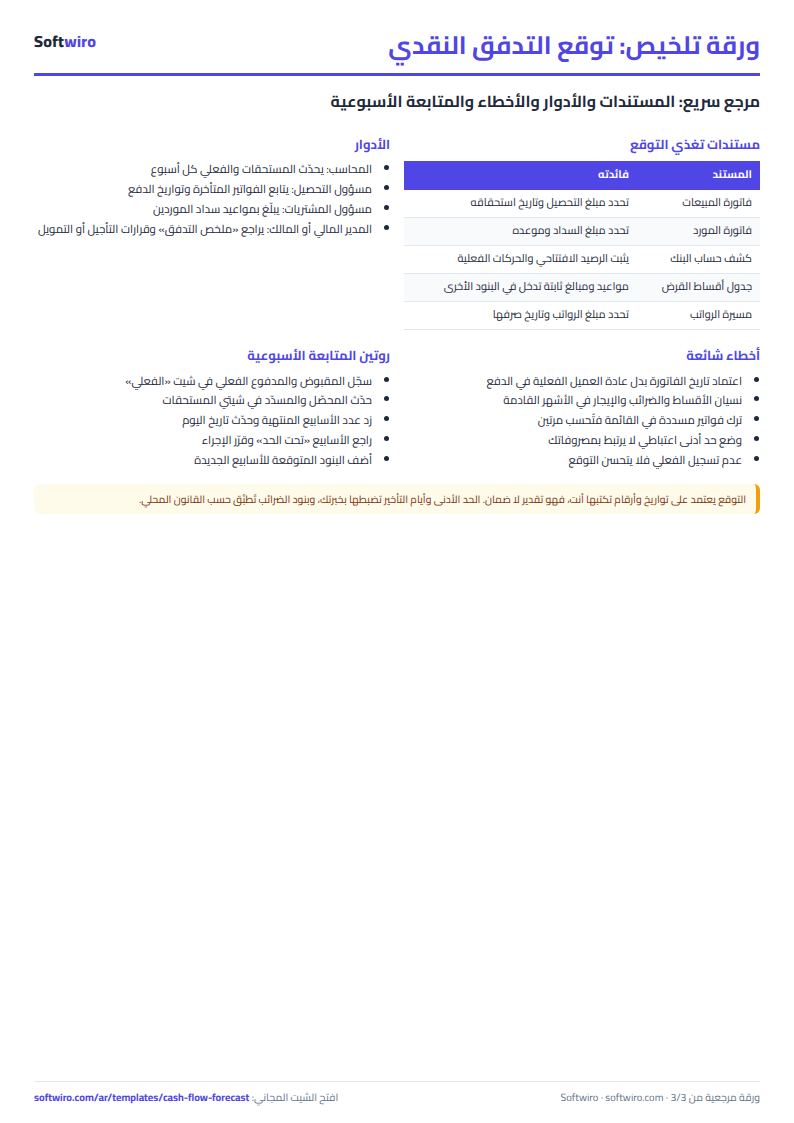
- Using the invoice date instead of the real payment habit: type your customers' true delay or the forecast will look prettier than reality.
- Forgetting instalments, taxes and rent: enter them every month in Other expected items; they are what surprises balances.
- Leaving settled invoices in the list: they count twice. Delete what was paid before the forecast start date.
- A minimum with no reasoning: tie it to a week or a month of costs, depending on how much safety you want.
- Not updating actuals: a forecast never compared with reality never improves.
When to move to a system
The sheet suits an owner with dozens of invoices who updates the file weekly. When invoices and payments grow beyond what you can carry by hand, Accountwiro records the invoice and the payment at the moment they happen and shows each customer's balance in one statement, so the source figures are already there. If you also want to control monthly costs next to the forecast, see the business expenses and budget sheet.
Frequently asked
How many weeks are enough? Thirteen weeks (a quarter) gives a sharp near-term view; the twelve months serve wider planning.
How do I set the minimum? A number you estimate from your costs and how much customer lateness you can absorb.
Can I rename the lines? Yes, in Settings, without changing their order.
Your next step
Open the sheet, type your balance and minimum, enter the open customer and supplier invoices for this week, and look at the first week that shows "below minimum".