You want to understand financial accounting well enough to apply it: when an account is debited and when it is credited, how journal entries turn into a trial balance and then an income statement and a balance sheet, and how to work out depreciation, inventory cost and the main ratios. The free accounting rules and equations sheet gathers this in 75 rules, each with its formula and an example from one consistent sample, plus a small journal where you post your own entries. It is a general teaching summary; standards and taxes follow local law.
The problem it solves
A learner memorises that "assets are debits" and then stumbles on the first real entry: does Suppliers go up with a debit or a credit? Where does revenue received in advance go? Is drawings an expense? The rules are scattered across a textbook and notes, and the examples use different numbers that never connect. Then the trial balance either balances or does not, and nobody knows why. The sheet gives you the rule, its example, and a check that runs on your own entries.
How the sheet works, step by step
- Open المرجع (the reference) and review the section you are studying: the accounting equation, debit and credit, the cycle and statements, accruals and adjustments, depreciation, inventory, break-even, or ratios. You can filter the table by the "section" column.
- If you forget a rule's name, pick it in بحث عن قاعدة (rule lookup) to see its formula, example and note.
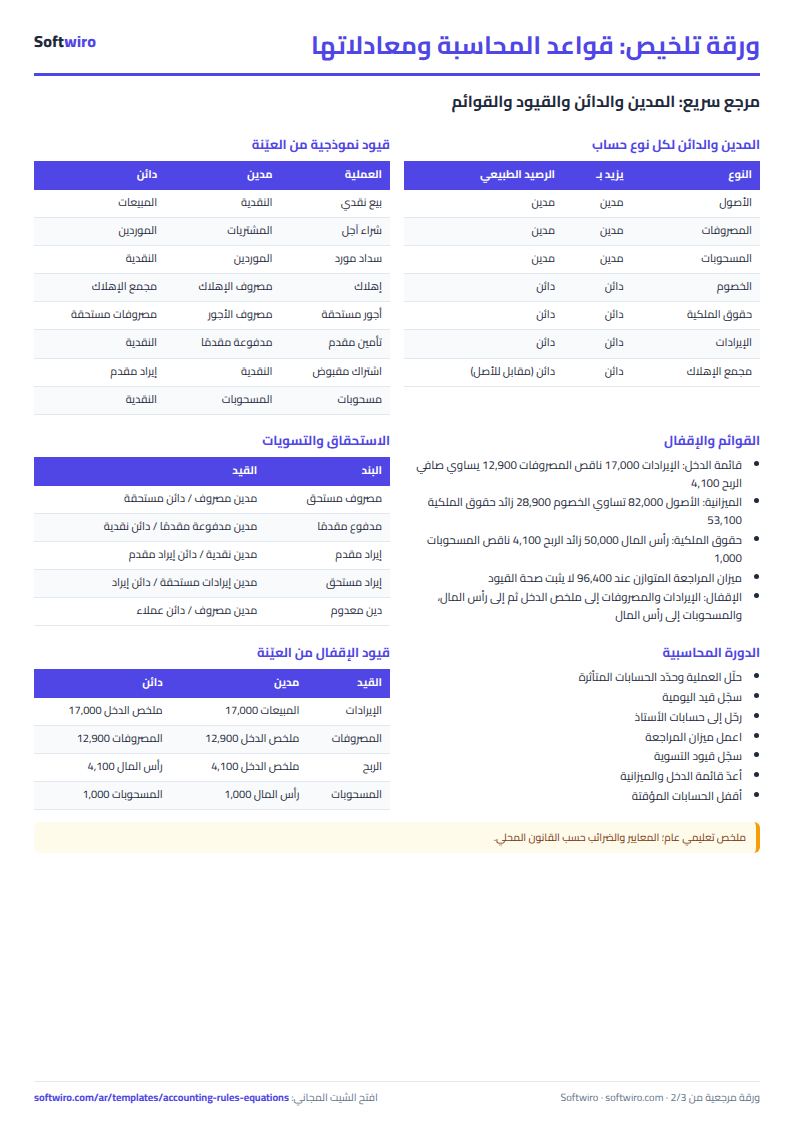
- Read أمثلة القيود (journal entry examples): 19 common transactions with their debit and credit accounts.
- Try حاسبات (calculators) and الإهلاك والمخزون (depreciation and inventory) with your own numbers.
- Record your entries in اليومية (the journal) by choosing the account from a list; the sheet checks each entry balances and posts the lines to ميزان المراجعة (the trial balance).
- Take اختبار ذاتي (the self-test), log your score in المتابعة (progress), then open الملخص (the summary).
What is in each sheet
- Reference: 75 rules: the accounting equation (7), debit and credit (12), the cycle and statements (10), accruals and adjustments (9), depreciation (9), inventory and cost of sales (9), margins and break-even (9), financial ratios (10).
- Journal entry examples and rule lookup: model entries and a search by rule name.
- Calculators: the expanded accounting equation, cost of goods sold and margins, cash versus accrual, break-even, and 11 financial ratios.
- Depreciation and inventory: a five-year depreciation table and FIFO against weighted average.
- Journal and trial balance: recording, posting and balance checks, with a warning for an unknown account or a balance on the wrong side.
- Self-test, progress and summary: 40 questions, review dates, and an income statement and balance sheet with six charts.
A walk-through on the numbers (sample data)
These figures come from the sample copy inside the sheet, what you see before typing anything.
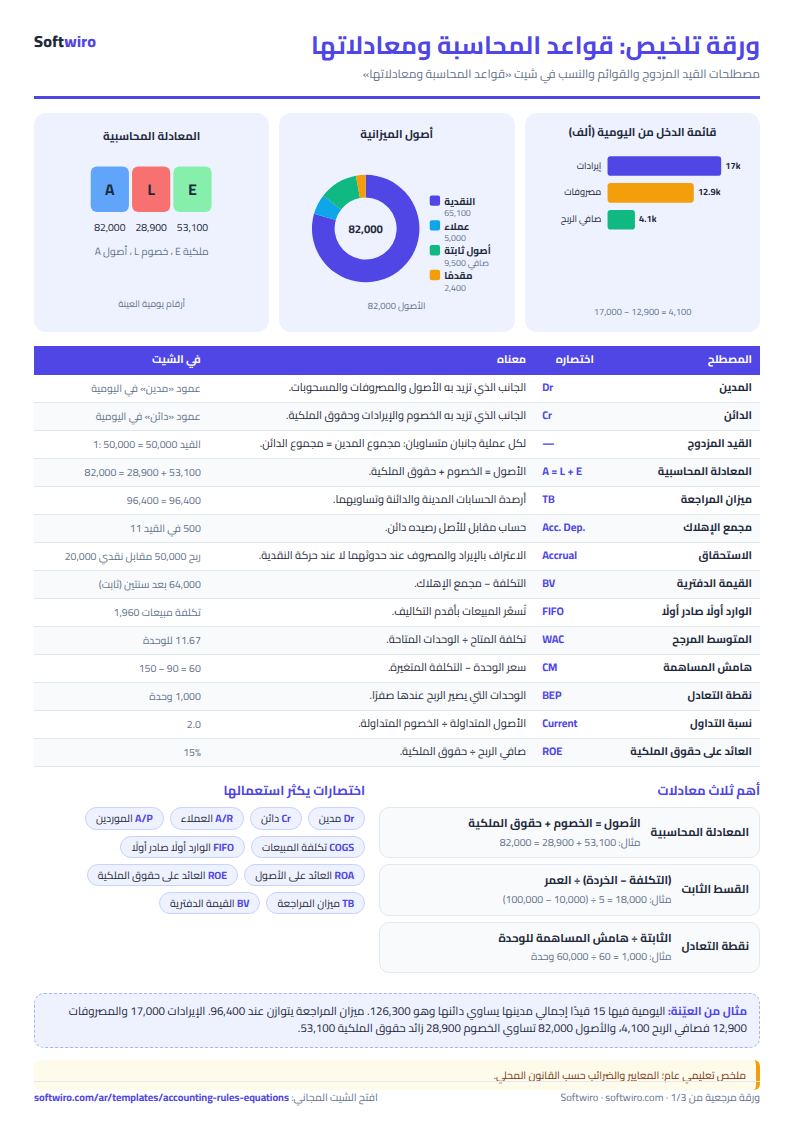
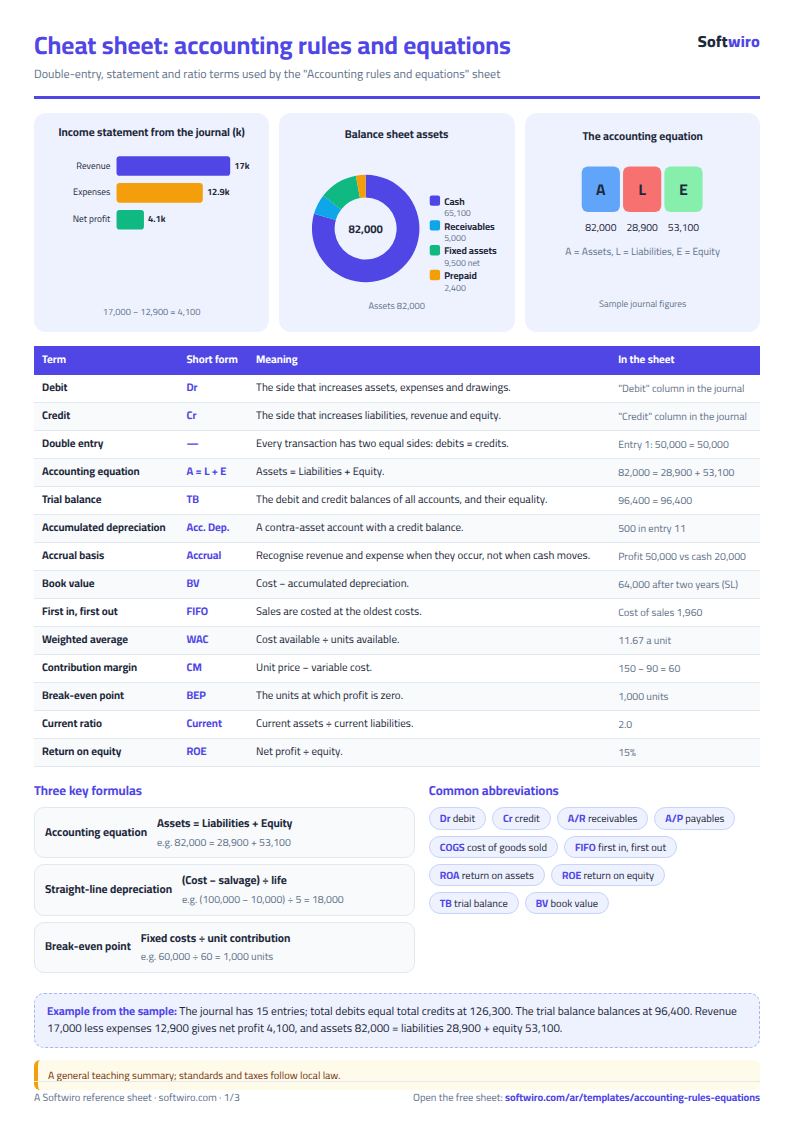
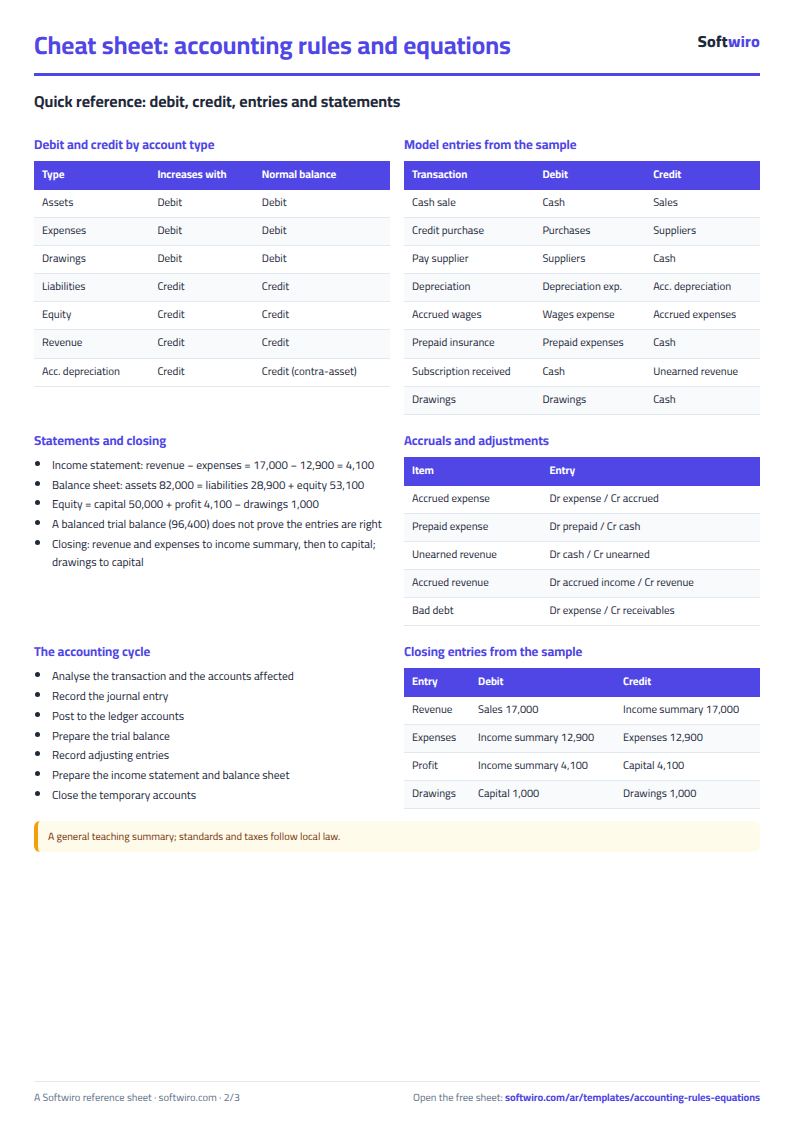
- Journal: 15 entries over 30 lines; total debits 126,300 equal total credits.
- Trial balance: debit balances total 96,400, equal to the credit balances. Cash has debits of 85,000 and credits of 19,900, so a debit balance of 65,100.
- Income statement: revenue 17,000 and expenses 12,900 (purchases 8,000, rent 2,000, wages 2,400, depreciation 500), so net profit is 4,100.
- Balance sheet: assets 82,000 = liabilities 28,900 + equity 53,100, where equity = capital 50,000 + profit 4,100 − drawings 1,000.
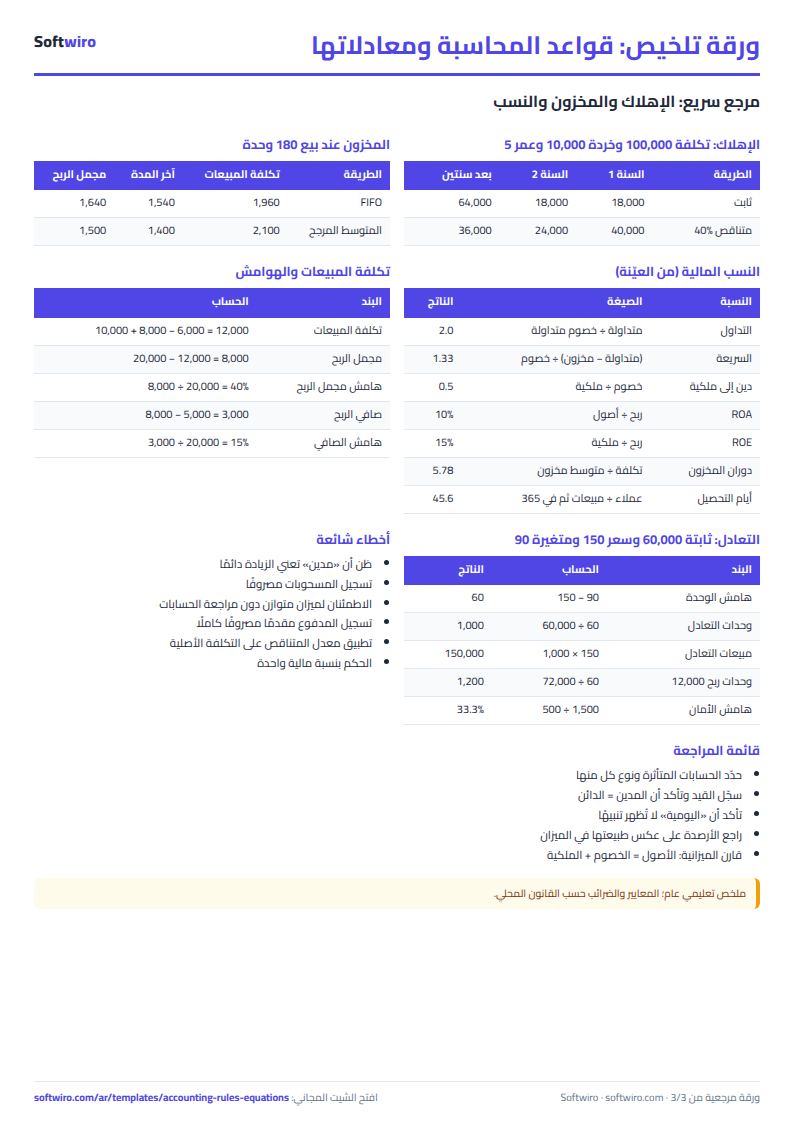
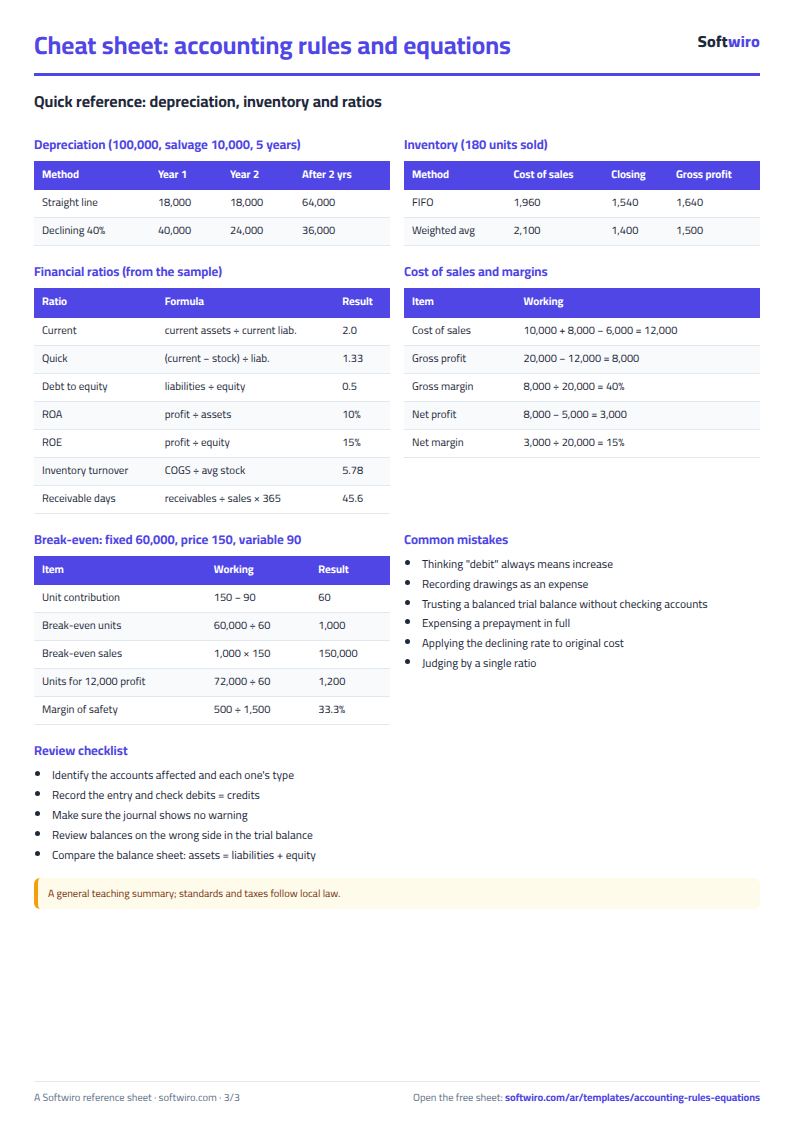
- Depreciation: an asset costing 100,000 with salvage 10,000 and a five-year life: straight line is 18,000 a year, so book value after two years is 64,000. Declining balance at 40% gives 40,000, 24,000, 14,400, 8,640 and then 2,960 in year five (it cannot go below salvage), so book value after two years is 36,000.
- Inventory: buying 100 units at 10, 150 at 12 and 50 at 14, then selling 180: FIFO cost of sales is 1,960 with closing inventory 1,540; weighted average (11.67 a unit) gives 2,100 and 1,400. Gross profit is 1,640 against 1,500, a difference of 140.
- Break-even: fixed costs 60,000, price 150, variable cost 90: contribution per unit 60 and break-even 1,000 units or 150,000; a 12,000 profit target needs 1,200 units; the margin of safety at 1,500 units is 33.3%.
- Ratios: current 2.0, quick 1.33, debt to equity 0.5, ROA 10%, ROE 15%, inventory turnover 5.78, receivable days 45.6.
- Self-test and progress: 36 of 40 questions answered and 26 correct, a score of 65%; three topics were due for review on 2026-11-15.
Common mistakes
- Thinking "debit" always means increase: assets and expenses increase with a debit; liabilities, revenue and equity increase with a credit.
- Recording drawings as an expense: they reduce equity and stay out of the income statement.
- Trusting a balanced trial balance: it can balance with a right amount in the wrong account, so check account types and each entry's narration.
- Expensing a prepayment in full: a 2,400 annual insurance payment is an asset used up monthly.
- Applying the declining-balance rate to original cost: it applies to the book value at the start of the year.
- Judging by a single ratio: a current ratio of 2.0 proves nothing alone; compare with yourself over time and with businesses like yours.
When to move from the sheet to a system
The sheet is excellent for learning and practice. Once you run a real business with invoices, tax, stock and several users, you need automatic posting, period closing and statements drawn directly from the entries, which is what the ProfAcc system provides. To practise entries for your own business use the journal and trial balance sheet and the fixed assets and depreciation sheet, and for examples read journal entry examples (Arabic).
Next step
Download the sheet, open اليومية and record two entries from this week in your business or from a textbook example, then open ميزان المراجعة and confirm the status reads "balanced". After that take the self-test and log your score in المتابعة so you have a first written review date.
FAQ
Does the sheet replace accounting standards? No. It is a general teaching summary; standards and taxes follow local law.
Does a balanced trial balance prove the entries are right? No. It does not reveal a forgotten entry or a correct amount posted to the wrong account.
What shows if an entry does not balance? The words "قيد غير متوازن" (unbalanced entry) appear in red beside each line of the entry, and the difference shows at the top of the journal.