You own fixed assets in your company, workshop or shop, such as furniture, computers, vehicles and machines, and you want to know at any moment what each is worth on the books, how much depreciation this year carries, what you sold and whether you gained or lost on it, and which asset has overdue maintenance or insurance about to lapse. The free fixed assets register and depreciation sheet answers all of this from one register you type once, and you can try it online from the template page before downloading.
The problem it solves
An asset register usually starts as a list of names and prices. At year end someone asks for each asset's depreciation and net value, you work it out by calculator, miscount the months, or forget an asset sold in mid-year. You find out late that a generator's service is overdue or the car's insurance lapsed two weeks ago. The sheet works out depreciation monthly from the purchase date, separates this year's depreciation from the accumulated total, and lists maintenance and insurance alerts.
How it works, step by step
- In الإعدادات (Settings) write today's date, the year to depreciate, the date the accumulated depreciation should run to, the alert days, then your categories and locations.
- In الأصول (Assets) write each asset in a row: code, name, category, location, custodian, purchase date, cost, salvage value, life in years and method.
- If you sold or scrapped the asset, write the disposal date and sale price. Write the next maintenance date and insurance expiry to get alerts.
- The sheet calculates the annual rate, accumulated depreciation, net book value, this year's depreciation and the asset status.
- Open جدول الإهلاك (Schedule) for each asset over ten years and الملخص (Summary) for totals and charts.
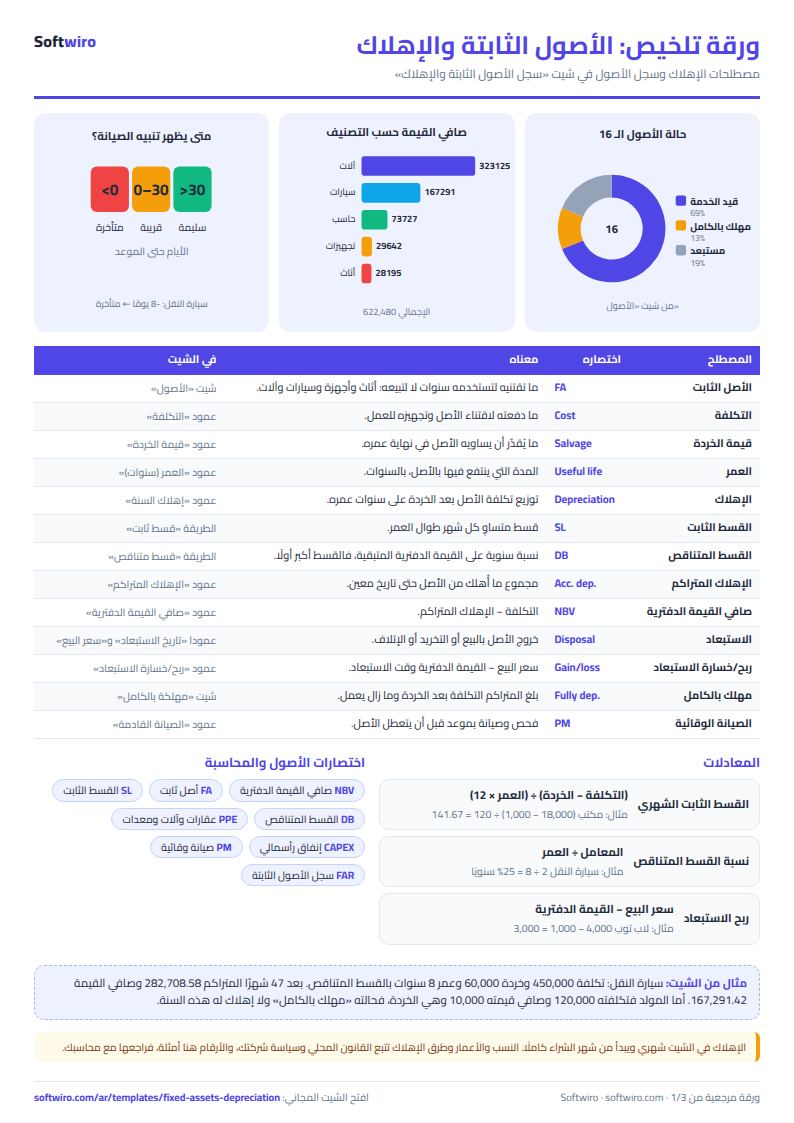
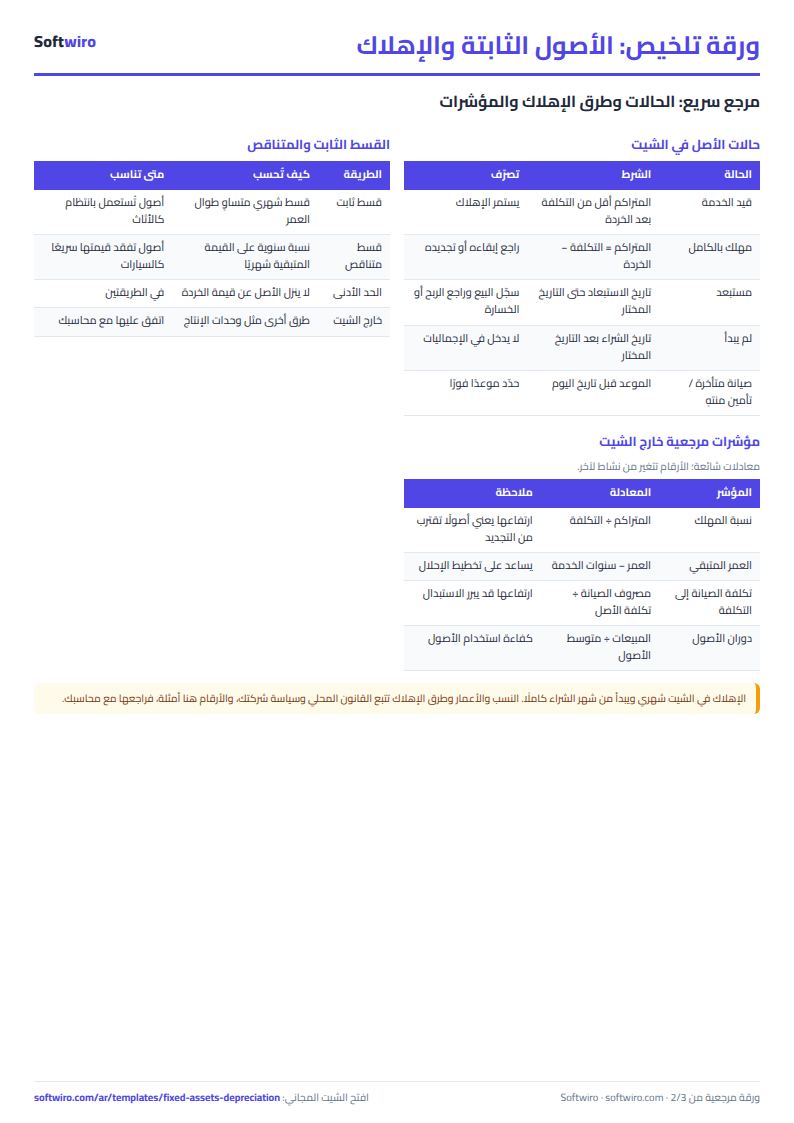
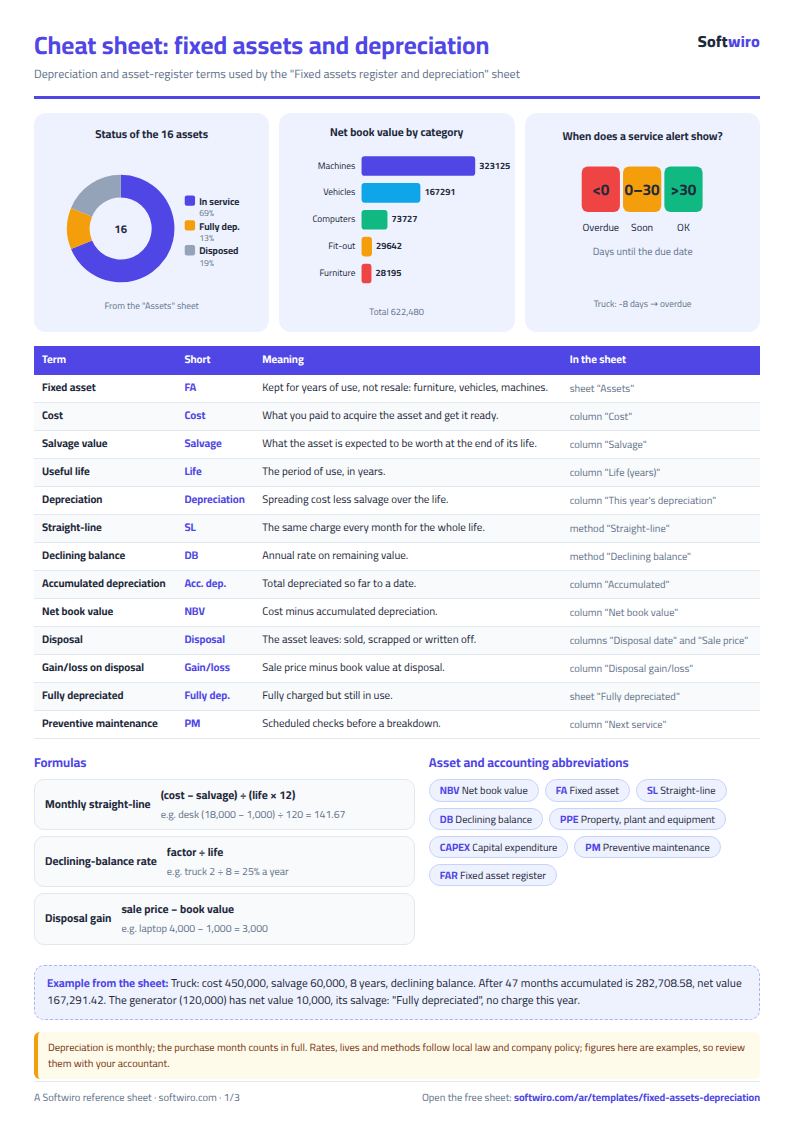
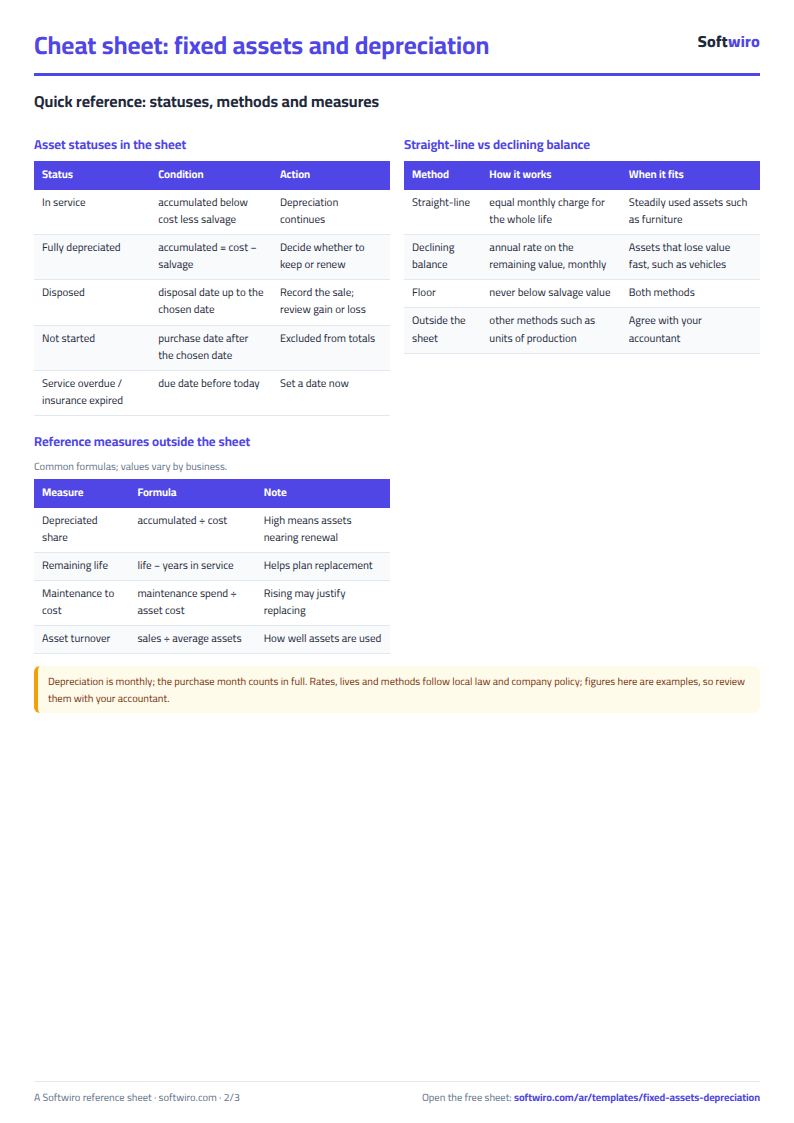
Depreciation is monthly and the purchase month counts as a full month. For straight-line, the monthly charge = (cost - salvage) / (life x 12). For declining balance, an annual rate = factor / life is applied monthly to the remaining book value, and the asset never goes below salvage. Rates and lives follow local law, your company's policy and your accountant; the figures in the sheet are examples only.
What each sheet does
- Settings: date, year, accumulation date, alerts, factor, and the category and location lists.
- Assets: the register with every calculated column; it holds 200 assets.
- Schedule: ten years per asset, with each year's total at the top.
- Disposals (الاستبعاد): sold or scrapped assets, book value, and the gain or loss on each.
- Alerts (التنبيهات): overdue or near maintenance, expired or near insurance.
- Fully depreciated (مهلكة بالكامل): assets still in use whose depreciation has run out.
- Summary: totals by category, location and year, and four charts.
A walk-through with the sample numbers
These are sample data inside the sheet, not a real company: 16 assets, today is 13 November 2026, the year is 2026 and the accumulated figure runs to 30 November 2026.
- Manager's desk: cost 18,000, salvage 1,000, life 10 years, straight-line. After 57 months (from March 2022) accumulated is 8,075, net value 9,925, and 2026 depreciation is 1,700.
- Delivery truck: cost 450,000, salvage 60,000, life 8 years, declining balance, so 25% a year. After 47 months accumulated is 282,708.58, net value 167,291.42 and 2026 depreciation 47,081.32. Its service is 8 days overdue and its insurance ends in 27 days.
- Generator: cost 120,000, 5-year life complete. Accumulated 110,000, net value 10,000 (the salvage), so no depreciation this year and the status reads fully depreciated.
- A laptop sold for 4,000: book value at sale 1,000, so the gain is 3,000. The company car sold for 170,000 against a book value of 100,384.24, a gain of 69,615.76. An old air conditioner scrapped without a sale in 2025 shows a loss of 1,000, its book value.
In the summary: 13 assets in service, cost 1,323,100, accumulated depreciation 700,619.86, net book value 622,480.14. Depreciation for 2026 is 159,916.50, which includes 23,523.75 for the company car sold in October. Disposals in 2026 are two assets with 174,000 in proceeds and a 72,615.76 gain. Alerts: one overdue service, two near, one expired insurance and two near, and two fully depreciated assets costing 128,500. The ten-year schedule starts at 159,916.50 in 2026, then 118,393.13 in 2027 and 103,994.56 in 2028.
Common mistakes
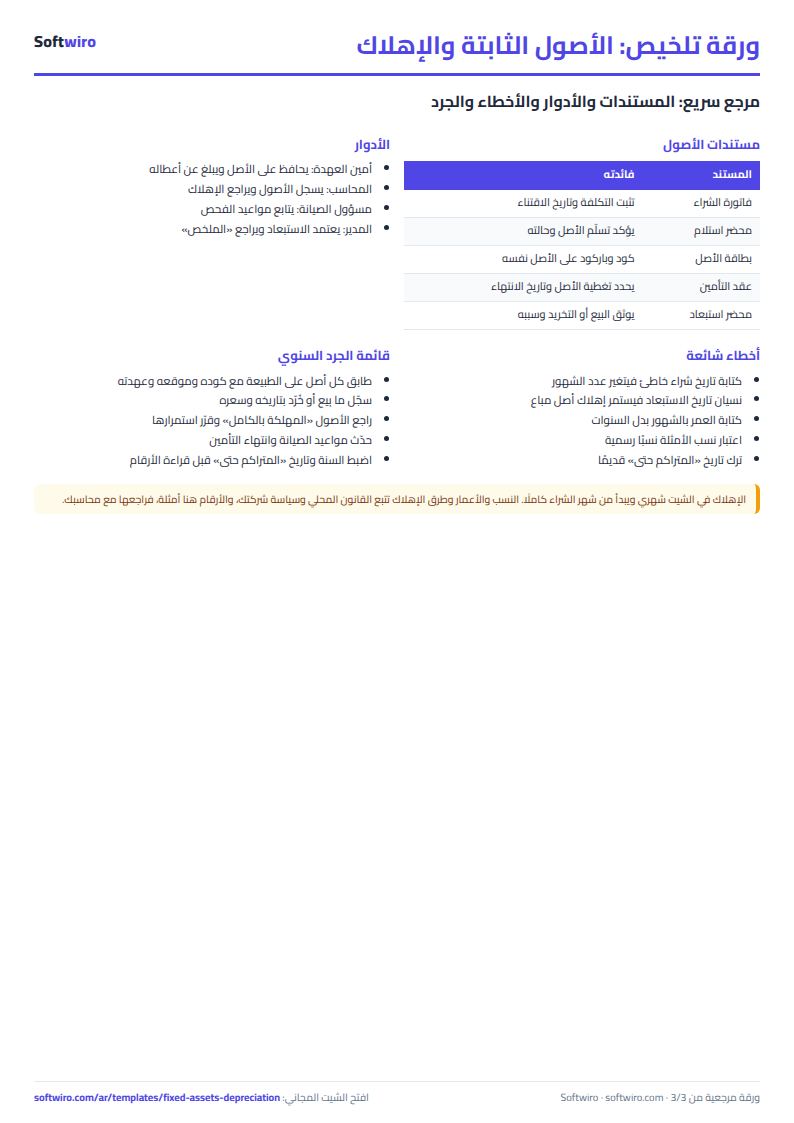
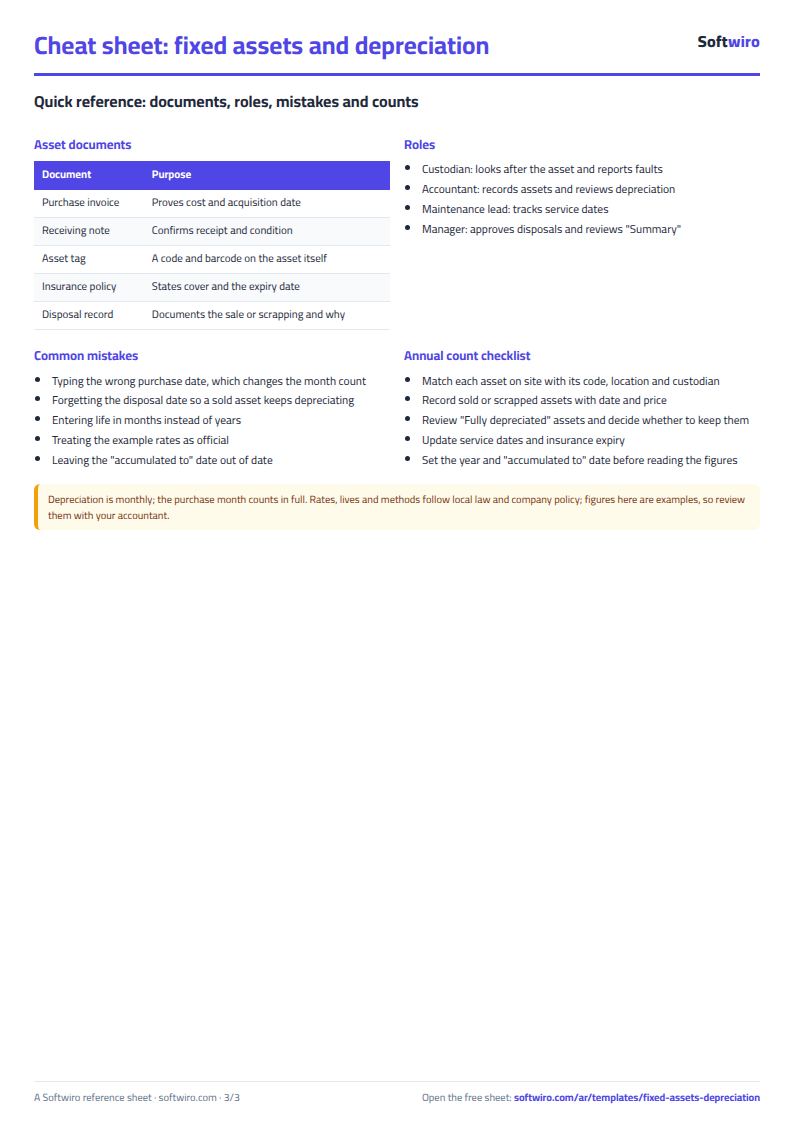
- Typing the wrong month for the purchase date, which changes the month count and so the whole depreciation.
- Mixing years and months for life: the cell is in years and the sheet multiplies by 12.
- Forgetting the disposal date, so an asset you no longer own keeps depreciating.
- Treating the example rates as official: rates follow local law and your company's policy.
- Leaving the "accumulated to" date at an old value, so you read yesterday's figures.
- Adding an improvement as a new asset without a clear policy; ask your accountant how to treat it.
When to move to a system
The sheet is enough for dozens of assets and one accountant. When assets run to hundreds, or you want monthly depreciation to become a journal entry that posts itself and closed periods that cannot change, look at ProfAcc for double-entry and period closing, or ask for software built your way. To track maintenance of a building's assets for an owners' association, try the owners' association assets and maintenance sheet.
Your next step
Open the template, download the file, clear the examples, type your assets, and review net value and this year's depreciation with your accountant before relying on them.