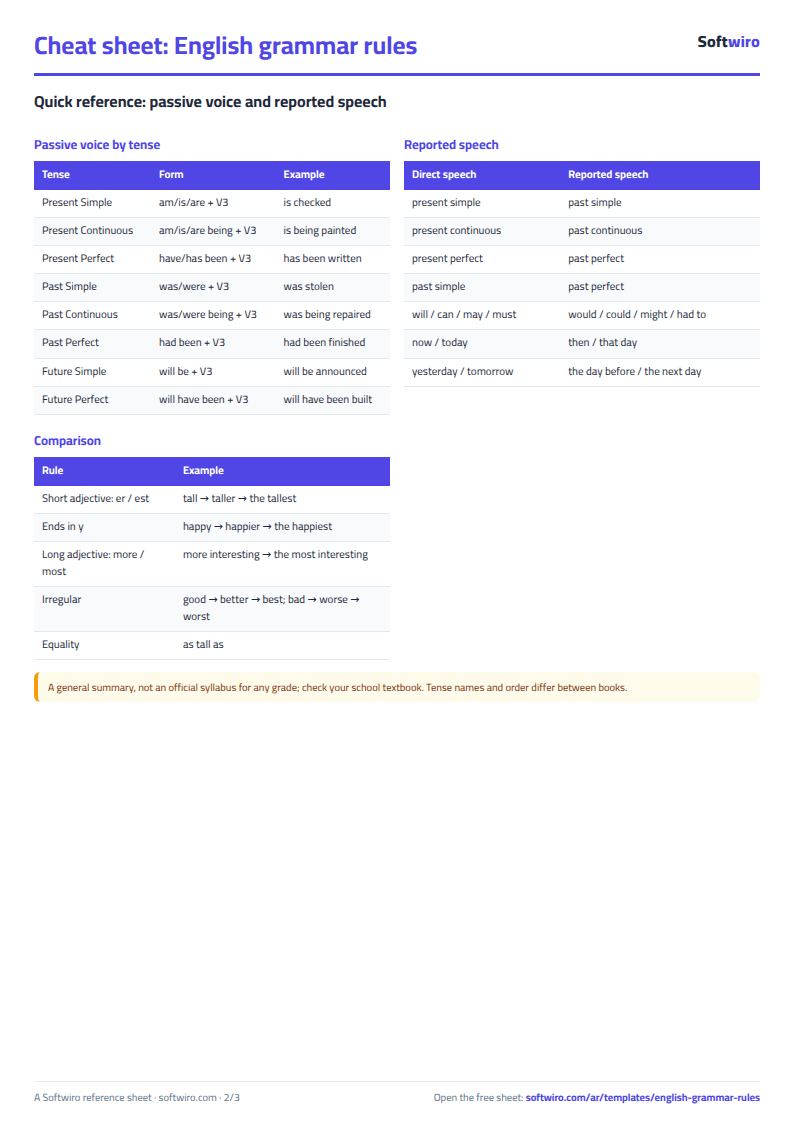
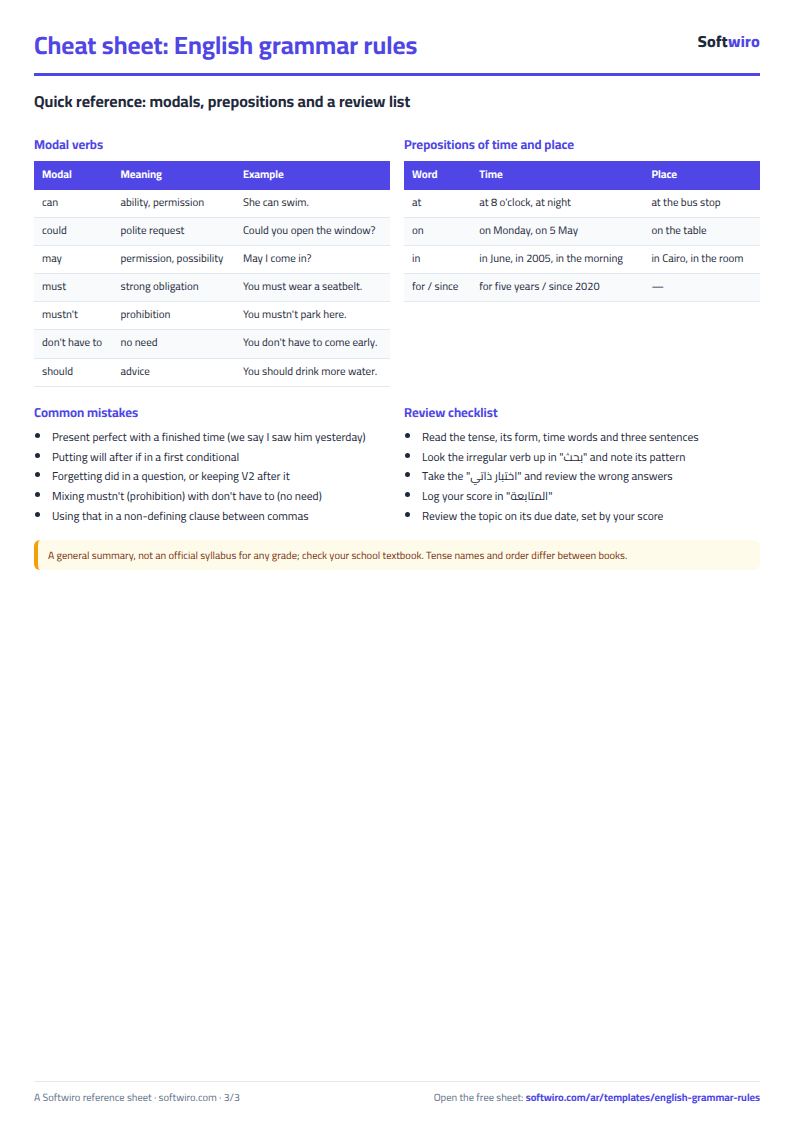
You want to review English grammar before the exam in one place, explained in Arabic: the form, when to use it, its time words, correct sentences to imitate, and then a test. The free English grammar rules sheet puts that together for the tenses and structures taught in school. The sheet itself is in Arabic with English examples, so this guide explains how to use it. It is a general summary, not an official syllabus for any particular grade; check your school textbook.
The problem it solves
A student knows there are twelve tenses but mixes up the present perfect and the past simple, forgets how the tense shifts in reported speech, and stumbles on irregular verbs, writing "goed" instead of "went". The rules are scattered across a notebook, a textbook and video clips, so there is no way to tell which topic has been mastered. The sheet puts them in ordered tables with Arabic explanations, and turns revision into a quiz with review dates.
How the sheet works, step by step
- Open الأزمنة (Tenses) and review each tense: its form, its use in Arabic, its time words and three sentences (positive, negative and question).
- Open القواعد (Rules) and filter by the section column to review one section, from the passive voice to question tags.
- Look the verb up in الأفعال الشاذة (Irregular verbs), or pick it in بحث (Lookup) to see its forms, meaning and pattern.
- In بحث pick a tense, a rule or a verb to see all its details.
- Take the 36-question اختبار ذاتي (Self-test) and log your score in المتابعة (Progress).
- Open الملخص (Summary) to see your score per branch and the topics due for review.
What is in each sheet
- Tenses: 12 tenses, each with three sentences and a note.
- Rules: 79 rules in 10 sections, each with a form, an explanation and an example.
- Irregular verbs: 120 verbs with their three forms, meaning and pattern.
- Lookup: three drop-downs for a tense, a verb and a rule.
- Self-test: 36 questions with a hidden key; a tick or a cross appears with the score at the top.
- Progress and Summary: review dates, your scores and the charts.
A walk-through on the sample numbers
These figures are the sample data inside the workbook, what you see before you type anything.
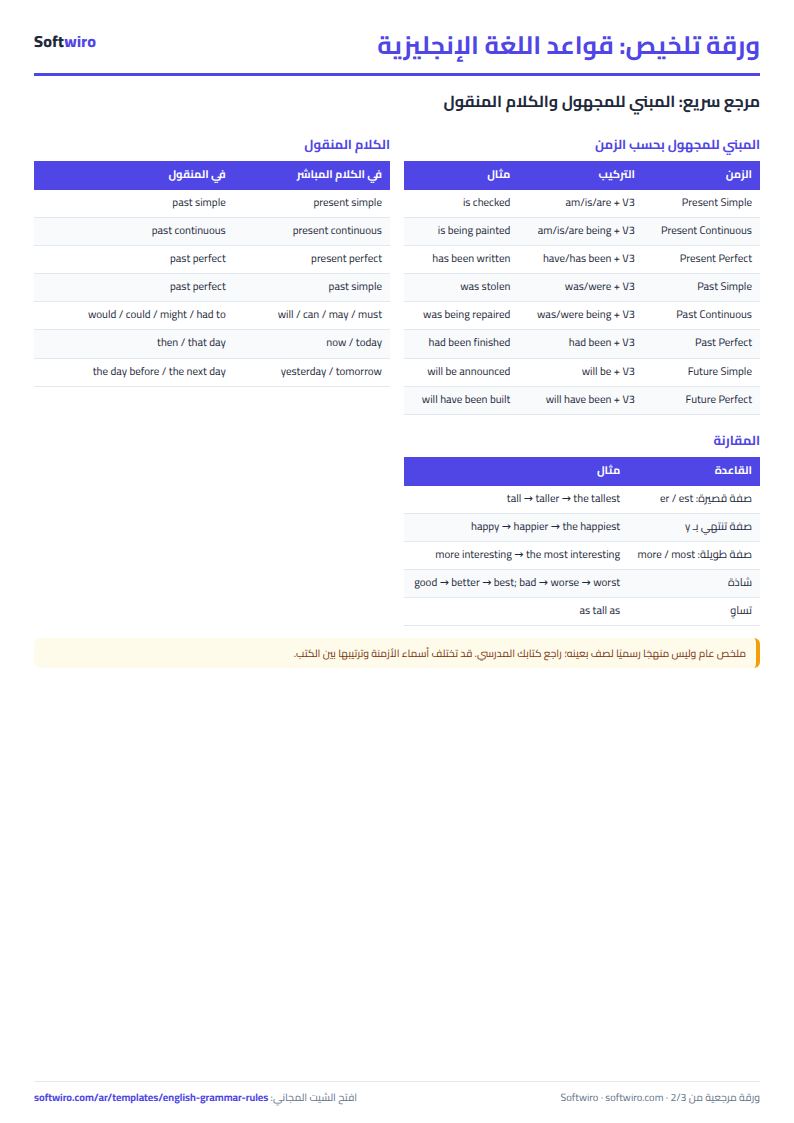
- Reference: the rules are split like this: passive voice 11, modals 11, prepositions 11, reported speech 9, relative pronouns 8, question tags 7, comparatives 6, other structures 6, conditionals 5, articles 5.
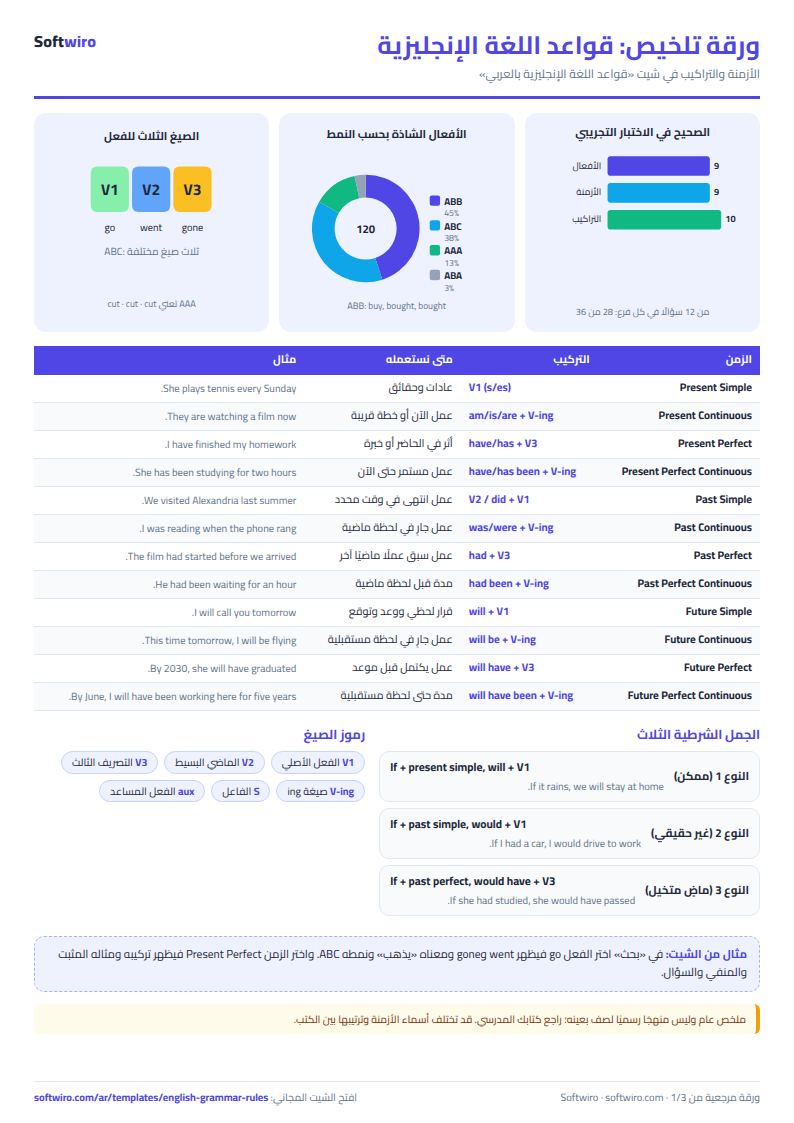
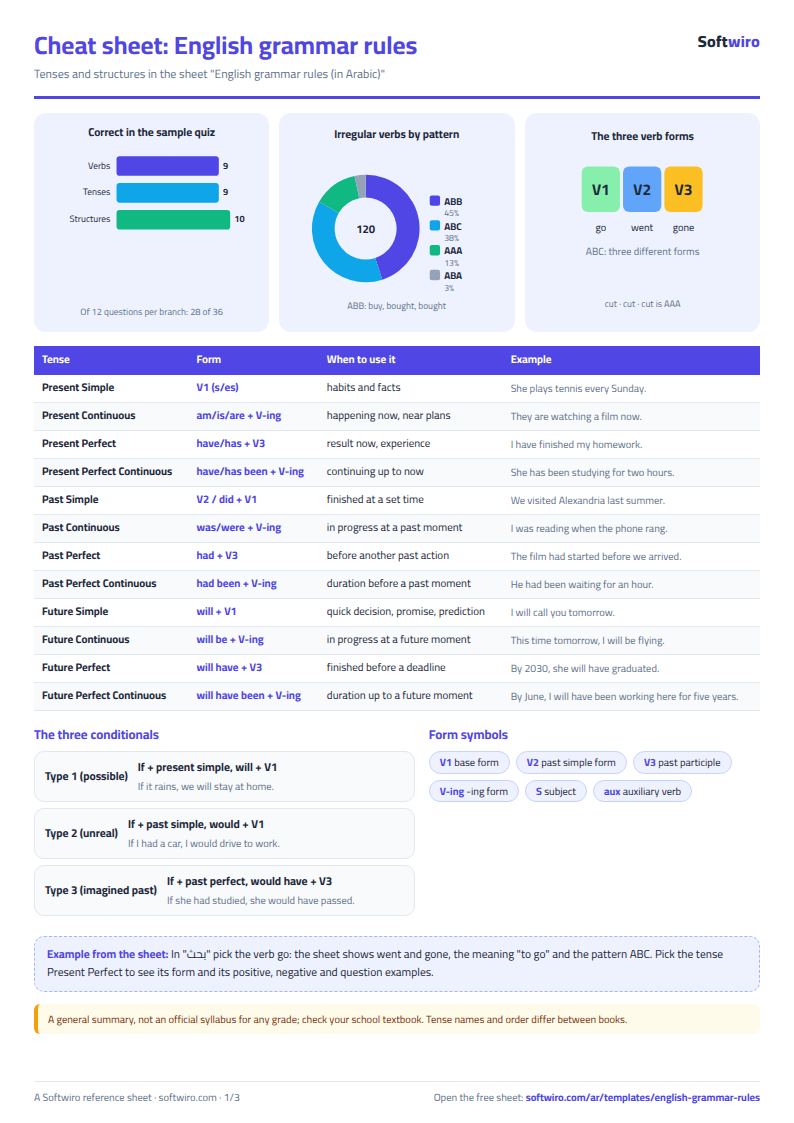
- Looking up a tense: choosing Present Perfect shows its form have/has + V3, the example "I have finished my homework." and the question "Have you finished your homework yet?".
- Looking up a verb: choosing go shows went and gone, the meaning "to go" and the pattern ABC.
- Irregular verbs: of 120 verbs, 16 follow the pattern AAA such as cut, 4 follow ABA such as come, 54 follow ABB such as buy and 46 follow ABC such as go.
- Sample quiz: 34 of the 36 questions were answered and 28 are correct, so the score is 77.8%. Irregular verbs: 9 correct of 12; tenses and passive: 9 of 12; structures: 10 of 12.
- Progress: three topics are due for review on 2026-11-15, and the average progress score is 69.3%.
Common mistakes
- Present perfect with a finished time: we say "I saw him yesterday", not "I have seen him yesterday".
- Will after if: in a first conditional we say "If it rains, we will stay at home"; there is no will in the if-clause.
- Forgetting did in a question: we say "Did you visit Alexandria?" and the verb returns to V1 after did.
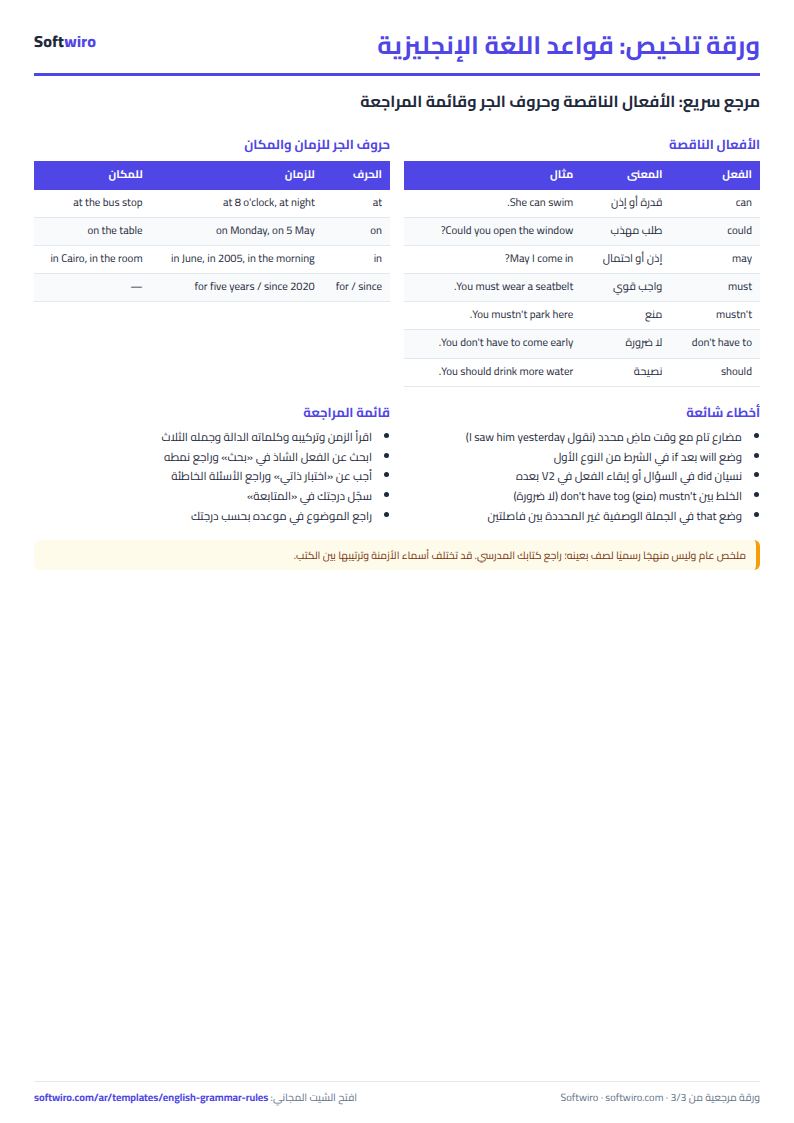
- Mixing mustn't and don't have to: the first is a prohibition, "You mustn't park here"; the second means no need, "You don't have to come early".
- Non-defining clauses: they sit between commas and never take that: "My brother, who lives in Dubai, is an engineer".
- A and an: the choice follows the sound: an hour, a university.
When to move from the sheet to a system
The sheet is enough for a student revising alone or a teacher preparing a summary for a class. If you want to track dozens of students, with a large question bank, writing exercises that the system marks and a board that shows where a class is weak, you need a system with a login for each user, and Softwiro can build one your way. To plan your study time, try the study planner or the weekly study routine.
Next step
Download the sheet and pick one section you have not mastered. Read its rules in "Rules" or its tenses in "Tenses", answer its questions in "Self-test" and log your score in "Progress". You will then have your first written review date. A week later, retake the quiz and compare it with the first score to see what has stuck.
FAQ
Does the sheet match my grade's syllabus? It is a general summary, not an official syllabus for any grade; check your textbook, as tense names and order differ.
Are all irregular verbs included? The table holds 120 of the most common ones, not every irregular verb in the language.
How do I answer the quiz? Type the English answer in English letters, case does not matter, or pick it from the list.