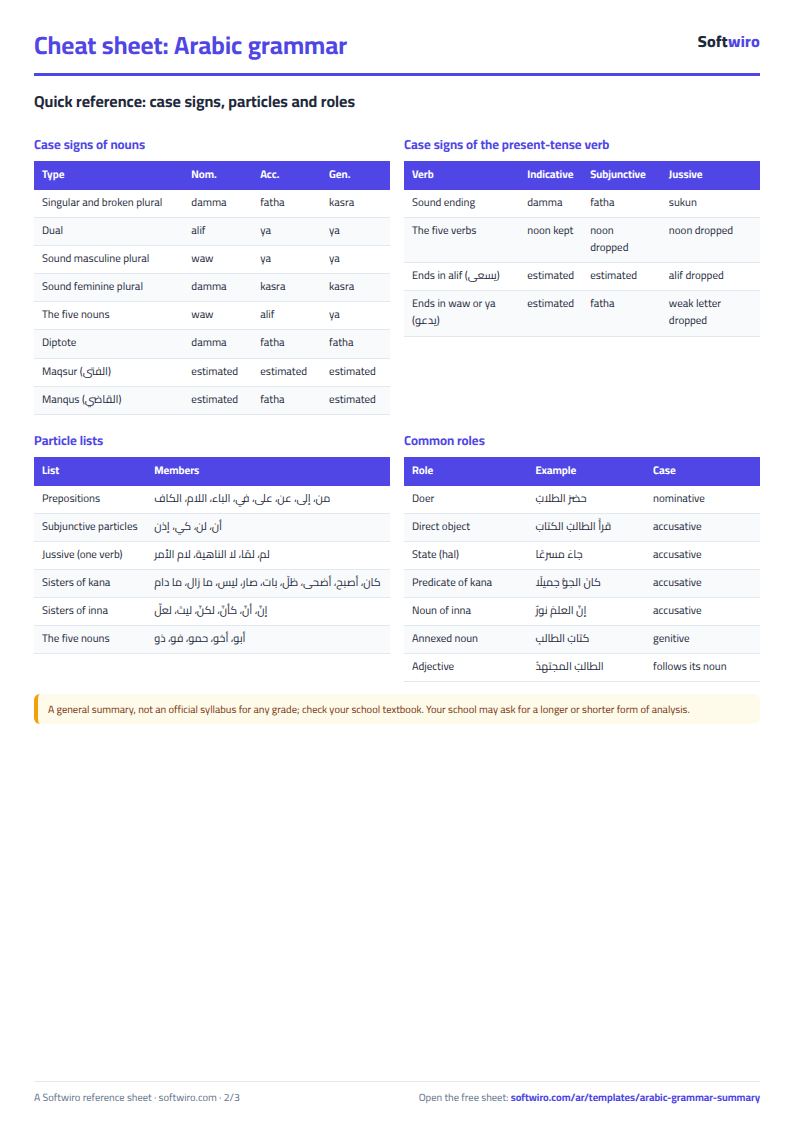
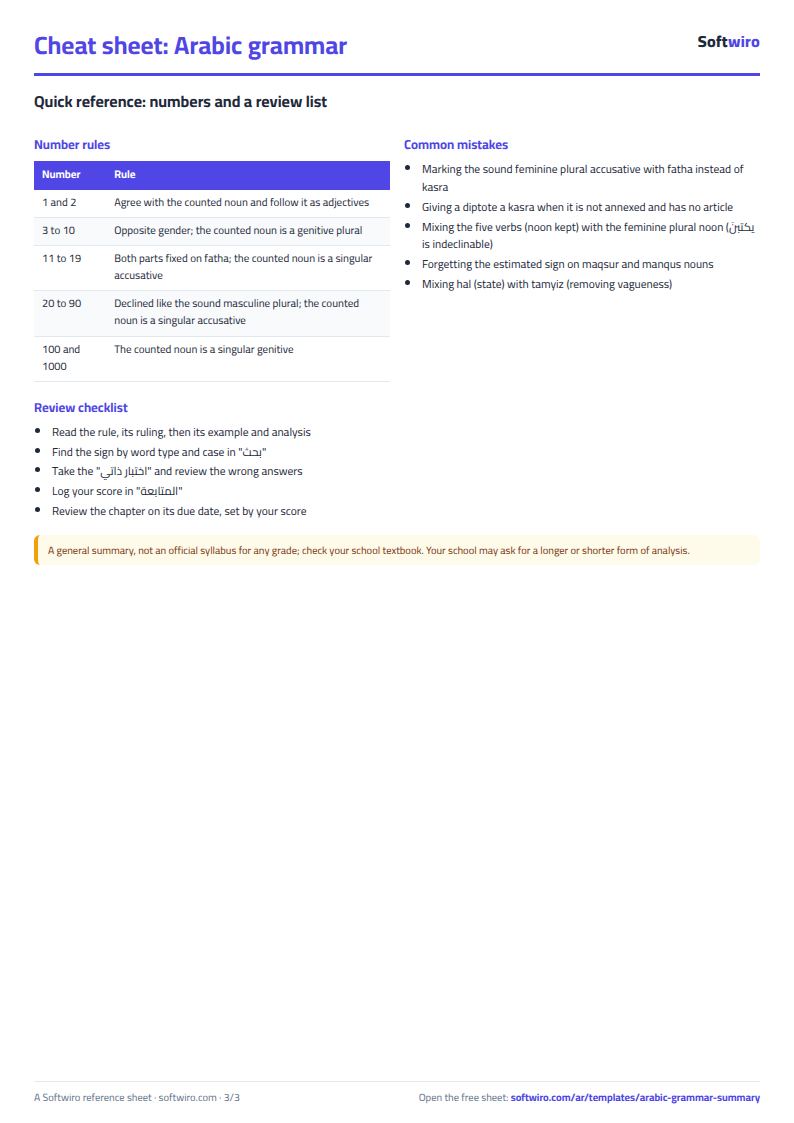
You want to review Arabic grammar (nahw) before the exam in one place: the rule and its ruling, a clear example, the i'rab (grammatical analysis) of the key word, then a test that shows where you slipped. The free Arabic grammar summary sheet puts that together for school-level rules. It is a general summary, not an official syllabus for any particular grade; check your school textbook. Disputed topics are left out. The sheet and its examples are in Arabic, so this guide explains how to use it.
The problem it solves
Students memorise the case signs and then get lost when analysing a sentence: is the plural-feminine word in "I saw the female students" marked with a kasra or a fatha? Is a diptote in "I passed by Ahmad" given a kasra? Notes are scattered across a notebook, a textbook and photos from the teacher, so you never know which chapter you have mastered. The sheet puts the rules in one table, puts the sign table beside it, and turns revision into a quiz with review dates.
How the sheet works, step by step
- Open قواعد النحو (Grammar rules) and filter the table by the section column to review one section. Each rule has its ruling, an example, the analysis of the key word and a note.
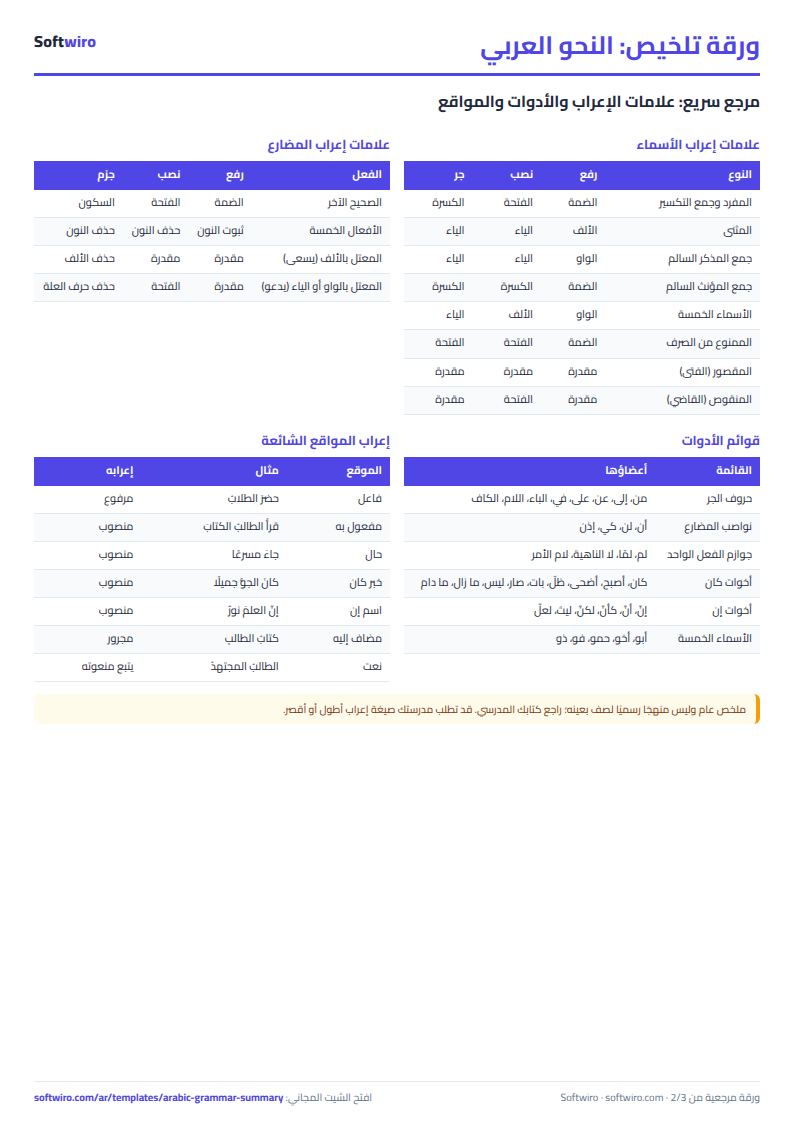
- Review علامات الإعراب (Case signs): read the row of each word type and the column of each case (nominative, accusative, genitive, jussive).
- Learn the lists in الأدوات والقوائم (Tools and lists): prepositions, subjunctive and jussive particles, the sisters of kana and inna.
- In بحث (Lookup) pick a rule by name, or pick a word type and a case to get the sign and a full example.
- Take the 36-question اختبار ذاتي (Self-test) by picking answers from the lists, and log your score in المتابعة (Progress).
- Open الملخص (Summary) to see your score per branch and the topics due for review.
What is in each sheet
- Grammar rules: 49 rules in 7 sections, from the parts of speech and declined versus indeclinable words to numbers, each with an example and the analysis of the key word.
- Case signs: 12 word types, four cases, the sign for each, and an example.
- Tools and lists: 11 lists with their members, what they do and an example.
- Lookup: three tools to reach a rule, a sign or a list in a second.
- Self-test: 36 questions with a hidden answer key; a tick or a cross appears with the score at the top.
- Progress and Summary: review dates, your scores and the charts.
A walk-through on the sample numbers
These figures are the sample data inside the workbook, what you see before you type anything.
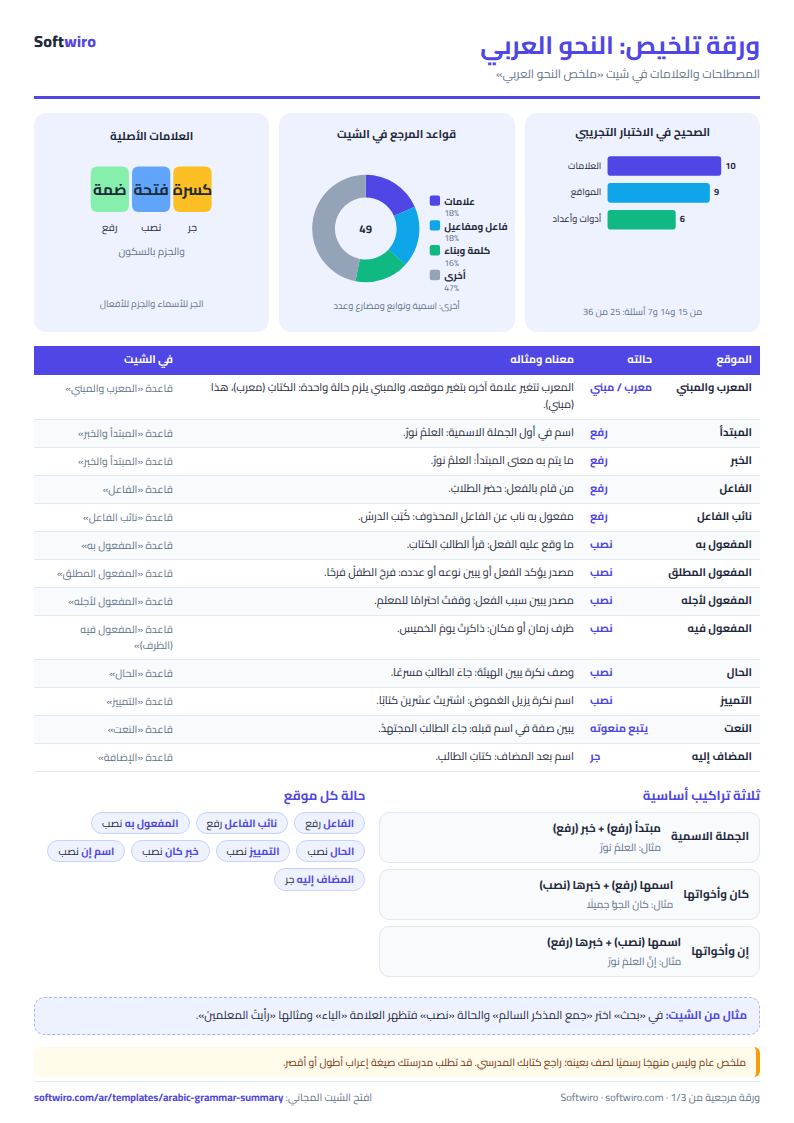
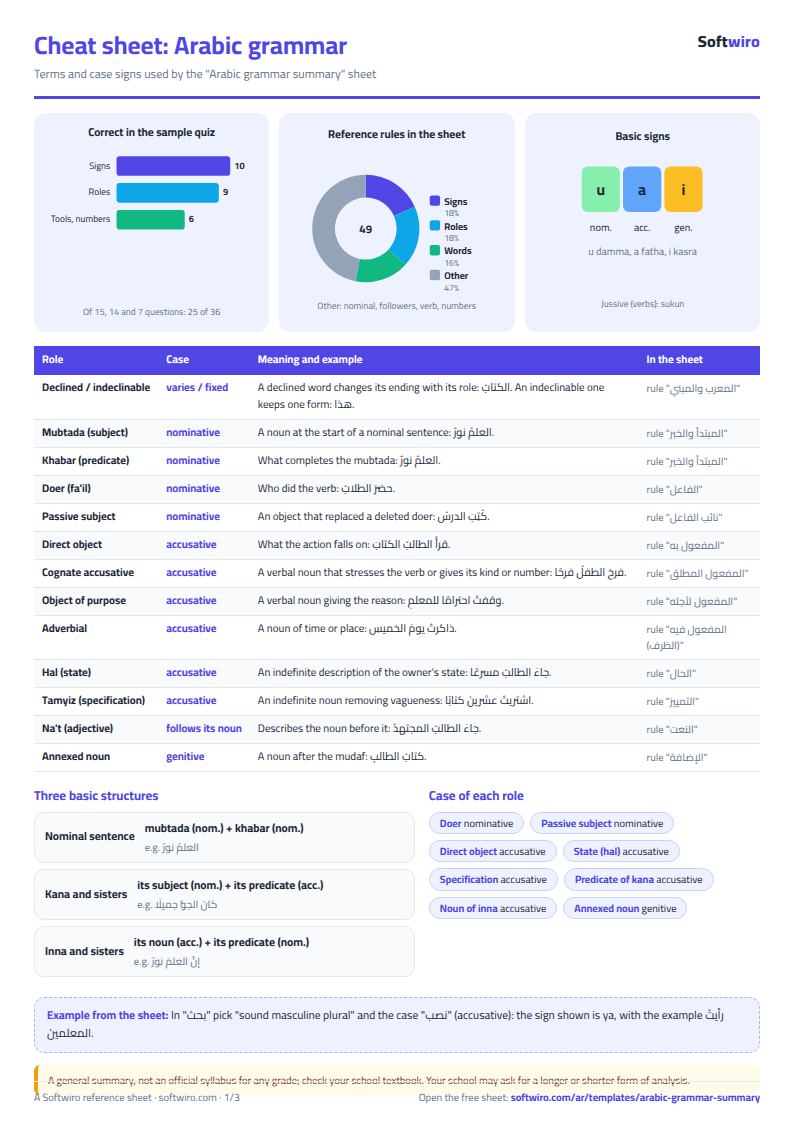
- Reference: the rules are split like this: case signs 9, subject, objects and hal 9, words and indeclinability 8, the nominal sentence 7, the present-tense verb 6, numbers 6, and followers, annexation and prepositions 4.
- Lookup by name: choosing "the five nouns" shows the ruling: they take waw in the nominative, alif in the accusative and ya in the genitive, as long as they are not annexed to the speaker's ya. The example is "جاءَ أخوكَ" and the key word is the subject marked by waw.
- Lookup by type and case: choosing "sound masculine plural" with "accusative" shows the sign ya, with the example "رأيتُ المعلمينَ".
- Sample quiz: 33 of the 36 questions were answered and 25 are correct, so the score is 69.4%. Case signs: 10 correct of 15; analysis of positions: 9 of 14; tools and numbers: 6 of 7.
- Progress: three topics are due for review on 2026-11-15, and the average progress score is 69.3%.
Common mistakes
- Accusative of the sound feminine plural: it takes the kasra in place of the fatha, so we write "رأيتُ الطالباتِ", not "الطالباتَ".
- Genitive of the diptote: it takes the fatha in place of the kasra when it is not annexed and has no definite article: "مررتُ بأحمدَ". With the article it takes the kasra: "مررتُ بالمساجدِ".
- Mixing the five verbs with the feminine plural noon: "الطلابُ يكتبونَ" is in the indicative with the noon kept, while "الطالباتُ يكتبنَ" is indeclinable with sukun.
- Forgetting the estimated sign: "جاءَ الفتى" has a subject with an estimated damma, not no sign at all.
- Mixing hal and tamyiz: hal describes the state of its owner ("جاءَ الطالبُ مسرعًا"), tamyiz removes the vagueness of a preceding noun ("عشرينَ كتابًا").
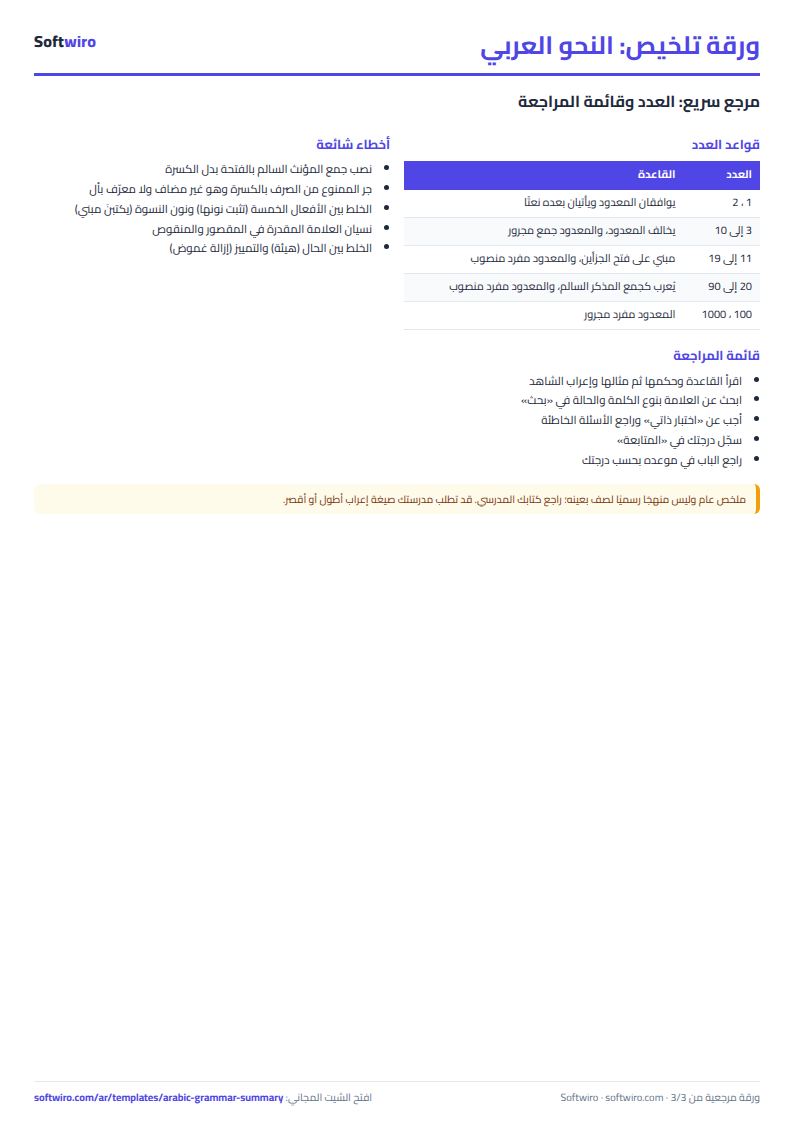
- Number agreement: numbers 3 to 10 take the opposite gender of what they count: "ثلاثةُ كتبٍ" and "ثلاثُ طالباتٍ".
When to move from the sheet to a system
The sheet is enough for a student revising alone or a teacher preparing a summary for a class. If you want to track dozens of students, with a large question bank, full texts to analyse and a board that shows where a class is weak, you need a system with a login for each user, and Softwiro can build one your way. To plan your study time, try the study planner or the weekly study routine.
Next step
Download the sheet and pick one section you have not mastered. Read its rules and examples in "Grammar rules", answer its questions in "Self-test", and log your score in "Progress". You will then have your first written review date.
FAQ
Does the sheet match my grade's syllabus? It is a general summary, not an official syllabus for any grade; check your textbook, as wording and order differ.
Is the analysis wording what my teacher asks for? It is the usual school wording; your teacher may want it longer or shorter.
How do I answer the quiz? Pick from the drop-down list so it matches the key; numbers are typed as digits.