Try the sheet here, on the example
The sheet is open below with sample numbers. Change any white cell and watch the results update, or press the blank-copy button to type your own data from scratch. Nothing you type leaves your browser.
Example from the sheet
| العدد الذري | الرمز | الاسم العربي | الكتلة الذرية (u) | المجموعة | الدورة | الفئة | الحالة (غرفة) |
|---|---|---|---|---|---|---|---|
| 1 | H | هيدروجين | 1.01 | 1 | 1 | لافلز | غاز |
| 2 | He | هيليوم | 4 | 18 | 1 | غاز نبيل | غاز |
| 3 | Li | ليثيوم | 6.94 | 1 | 2 | فلز قلوي | صلب |
| 4 | Be | بيريليوم | 9.01 | 2 | 2 | فلز قلوي أرضي | صلب |
| 5 | B | بورون | 10.81 | 13 | 2 | شبه فلز | صلب |
| 6 | C | كربون | 12.01 | 14 | 2 | لافلز | صلب |
| 7 | N | نيتروجين | 14.01 | 15 | 2 | لافلز | غاز |
| 8 | O | أكسجين | 16 | 16 | 2 | لافلز | غاز |
| 9 | F | فلور | 19 | 17 | 2 | هالوجين | غاز |
| 10 | Ne | نيون | 20.18 | 18 | 2 | غاز نبيل | غاز |
| 11 | Na | صوديوم | 22.99 | 1 | 3 | فلز قلوي | صلب |
Example from the “العناصر” tab (Arabic), with the numbers and formulas that are in the file.
What is inside
- الجدول الدوري: Periodic Table: the elements in position by group (1 to 18) and period (1 to 7), coloured in ten categories, with the lanthanides and actinides in two rows below the table. The element you look up is highlighted.
- بحث عن عنصر: Element lookup: type the symbol (Fe), atomic number (26) or the name in Arabic or English, and an element card appears with both names, atomic mass, group, period, block (s, p, d, f), category, state and valence electrons for main-group elements.
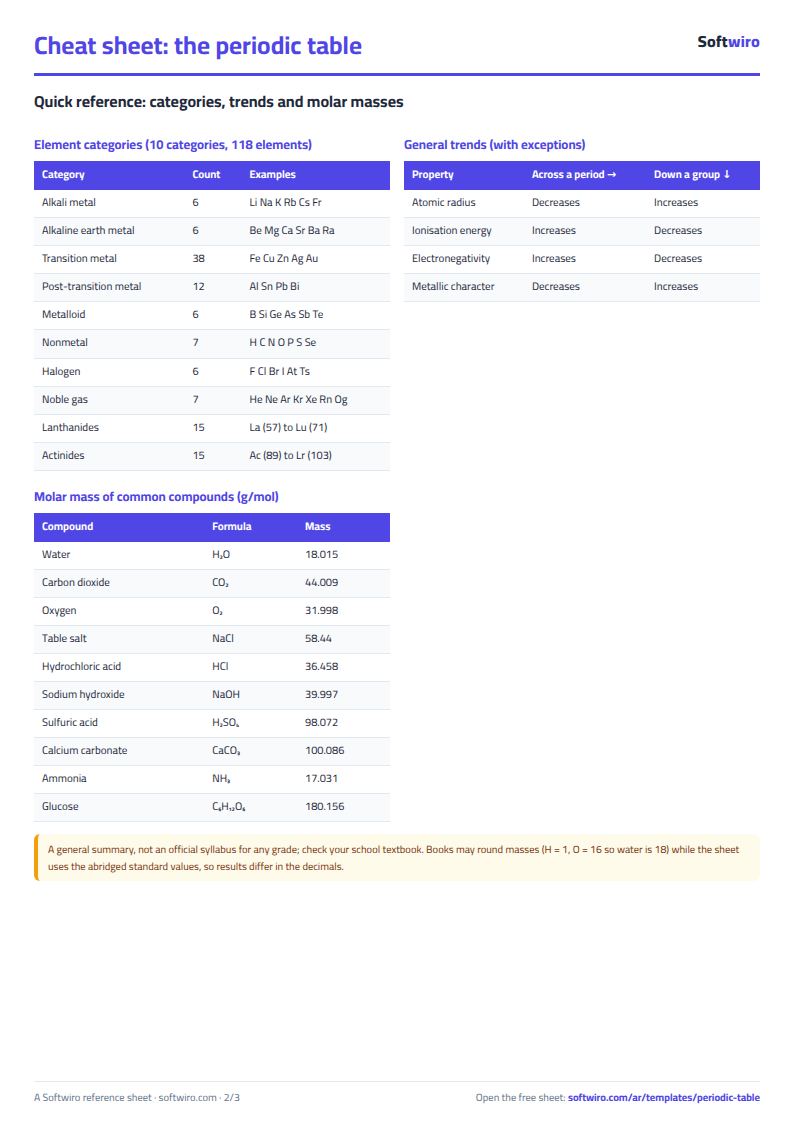
- العناصر: Elements: the full reference table of 118 rows. Atomic masses are the abridged standard values. An element with no stable isotope shows its mass in brackets, with a note that it is a mass number.
- الكتلة المولية: Molar mass: enter each element's symbol and its number of atoms (up to six elements) to get the molar mass in grams per mole and the mass percentage of each element. Below that is a converter between grams, moles and number of particles.
- مركبات شائعة: Common compounds: 17 compounds (water, table salt, sulfuric acid, calcium carbonate, glucose and others) written with their symbols and atom counts, with molar masses calculated from the elements table. You can add your own, up to 30.
- اتجاهات الجدول: Periodic trends: a table of atomic radius, ionisation energy, electronegativity and metallic character across a period and down a group, with the reason for each, plus data for periods 2 and 3 and two charts.
- اختبار ذاتي: Self-test: 38 questions on symbols, atomic numbers, groups, periods, categories, states, molar mass and trends. Type your answer and a ✔ or ✘ appears, with your score at the top. The answer key is in hidden columns.
- المتابعة: Review tracker: the topic, review date and your score. The sheet works out the next review date from the score and flags topics that are due, with a chart of your scores.
- الملخص: Summary: the number of elements in each category, state and block, your quiz score by topic and the number of topics waiting for review, with three charts.
The file opens on a start tab (“ابدأ هنا”, Start here) that explains how to use it.
What makes it different
The sheet puts what you need for studying in one place: full element data, quick lookup, a molar mass calculator that shows its working, a quiz that marks itself and a schedule that tells you when to review. Atomic masses are the abridged international standard values. A radioactive element shows its mass in brackets, as in reference tables, so you do not confuse a standard atomic mass with a mass number.
How to use it
- Open "الجدول الدوري" (Periodic Table) to see the elements arranged by group and period and coloured by category.
- In "بحث عن عنصر" (Element lookup) type an element's symbol (such as Fe), atomic number (26) or name. Its full card appears and its place is highlighted in the table.
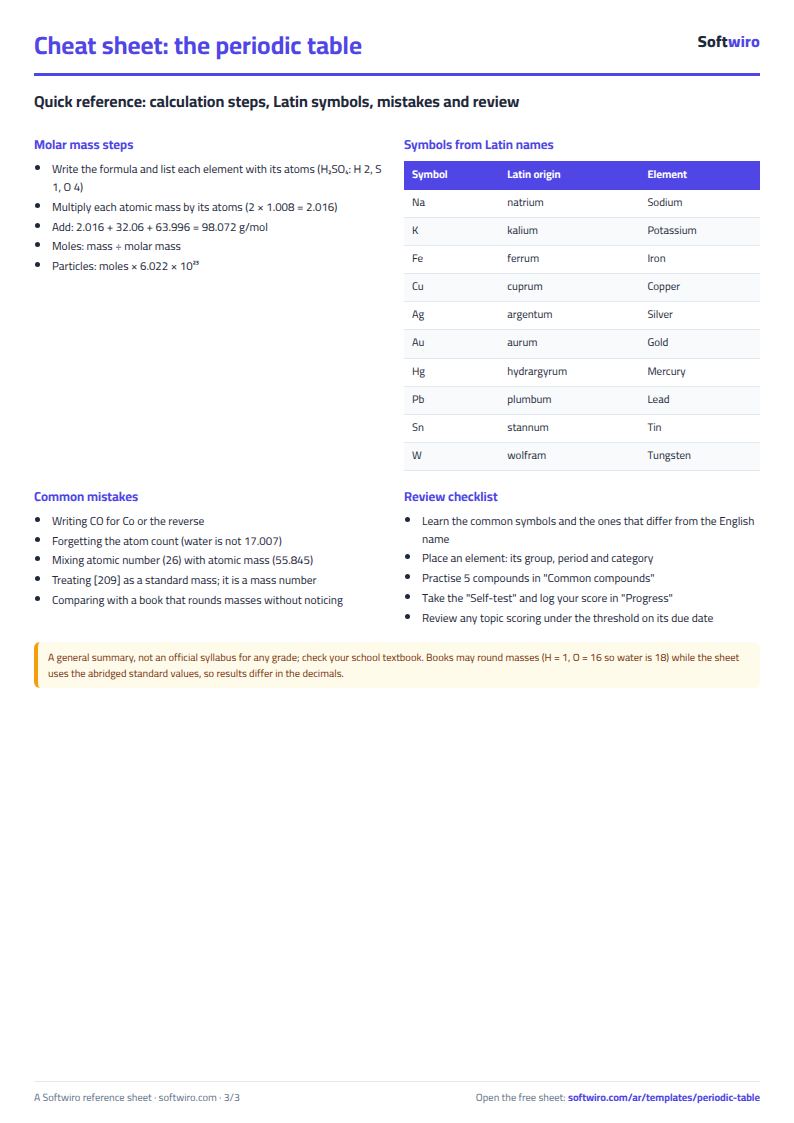
- In "الكتلة المولية" (Molar mass) type the symbol of each element in the compound and its number of atoms (H and 2, then O and 1). The molar mass and each element's percentage appear. Below it, convert from grams to moles and back.
- Read "اتجاهات الجدول" (Periodic trends) to see how electronegativity and atomic radius change across a period and down a group.
- Test yourself in "اختبار ذاتي" (Self-test): type your answer in the white cell and a ✔ or ✘ appears, with your score at the top of the sheet.
- In "المتابعة" (Review tracker) record the topic you reviewed, the date and your score. The sheet sets your next review date.
Before you start:
- This is a general summary and not an official syllabus for any particular grade, so check your school textbook. The order or classification of some elements can differ slightly between books.
- Atomic masses are the abridged standard values from the International Union of Pure and Applied Chemistry (IUPAC). An element with no stable isotope shows its mass number in brackets, such as [209] for polonium. That is the mass number of one of its longest-lived isotopes and differs slightly between references.
- The classification used here: lanthanides (57 to 71) and actinides (89 to 103) are in the f block with no group number, and hydrogen is a nonmetal in group 1. Most properties of elements 104 to 118 are predicted rather than measured, so their state shows "unconfirmed".
- Physical state at room temperature (about 20 to 25 degrees Celsius): 11 gases, two liquids (bromine and mercury) and the rest solids.
- The molar mass calculator takes up to six elements per compound, the "مركبات شائعة" (Common compounds) list holds 30 compounds, the quiz holds 38 questions and the review tracker holds 20 topics.
- In the quiz, a numeric answer is accepted within a small tolerance written in the sheet (such as 0.05 for molar masses), and for text answers letter case in English does not matter. Choose the category and state from the drop-down list.
Free cheat sheet for this field
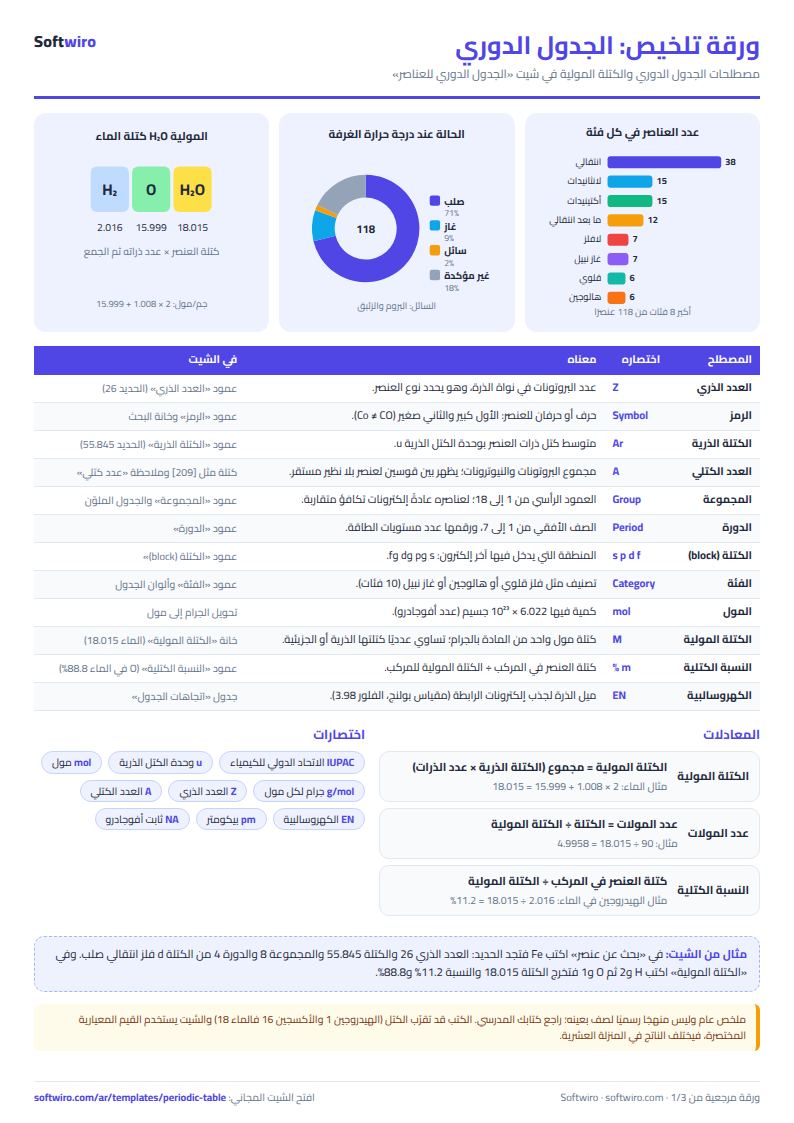
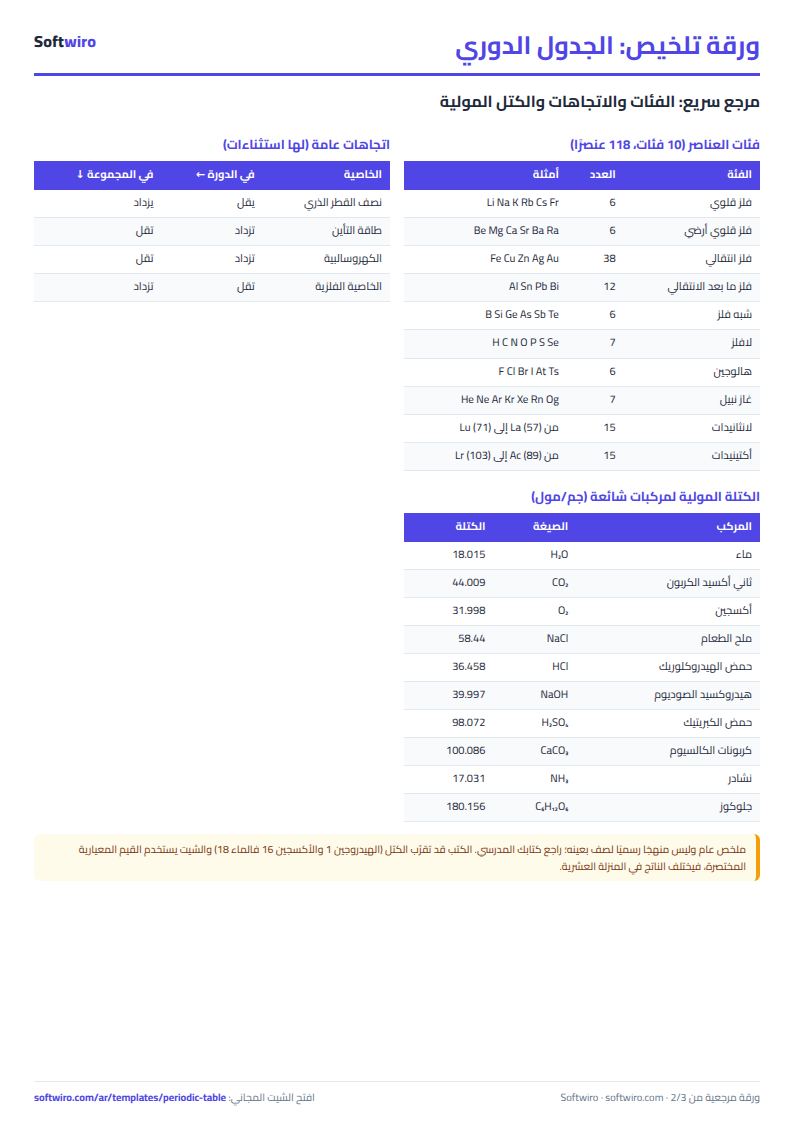
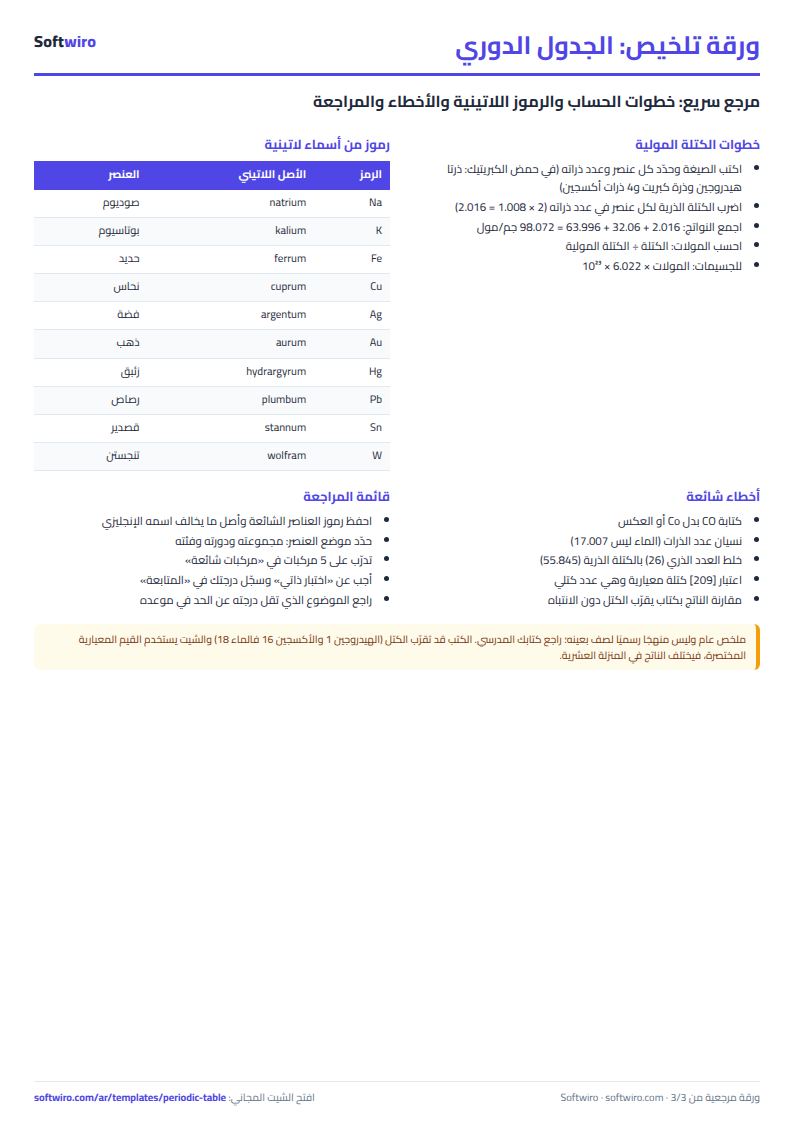
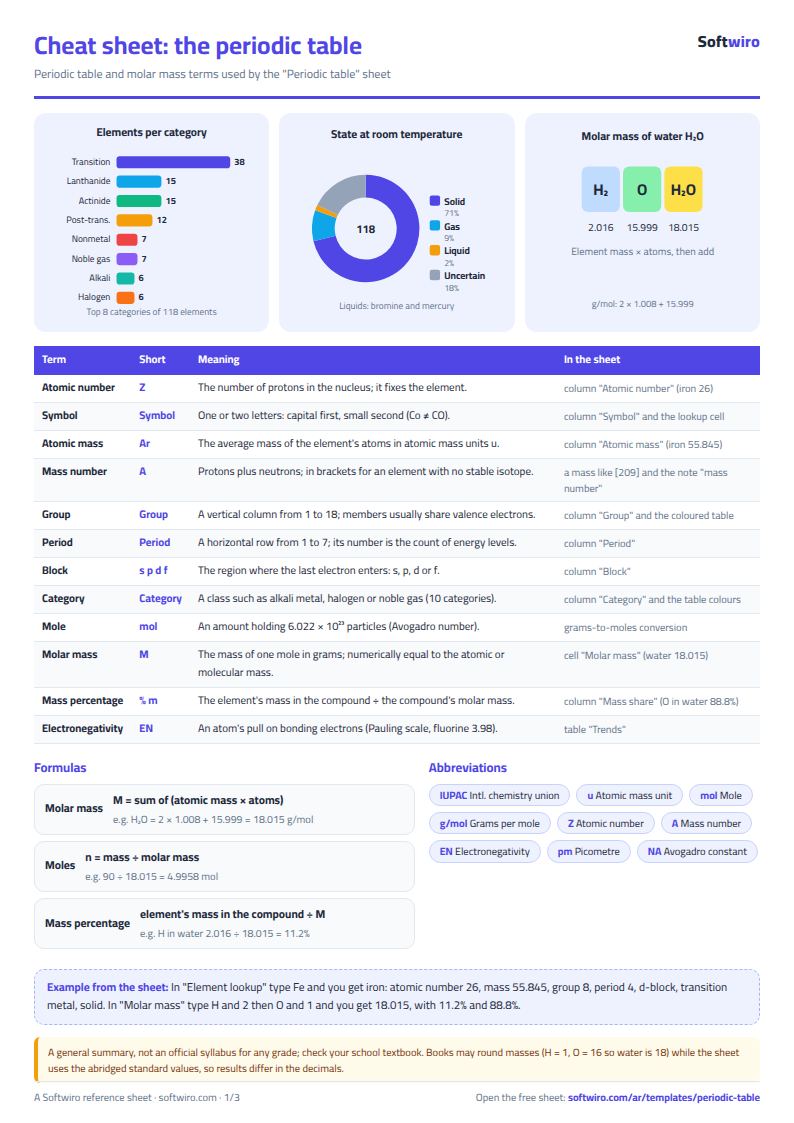
Terms, abbreviations, tables and diagrams over several pages, in Arabic and English. Download it as a PDF or images, including a phone-size version.
Still running this on Excel?
This sheet suits a start and a limited amount of data. If your way of working grows, or you need more than one person working on it at the same time, Softwiro can build you a program that fits the way you work.
| In this sheet | In Custom Software from Softwiro |
|---|---|
| One file that one person edits at a time, and copies reach you on WhatsApp. | A program with a login for each user and permissions you define, and everyone sees the same data. |
| You type everything and check the numbers by hand. | We design the screens around your work steps, so each person records only what concerns them. |
| Columns and formulas are fixed as the sheet was designed. | We build what you need: reports, alerts and screens your way. |
| Backups and security are your own responsibility. | The program runs on a secured server with regular backups. |
Frequently asked questions
Does this sheet match my grade's syllabus?
It is a general summary and not an official syllabus for any particular grade, so check your school textbook. The order or classification of some elements can differ between books, and your book may use rounded masses such as H = 1 and O = 16, which changes a molar mass answer in the second decimal place.
Why do some elements show their mass in brackets?
Because the element has no stable isotope, so it has no standard atomic mass. The mass number of one of its longest-lived isotopes is written in brackets instead, such as [209] for polonium. These numbers differ slightly between references. The sheet has 34 elements of this kind.
How do I calculate the molar mass of a compound?
In "الكتلة المولية" (Molar mass) type each element's symbol in one cell and its number of atoms in the next one (water: H and 2, then O and 1). The sheet multiplies each element's mass by its atom count and adds them up, giving 18.015 g/mol, and shows the percentage of each element.
How does the quiz mark my answers?
A numeric answer has a tolerance written in the sheet (0.05 for molar masses, for example). For text answers, letter case does not matter in English, so au is accepted for gold's symbol Au. Choose category, state and trend from the drop-down list so they match the key.
Is the template free?
Yes, with no sign-up and no email address. Use it, edit it and share it as you like.
Does it work in Google Sheets and on mobile?
The sheet uses formulas supported by Excel 2016 and later, Google Sheets and LibreOffice, so you can upload it to Google Drive and open it with Google Sheets on a computer or a phone.
What is the difference between the white and the gray cells?
You type in the white cells; the gray cells are calculated automatically. Don't type in a gray cell, or you will erase its formula.
Can I use the sheet from an AI assistant?
Yes. Add our MCP server (URL https://softwiro.com/api/mcp, no key needed) to your assistant and ask it to do the calculation in this template. The numbers come from the sheet's own formulas, and we do not store your data. The steps and a ready-made prompt are in this article: https://softwiro.com/blog/mcp-excel-templates-ai-agent-guide.html
All the templates in this group: Free study summaries: rules, formulas and self-tests
More free templates for: Study summaries
More free templates
- Science formulas cheat sheet: physics, chemistry and biology with examples
- Arabic grammar summary sheet: rules, i'rab and a self-test with examples
- English grammar rules sheet in Excel: tenses and structures with examples
- Algebra rules summary sheet: laws, identities and solving equations with examples
- Solid geometry formulas sheet: areas and volumes with examples and a calculator
- English vocabulary and expressions sheet in Excel: words by topic and spaced review
- Complete nursery management sheet
- Private school management sheet
- Complete clinic management sheet
- Medical lab management sheet
- Pharmacy management sheet: sales, purchases, shortages and suppliers
- Small hospital management sheet: departments, beds, admissions and revenue
- Metal and turning workshop job sheet in Excel: job orders, materials and labor
- Glass and aluminium workshop sheet in Excel: orders by square metre, cutting and waste