You sell clothes wholesale to retail traders across the governorates, and you want one place that tells you how many pieces of each model are in the warehouse, who owes how much and since when, what is still out on consignment, and which model earns the most. The free wholesale clothing trade sheet does this from simple logs you type: purchases, sales, returns, consignment and collections. You can also try it online from the template page.
The problem it solves
A wholesaler sells by the series (a fixed number of pieces in different sizes), sells on credit and hands over goods on consignment. The numbers scatter: an invoice in one book, a payment on a slip, consignment in a rep's memory. The result is a model sold beyond what is in stock, a trader over his limit without anyone noticing, and consignment sitting for a month without settlement. The fix is for every movement to be typed once in its own log and for the sheet to calculate the rest.
How it works, step by step
- In الإعدادات (Settings) write today's date, the days of consignment before a warning (30 in the example) and the first month of the summary.
- In الموديلات (Models) write the code, name, season, cost per piece, wholesale price, pieces per series and the minimum.
- In التجار (Traders) list each trader with a credit limit and any old balance.
- When goods arrive, write in المشتريات (Purchases) the factory, code, pieces and cost per piece.
- When you sell, write one line per model in المبيعات (Sales): trader, number of series, any loose pieces and an optional discount.
- Write what came back in المرتجعات (Returns), what you handed over on consignment in الأمانة (Consignment), and every payment in التحصيل (Collections).
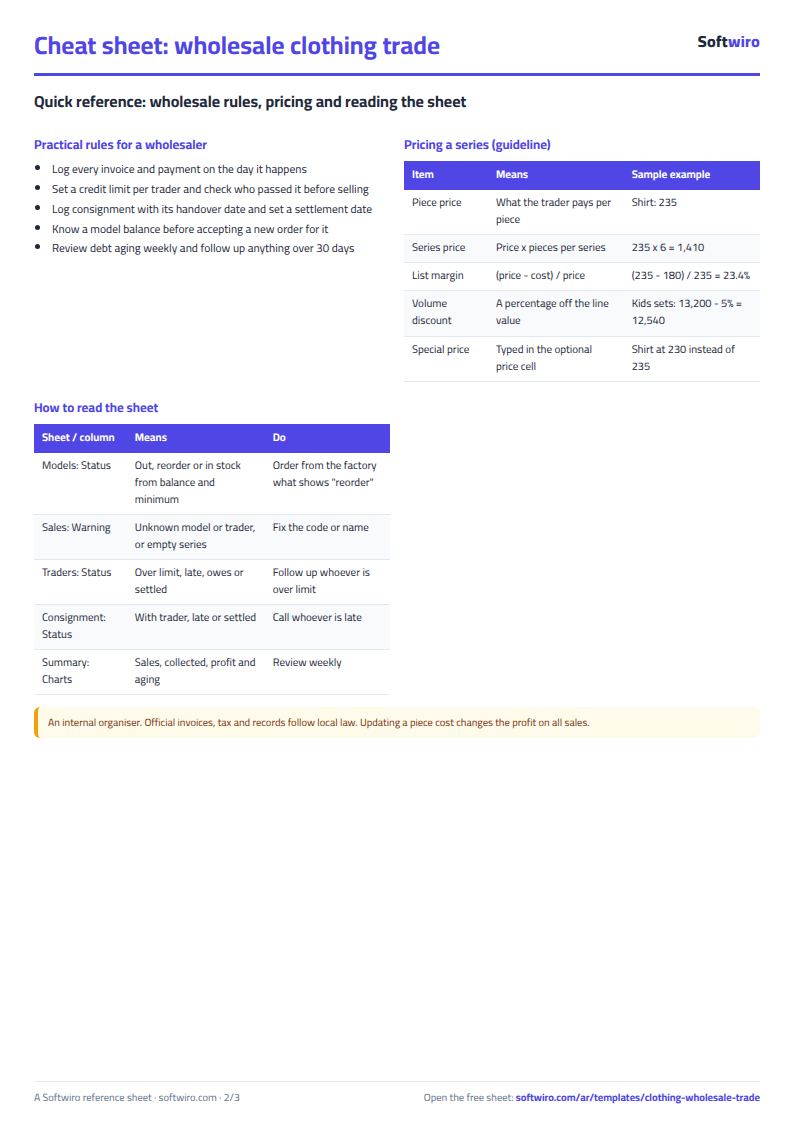
The rules: pieces = series x pieces per series + loose pieces, and line value = pieces x piece price x (1 - discount). Warehouse stock = purchases - invoiced sales + returns - consignment out + consignment returned. What a trader sold from consignment enters his account when you type the sold quantity and the settlement date.
What each sheet does
- Summary: the key figures, a six-month table and five charts.
- Models: stock in pieces and series and its value at cost, what is with traders, revenue, profit, margin and status (in stock, reorder or out). 200 models.
- Purchases, Sales and Returns: the three logs; a red warning cell flags an unknown model or trader. They hold 600, 1,200 and 300 rows.
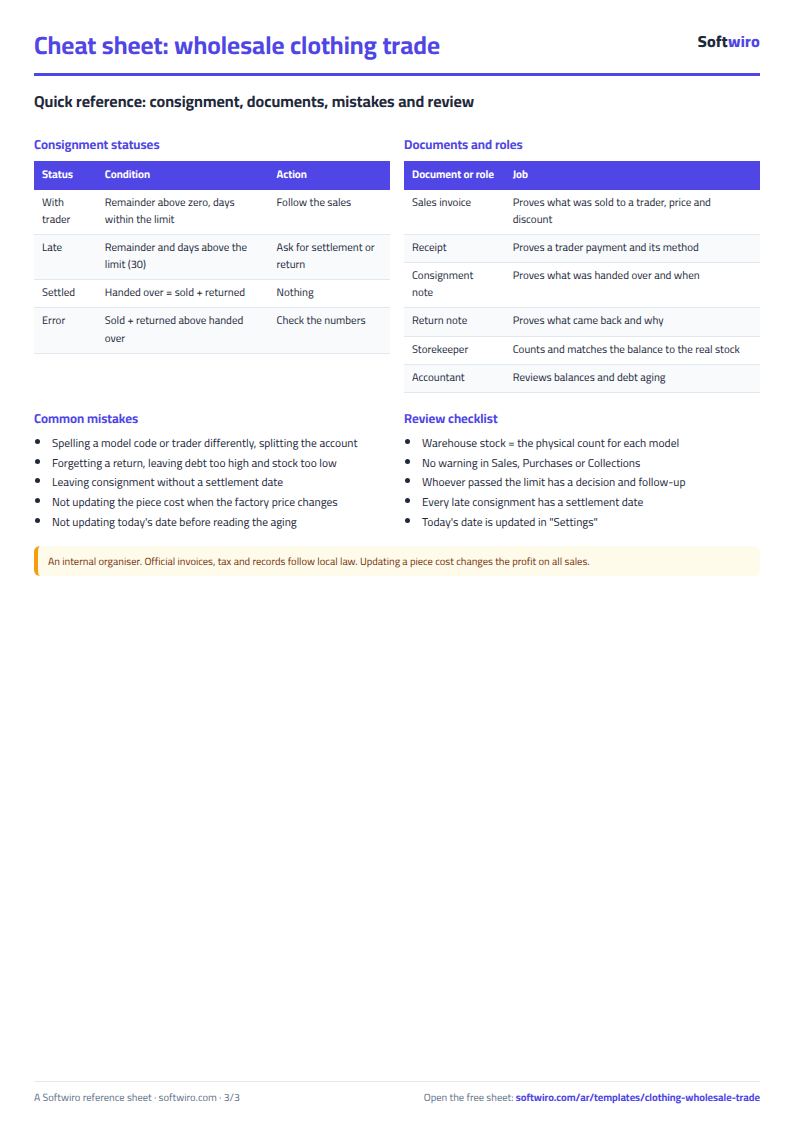
- Consignment: what is left with the trader, the days, and the status "with trader", "late" or "settled". 300 rows.
- Collections: payments with receipt number and method. 800 payments.
- Traders: balance due, profit, debt aging and the limit status. 200 traders.
How it differs from the clothing store inventory sheet
We also have the clothing store inventory sheet, built on a code per colour and size and selling by the piece to a shopper. This sheet is different: the unit of sale is the series, sales are on credit to traders who have accounts, and it has consignment, debt aging and credit limits. If you sell to the public use the first; if you sell to retailers this is the better fit. If all you need is a general debt book, look at the customer ledger sheet.
A walk-through with the sample numbers
These are fictional sample data in the sheet, not a real business: 8 models and 6 traders, and today is 15 November 2026.
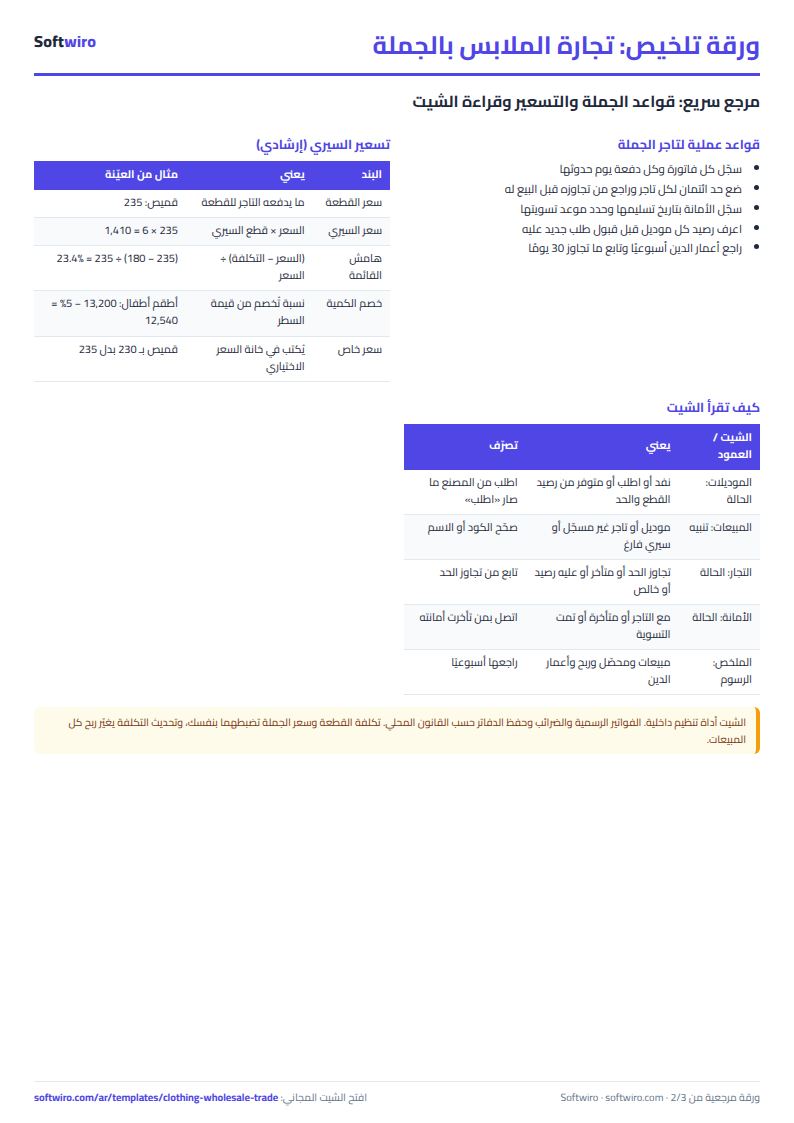
- Selling by the series: invoice F-1001 sold 10 series of the classic shirt, 6 pieces each, so 60 pieces at 235 make 14,100. Invoice F-1003 sold 4 series of the abaya (5 pieces per series) plus 2 loose pieces, which is 22 pieces for 9,900.
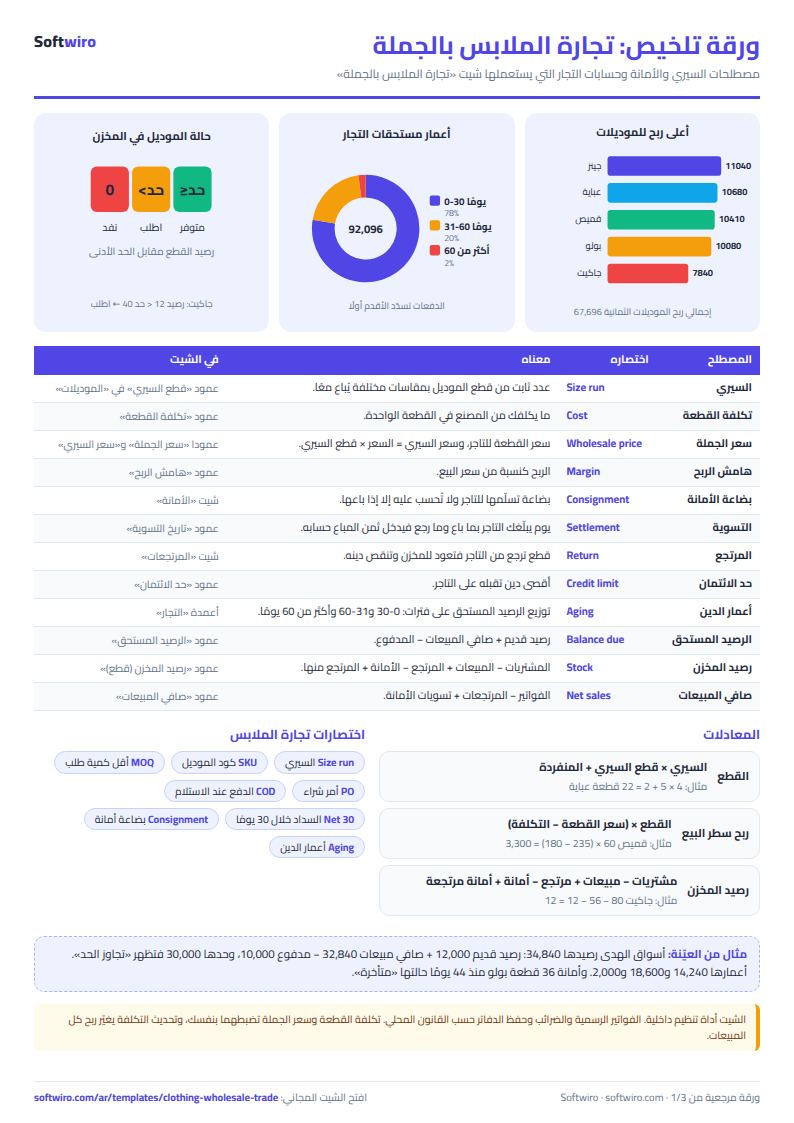
- Totals: purchases 405,410, invoiced sales 258,106, returns 6,930 (about 2.7%) and consignment settlements 13,920, so net sales are 265,096. Cost is 197,400 and profit 67,696, a margin of about 25.5%.
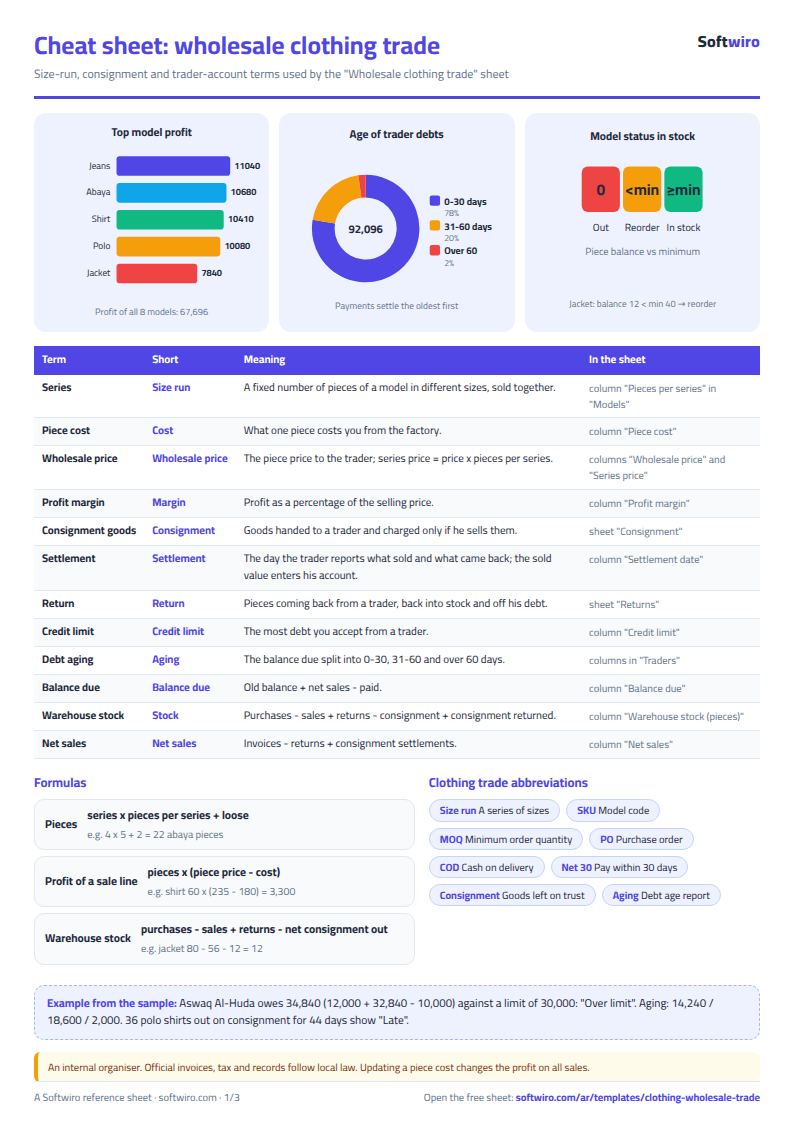
- Most profitable models: jeans 11,040, then the abaya 10,680, then the shirt 10,410.
- Warehouse: 1,113 pieces worth 191,370 at cost. The dress is out (75 bought, 75 sold), while the jacket, the pullover and the abaya are below their minimum, so they show "reorder".
- Consignment: 60 polo shirts went to a trader in Sohag on 2 October; 24 were sold and 36 remain after 44 days, so it shows "late" because it passed 30 days. In total 94 pieces are with traders.
- Collections: 185,000 collected and 92,096 owed by traders, of which 20,600 is older than 30 days and 2,000 older than 60.
- A trader over the limit: Aswaq Al-Huda owes 34,840 (12,000 old + net sales 32,840 - paid 10,000) against a limit of 30,000, so it shows "over limit". Of that, 14,240 is from the last 30 days, 18,600 is 31 to 60 days old and 2,000 is older.
Common mistakes
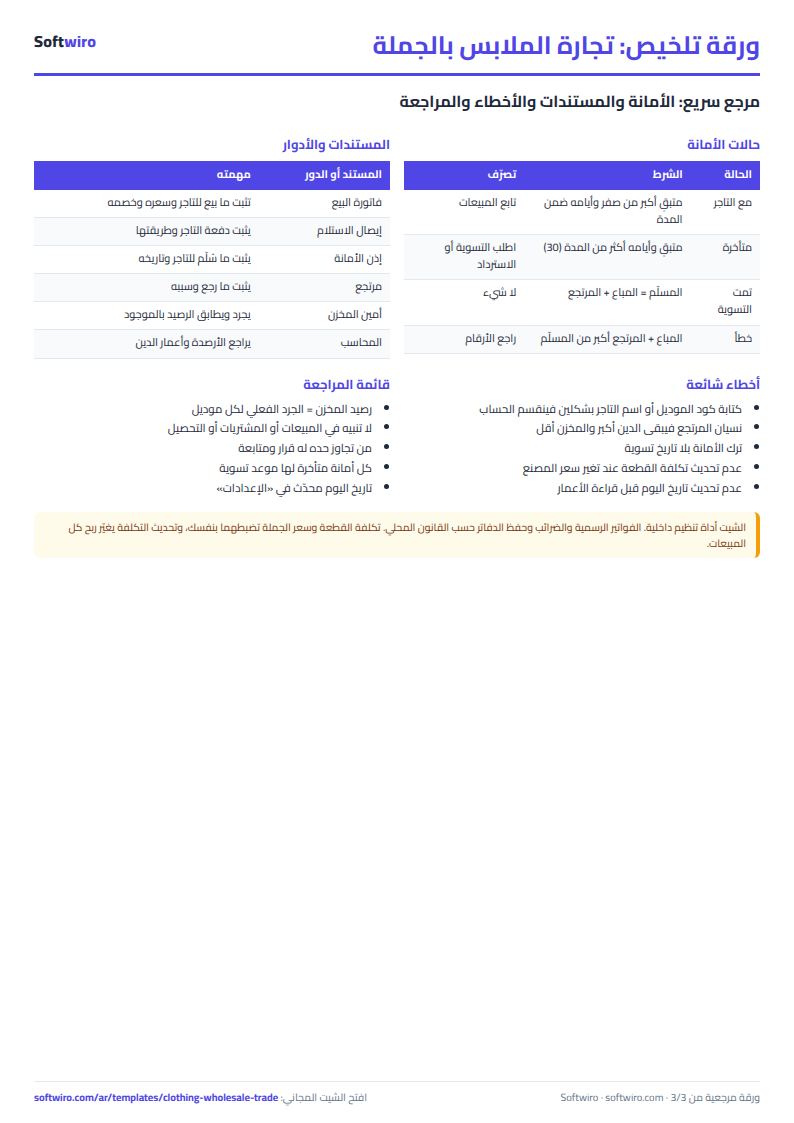
- Typing a model code or trader name two different ways, which splits the account. Use the drop-down lists.
- Forgetting to log a return, so the trader's debt stays too high and the stock too low.
- Leaving consignment without a settlement date, so it does not enter the aging.
- Not updating the piece cost when the factory price changes, so profit is calculated on the old cost.
- Not updating today's date, so ages and consignment days look newer than they are.
Anything about official invoices and taxes follows local law.
When to move to a system
The sheet is enough for a wholesaler with one warehouse and a few hundred invoices a month. When the number of traders and staff grows, or you need invoices sent on WhatsApp and permissions that hide cost from a sales clerk, look at Accountwiro, or ask for software built your way.
Your next step
Open the template, download the blank copy, type your models, traders and their old balances, then log your latest invoice and payment and open "التجار" to see who passed their limit this week.