You want to study the periodic table without flipping through textbook pages, to get the molar mass of any compound in seconds, and to test yourself before the exam. The free periodic table sheet puts it all in one file: all 118 elements with Arabic and English names, a colour-coded table, lookup by symbol, a molar mass calculator and a 38-question quiz. It is a general summary, not an official syllabus for any particular grade; check your school textbook.
The problem it solves
The textbook table is one crowded page, while the exam asks for scattered things: an element's symbol, its atomic number, its group and period, its category, its state, then a molar mass inside a problem. You jump between the table, a list of masses and a calculator, and you slip on a symbol or a sum. The sheet keeps this data in one place: you read it, search it, calculate with it and test yourself on it.
How the sheet works, step by step
- Open الجدول الدوري (Periodic table) to see the elements by group (1 to 18) and period (1 to 7), coloured by category. The lanthanides and actinides sit in two rows below the table.
- In بحث عن عنصر (Element lookup) type a symbol, atomic number or name; the element card appears and its place is highlighted in the table.
- In الكتلة المولية (Molar mass) type each element's symbol and its number of atoms; the molar mass and each element's share come out.
- Read اتجاهات الجدول (Trends) to see how atomic radius and electronegativity change across a period and down a group.
- Answer اختبار ذاتي (Self-test); a tick or a cross appears and the score shows at the top.
- Log what you reviewed and your score in المتابعة (Progress), and the sheet proposes the next review date.
What is in each sheet
- Periodic table: the table in ten category colours, with the chosen element highlighted.
- Element lookup: a full card, searched by symbol, number or name.
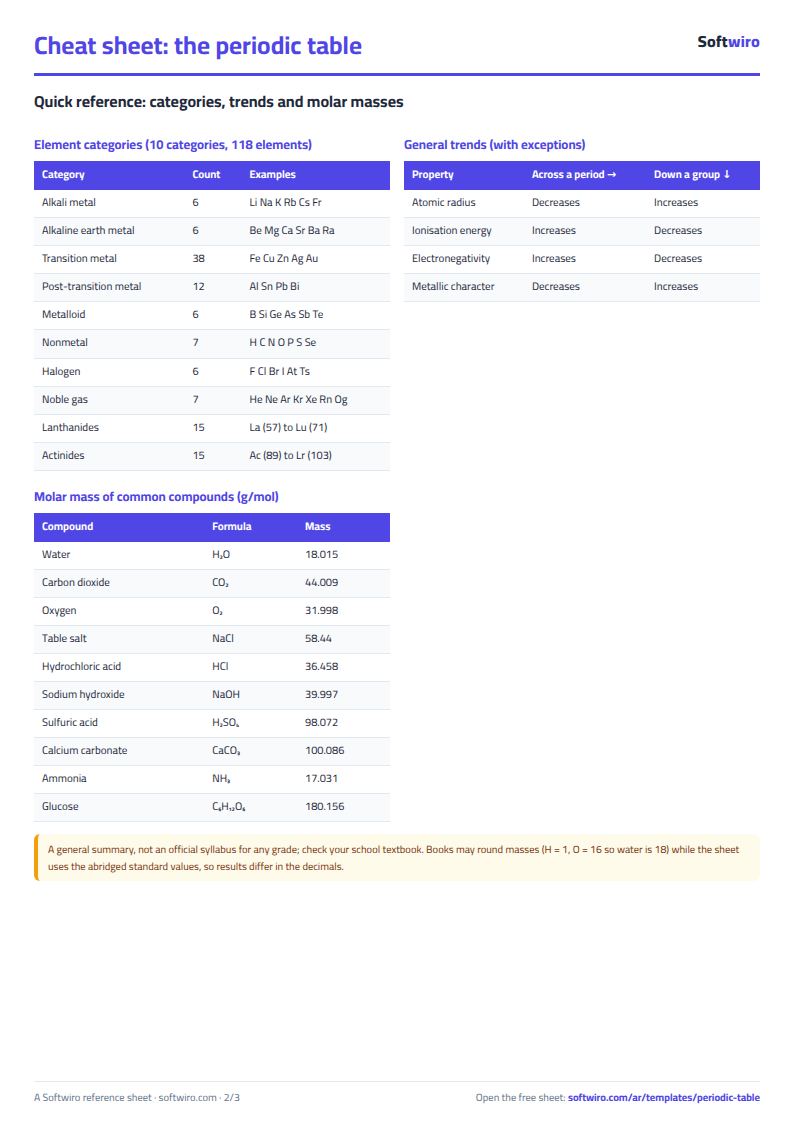
- Elements: 118 rows with atomic number, symbol, both names, atomic mass, group, period, block (s, p, d, f), category and state.
- Molar mass: six symbol-and-count pairs, mass percentages, and a gram-to-mole conversion.
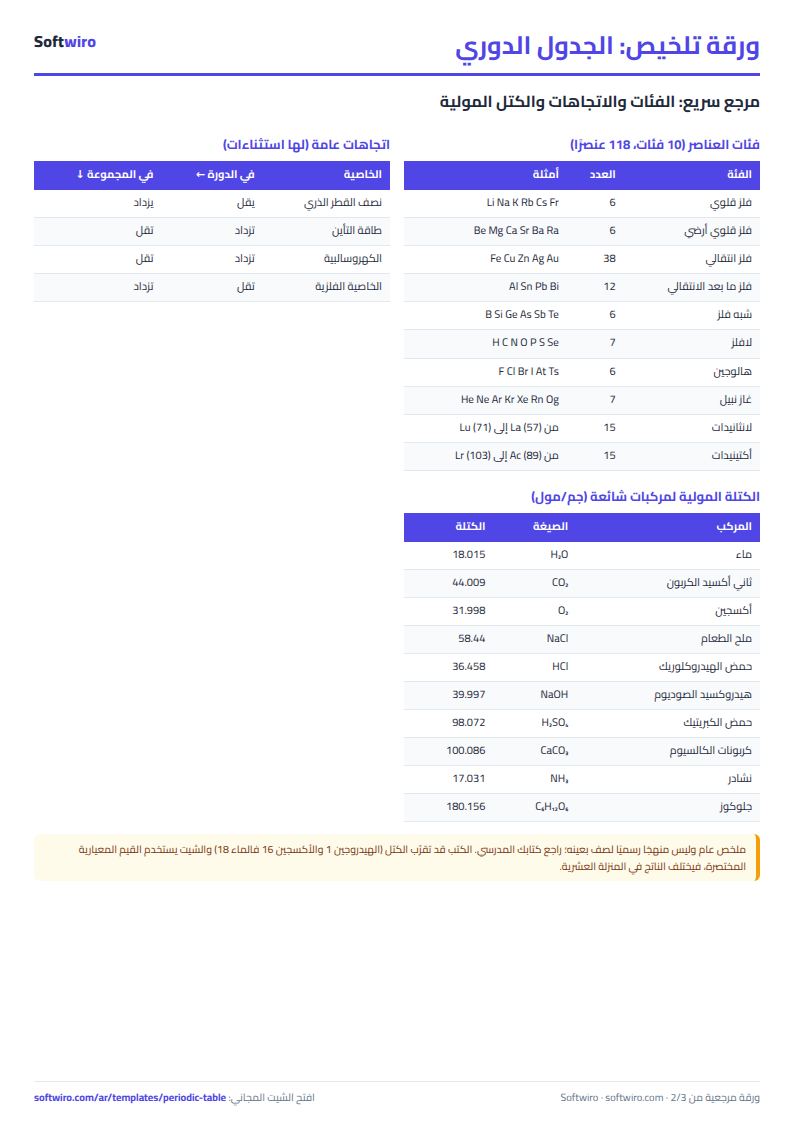
- Common compounds: 17 compounds with their molar masses; the list holds 30.
- Trends: the trends table, data for periods 2 and 3, and two charts.
- Self-test: 38 questions with a hidden answer key.
- Progress and Summary: review dates, counts of categories and states, and your result per topic.
Walk-through on the sample numbers (sample data)
These numbers come from the sample copy inside the sheet, what you see before typing anything.
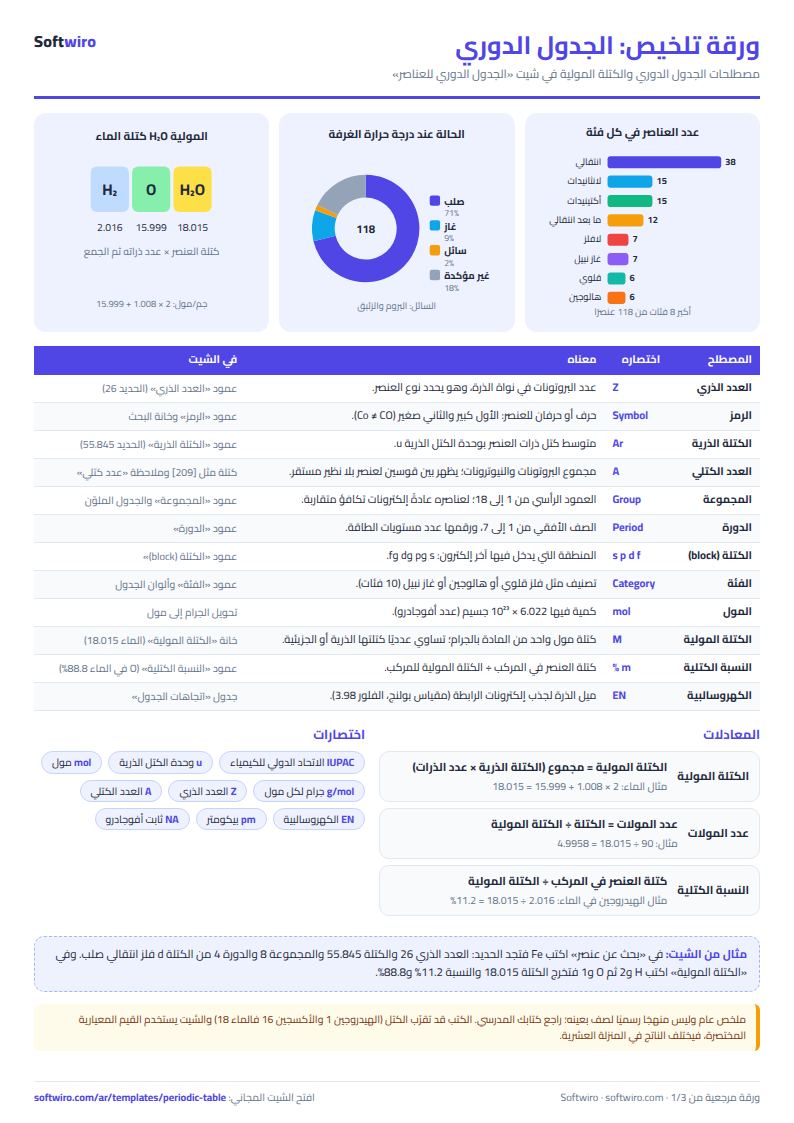
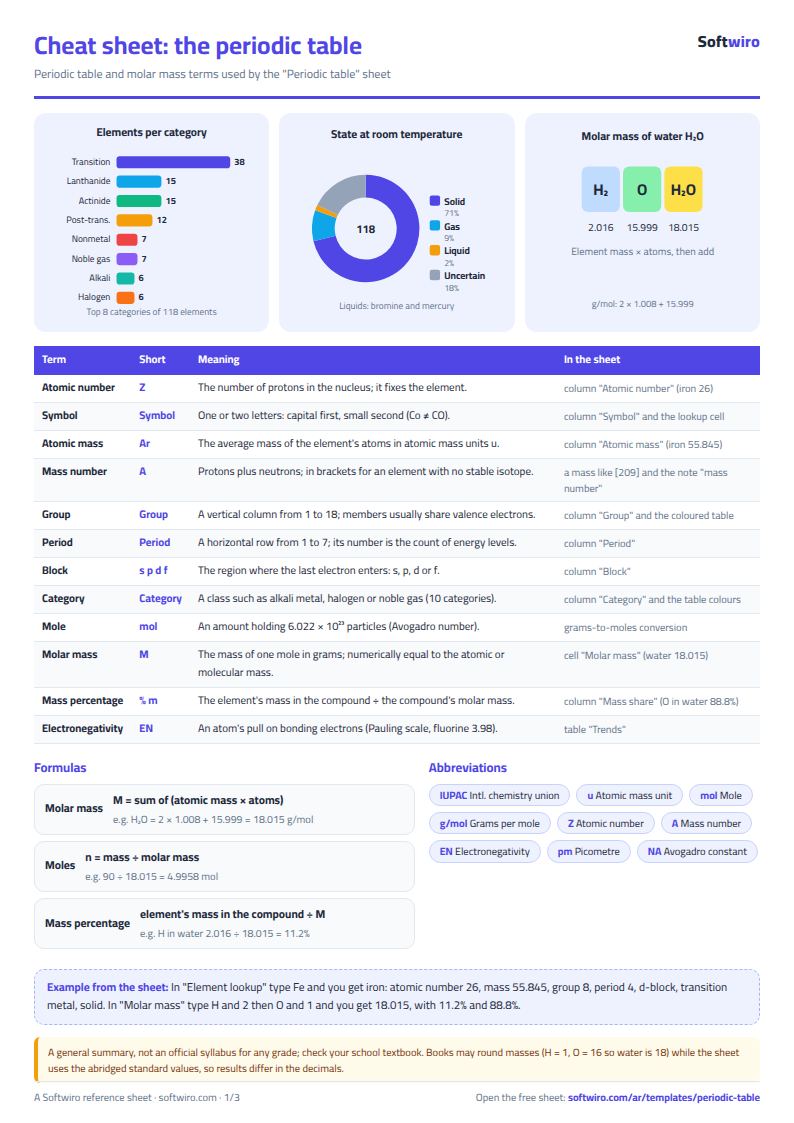
- Looking up Fe: iron, atomic number 26, atomic mass 55.845, group 8, period 4, d-block, transition metal, solid at room temperature.
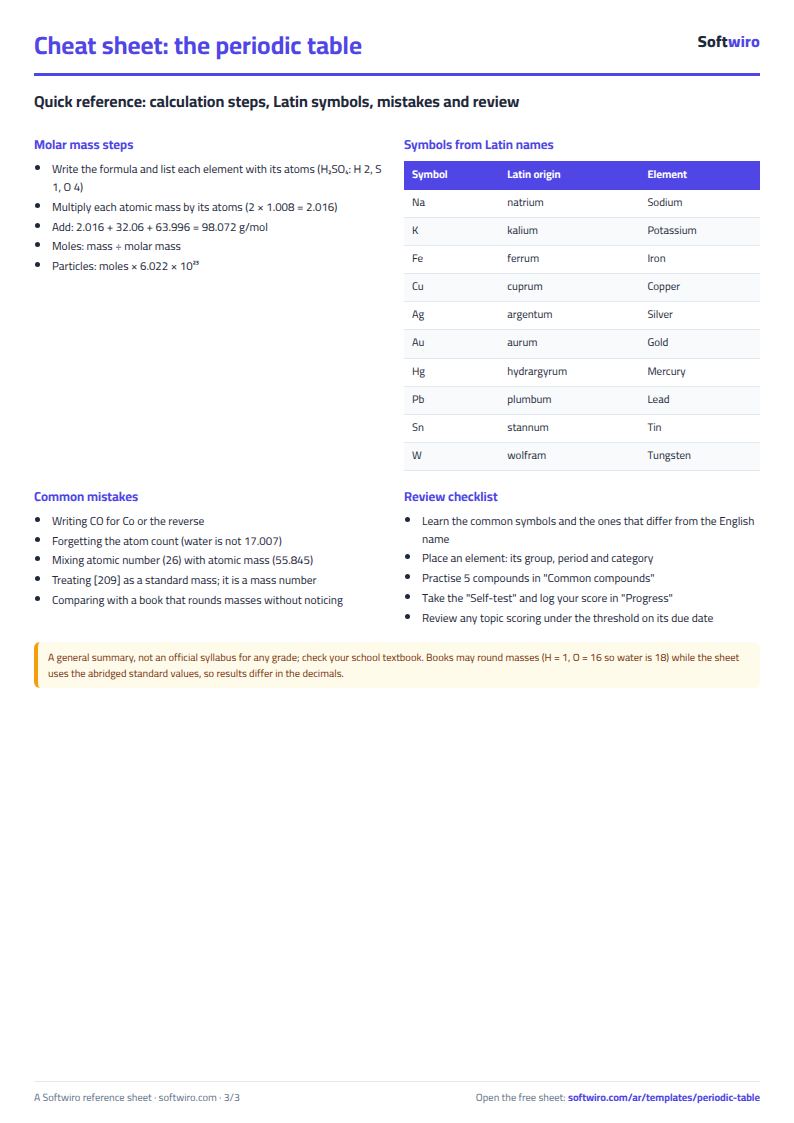
- Molar mass of water H₂O: 2 × 1.008 = 2.016 for hydrogen and 1 × 15.999 = 15.999 for oxygen, so the total is 18.015 g/mol. Hydrogen is 11.2% and oxygen 88.8%.
- Grams to moles: 90 g of water is 90 ÷ 18.015 = 4.9958 mol. Half a mole weighs 9.0075 g.
- Compounds in the list: calcium carbonate CaCO₃ is 100.086, glucose C₆H₁₂O₆ is 180.156, sodium chloride is 58.44.
- Trends: in period 2 electronegativity rises from 0.98 for lithium to 3.98 for fluorine, an increase of 3.00. Radius in group 1 goes from 145 pm for lithium to 260 pm for caesium.
- The table in numbers: 118 elements, 84 with a standard atomic mass and 34 with no stable isotope (mass in brackets). By state: 11 gases, 2 liquids, 84 solids and 21 of uncertain state.
- The sample quiz: 34 of 38 questions answered, 28 correct, a score of 73.7%. In Progress, three topics are due for review on 2026-11-15, with an average score of 66.7%.
Common mistakes
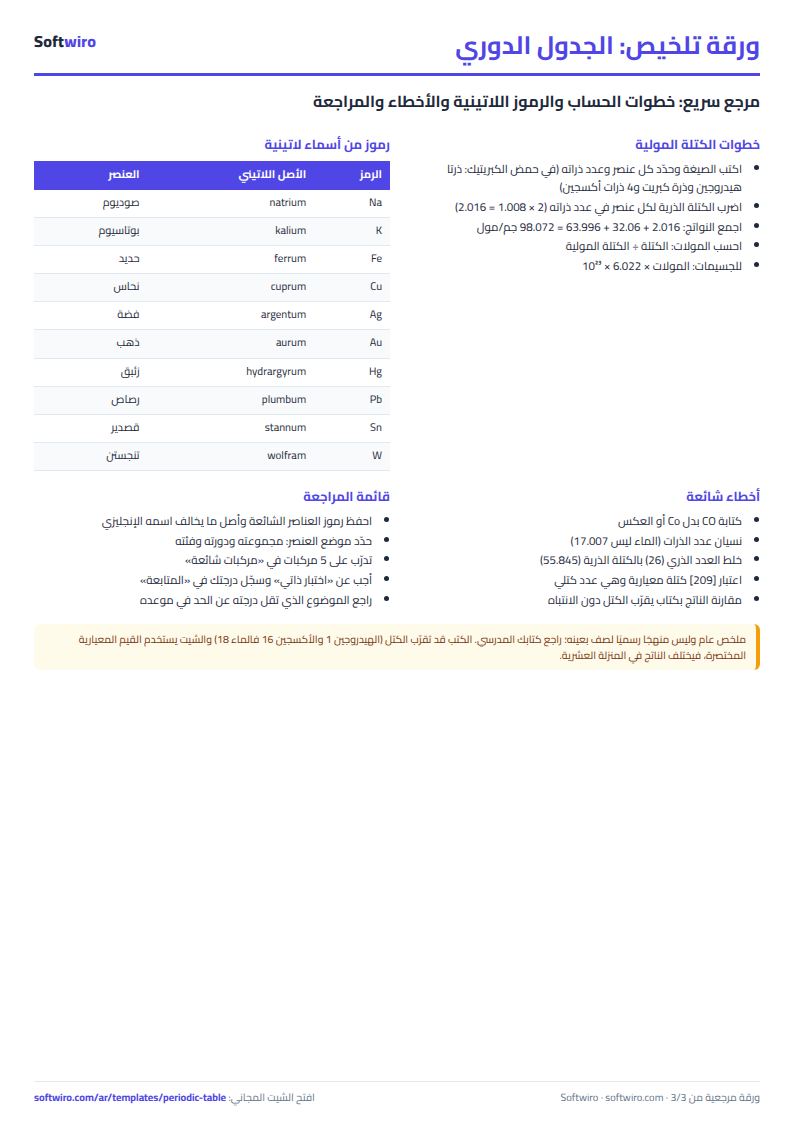
- Mixing up symbols: Co is cobalt and CO is carbon monoxide. Capital first letter, small second.
- Forgetting the atom count: water is 18.015, not 17.007 (hydrogen counted once); multiply each mass by its number of atoms.
- Confusing atomic mass with atomic number: the first is a mass in u (iron 55.845), the second is the number of protons (iron 26).
- Treating a bracketed mass as a standard one: [209] for polonium is a mass number of one isotope; use it knowingly if you must.
- Comparing with a book that rounds masses: if your book takes O = 16 and H = 1, water is 18 there and 18.015 here. The difference is rounding, not method.
When to move from the sheet to a system
The sheet is enough for a student or teacher who studies and reviews alone. If you want to follow dozens of students across classes, with a large question bank and a board showing the class's weak topics, you need a program with a login for each user, and Softwiro can build one your way. To organise your study time further, see the study planner and the science rules summary.
Next step
Download the sheet, open «بحث عن عنصر» and type the symbols of three elements you do not know by heart, then compute the molar mass of a compound from your current lesson in «الكتلة المولية», take the quiz once and log your score in «المتابعة». That gives you your first written review date.
FAQ
Does this sheet match my grade's syllabus? It is a general summary, not an official syllabus for any particular grade; check your school textbook, since the order or classification of some elements can differ between books.
Why are some masses in brackets? The element has no stable isotope, so a mass number of one of its longest-lived isotopes is written instead of a standard atomic mass.
How does the quiz mark answers? Numbers have a small tolerance, and for text the case of English letters does not matter.