You want to review the science laws before the exam in one place: the formula, what each symbol means, its unit, a solved example, then try numbers yourself and test what you know. The free science rules summary sheet does that for physics, chemistry and biology at prep and early-secondary level. It is a general summary, not an official syllabus for any particular grade; check your school textbook.
The problem it solves
A student memorises the law and then slips on substitution or on the unit: mass in grams and volume in cubic metres, or forgetting that kinetic energy has a half and a squared speed, or mixing up resistance and voltage. The laws are scattered across a notebook, a textbook and photos from the teacher. The sheet gathers them in tidy tables and gives each rule what it needs to be applied correctly.
How the sheet works, step by step
- Read قوانين الفيزياء (Physics laws): each law has its formula, symbols with SI units, a solved example and a note.
- Review أساسيات الكيمياء (Chemistry basics): states of matter, the atom, the valency table, common formulas, balancing and acids with pH.
- Review أساسيات الأحياء (Biology basics): cell parts, body systems, photosynthesis and respiration.
- In بحث عن قاعدة (Rule lookup) choose a law, an ion or a system and its details appear.
- Try حاسبات (Calculators): type your numbers in the white cells and the result and its unit appear.
- Take the 32-question اختبار ذاتي (Self-test) and log your score in المتابعة (Progress), and the sheet sets your next review date.
What is in each sheet
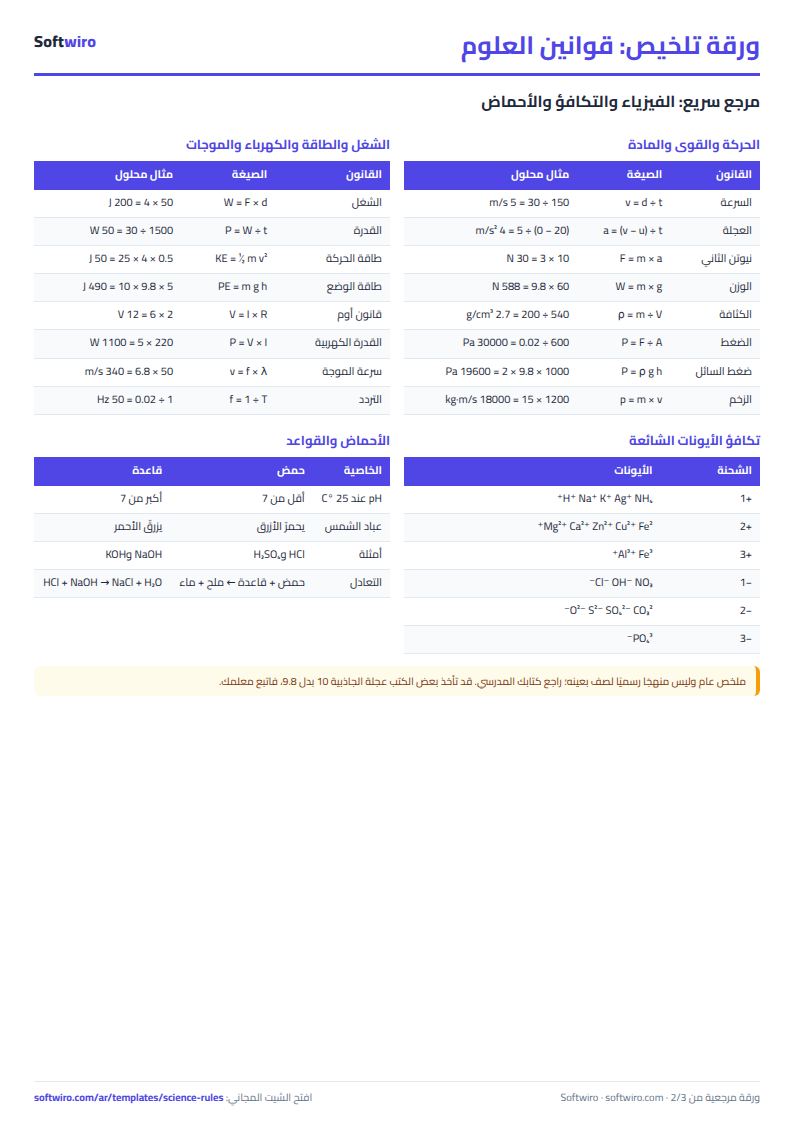
- Physics laws: 18 rules, from average speed and Newton's laws to Ohm's law and wave speed.
- Chemistry basics: 3 states of matter, a valency table of 20 ions, 12 common substances, 8 balanced equations and a pH scale with approximate examples.
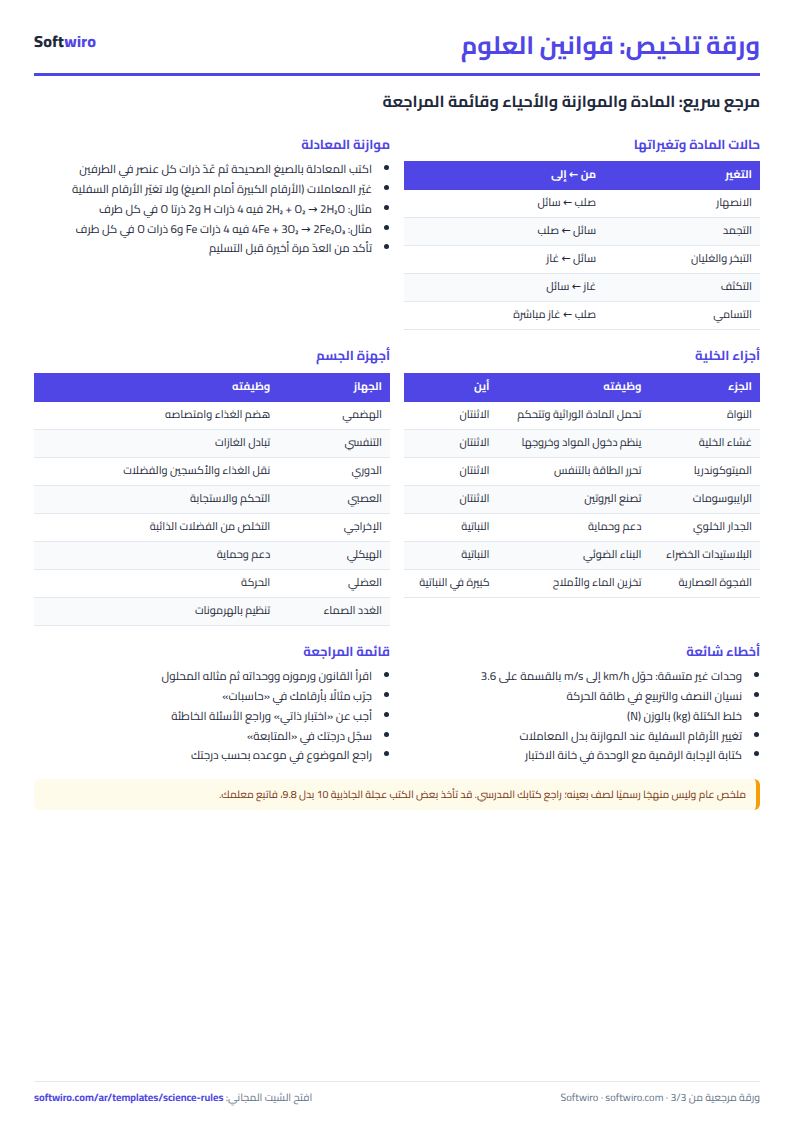
- Biology basics: 8 cell parts, 8 body systems and the equations of photosynthesis and respiration.
- Rule lookup: three drop-downs for a law, an ion and a system.
- Calculators: 22 calculators, each with a ready example.
- Self-test, Progress and Summary: questions with a hidden key, review dates and your result per branch.
Walk-through on the sample numbers (sample data)
These numbers come from the sample copy inside the sheet, what you see before typing anything.
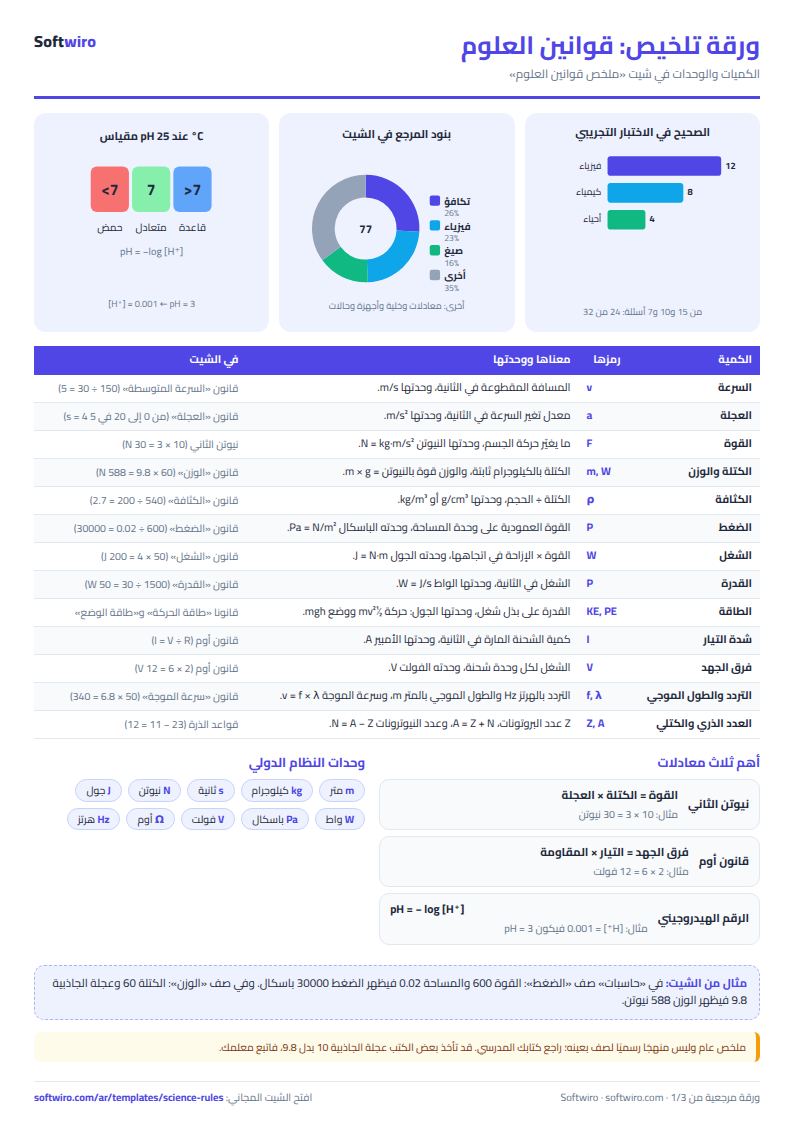
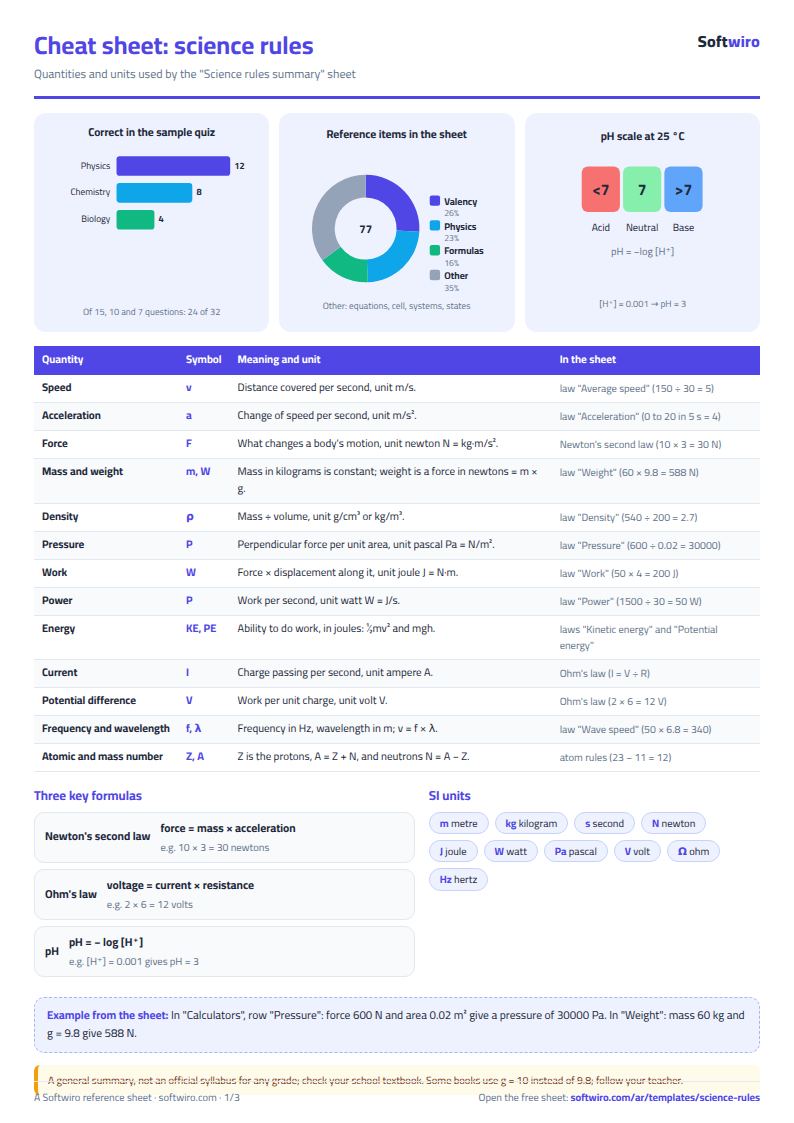
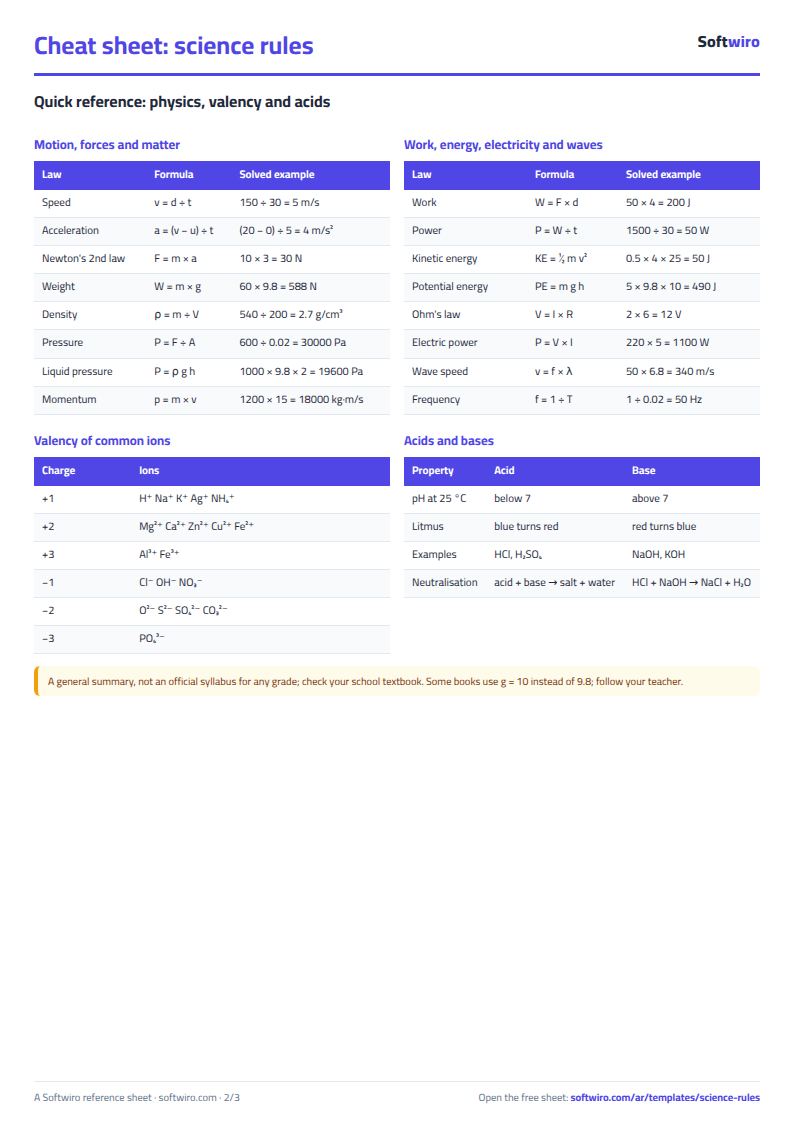
- Speed: a car covering 150 m in 30 s goes 5 m/s. A speed of 72 km/h is 20 m/s.
- Force and weight: a 10 kg mass accelerating at 3 m/s² needs 30 N. A 60 kg mass weighs 60 × 9.8 = 588 N.
- Density and pressure: 540 g in 200 cm³ has a density of 2.7 g/cm³. A force of 600 N on 0.02 m² gives a pressure of 30000 Pa.
- Work, power and energy: 50 N × 4 m = 200 J. Work of 1500 J in 30 s is 50 W. A 4 kg mass at 5 m/s has 50 J of kinetic energy.
- Electricity and waves: a current of 2 A through 6 Ω gives 12 V, and a device at 220 V × 5 A draws 1100 W. A 50 Hz wave of 6.8 m wavelength travels at 340 m/s.
- Chemistry: [H⁺] = 0.001 gives pH = 3. 36 g of a substance with molar mass 18 g/mol is 2 mol. An atom with mass number 23 and atomic number 11 has 12 neutrons.
- The sample quiz: 29 of 32 questions answered, 24 correct, a score of 75%. Physics has 12 correct of 15, chemistry 8 of 10 and biology 4 of 7.
- Progress: four topics are due for review on 2026-11-15, and the average progress score is 71.1%.
Common mistakes
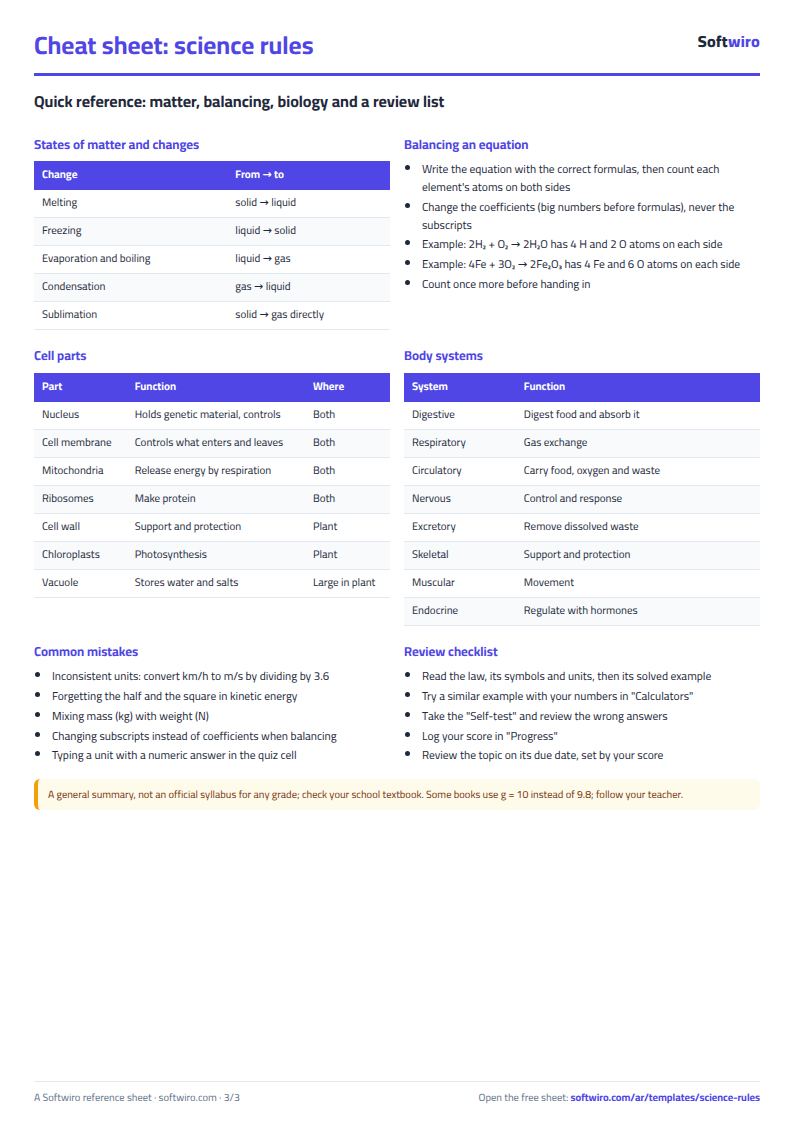
- Inconsistent units: convert km/h to m/s by dividing by 3.6 before substituting, and make sure mass is in kilograms when force is in newtons.
- Forgetting the half and the square: KE = ½ × m × v². Doubling the speed multiplies the energy by 4, not 2.
- Mixing mass and weight: mass is in kilograms and constant, weight is in newtons and equals mass × g.
- Balancing by changing the formula: in H₂ + O₂ → H₂O change the coefficients (2H₂ + O₂ → 2H₂O), not the subscripts inside a formula.
- Writing a formula without balancing charges: Al³⁺ with O²⁻ gives Al₂O₃ by the criss-cross method, not AlO.
When to move from the sheet to a system
The sheet is enough for a student reviewing alone or a teacher preparing a summary for a class. If you want to follow dozens of students across classes, with a large question bank, step-by-step solutions and a board showing the class's weak laws, you need a program with a login for each user, and Softwiro can build one your way. For chemistry in depth try the periodic table sheet, and to organise your time see the study planner.
Next step
Download the sheet, pick one law you have not mastered, read its example in «قوانين الفيزياء», then solve a similar one in «حاسبات» with your own numbers, take the quiz and log your score in «المتابعة». That gives you your first written review date.
FAQ
Does the sheet match my grade's syllabus? It is a general summary, not an official syllabus for any particular grade; check your school textbook, since wording or the value of g (9.8 or 10) can differ.
How do I write my answer in the quiz? Numbers without a unit, chemical formulas with ordinary digits such as H2O, and choices from the list.
Are the pH values for everyday examples exact? They are approximate and vary with concentration; the calculation from [H⁺] is exact.