You run a stationery shop with external school books and a photocopy counter, and before and after the school season you want three answers: what will run out, how much you really earn from copying and printing, and what is still owed on each school list in deposit and balance. The free stationery shop and photocopy management sheet (the page is in Arabic) answers from things you type: your items and prices, deliveries and sales, the photocopy log and the school lists.
The problem: three income streams in one notebook
The shop sells items by the piece, sells photocopied pages by the pound and a half, and prepares whole lists for schools with a deposit and a later hand-over. They all crowd into September. A parent asks for a list and the seller promises external books that have not arrived; copying is priced in the head so nobody knows its profit; a ready list sits on a shelf with a balance nobody collected. The sheet puts the three streams in one file and reserves a list's items from the stock before hand-over.
How it works, step by step
- In الإعدادات (Settings) type today's date and any date inside the month to summarise, and review the categories and the list of suppliers and publishers.
- In الأصناف (Items) write each item's code, name, category, unit, buying price, selling price, minimum level, opening balance and supplier.
- In الخدمات (Services) write the copy and print prices, the cost of a page and each service's type (black-and-white or colour).
- In المشتريات (Purchases) log deliveries, in المبيعات (Sales) log sales as a daily total per item, and in سجل التصوير (Photocopy log) the service, the pages and the copies.
- For each school list write a row in قوائم المدارس (School lists) and its items in بنود القوائم (List lines) under the same number. On hand-over change the status to «تم التسليم» (delivered) and log what was paid.
- Open إعادة الطلب (Reorder) to see what to buy, and الموسم (Season) and الملخص (Summary) to compare months and income streams.
What each sheet does
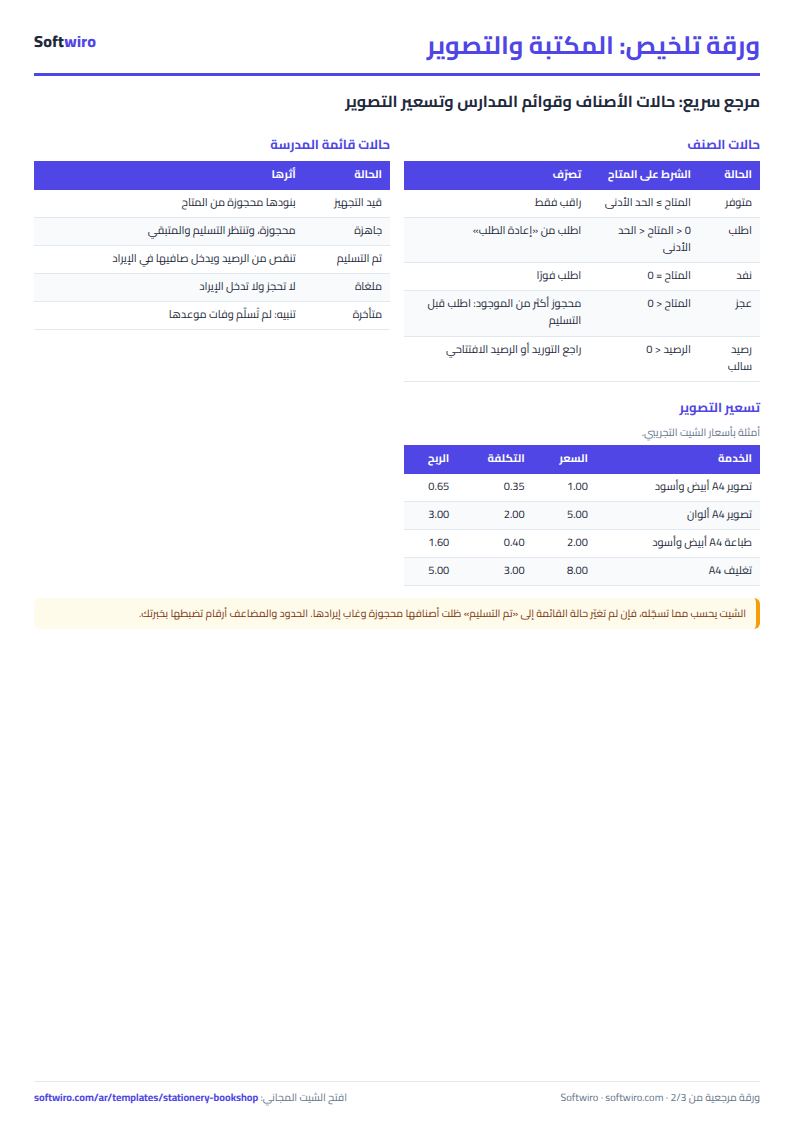
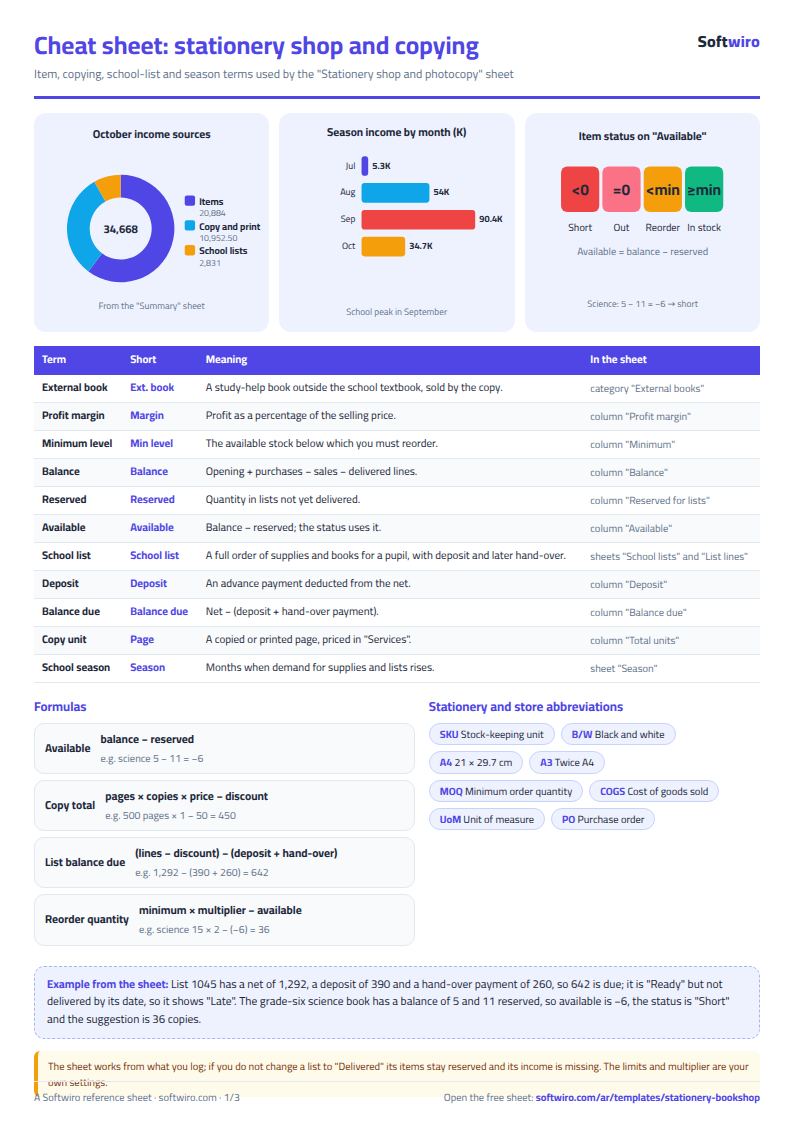
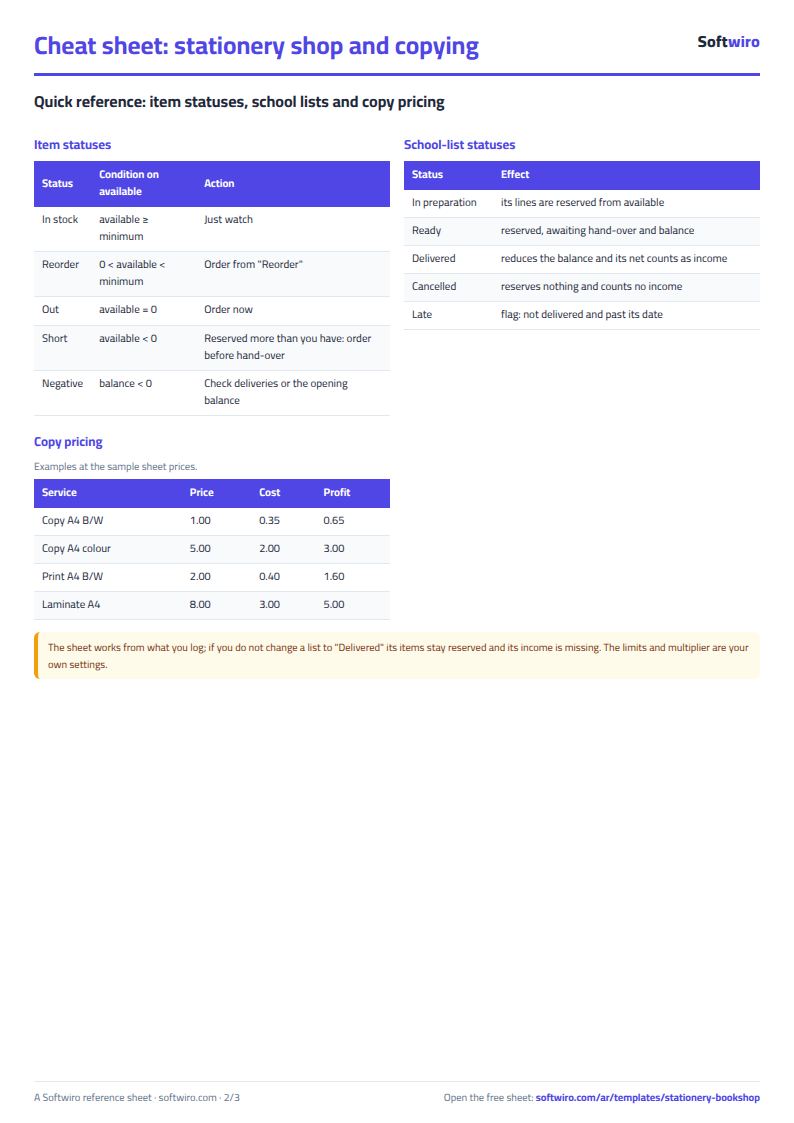
- Items: balance = opening + purchases − sales − delivered list lines. Available = balance − reserved for undelivered lists, and the status is worked out on the available figure.
- Services and photocopy log: a service total = pages × copies × page price − discount, and its profit = total − pages × page cost.
- School lists and their lines: net = sum of lines − discount, balance due = net − (deposit + hand-over payment), with a «late» flag.
- Reorder: short items ranked by suggested quantity and its cost.
- Season and summary: income for each month of the year by stream, the chosen month's figures, and profit by category.
A walk-through with the sample numbers
These numbers are sample data inside the sheet, not a real shop: 16 items, 7 services and 48 school lists, today is 2 November 2026 and the month is October 2026.
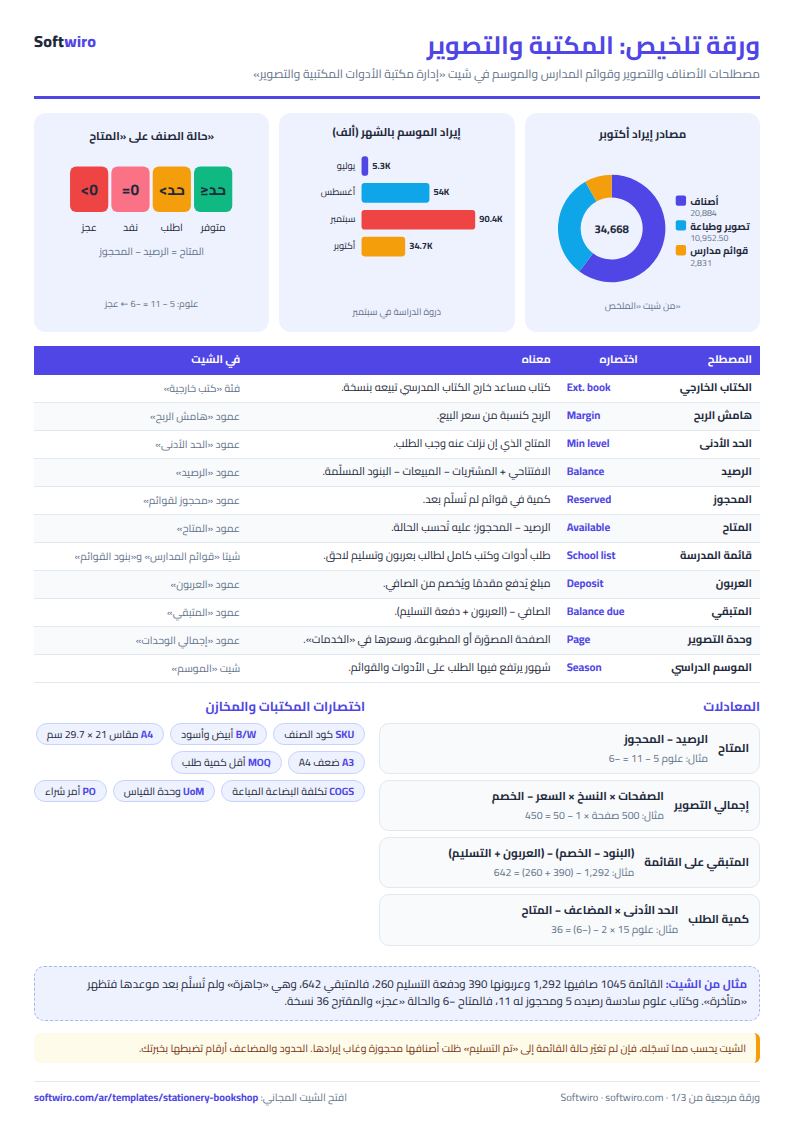
- October item sales: 20,884 with a profit of 5,534.50, or 26.5%.
- External books: direct sales in October were 9,725 with a profit of 2,400, or 24.7%, with more going out through the lists. That is why the sheet reserves a list's books from stock, so you do not promise them to a second parent when you do not have them.
- Copying and printing: income 10,952.50 and profit 7,137.15. Black-and-white pages were 4,573 and colour pages 626, yet colour brought about 30.6% of service income because a colour page costs more.
- School lists: 9 lists dated October, with 2,831 income from the delivered ones. Four lists are not yet delivered, one of them «late» past its date, and the balance still due on all lists is 2,665.
- Stock: worth 28,184.50 at cost. Three items are «اطلب» (reorder) and two are «عجز» (shortfall): the grade-six science book has a balance of 5 but 11 reserved, so 6 are missing and the suggestion is 15 × 2 + 6 = 36 copies costing 2,160. Ordering all shortages costs 6,615.
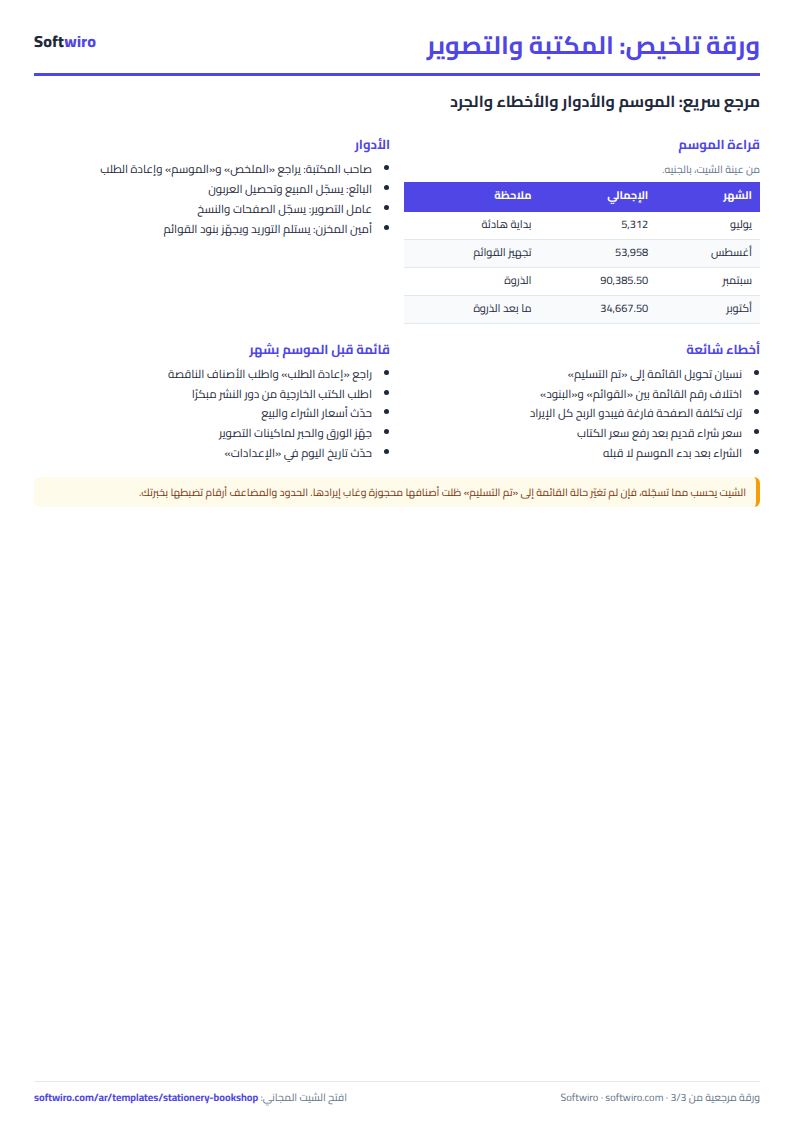
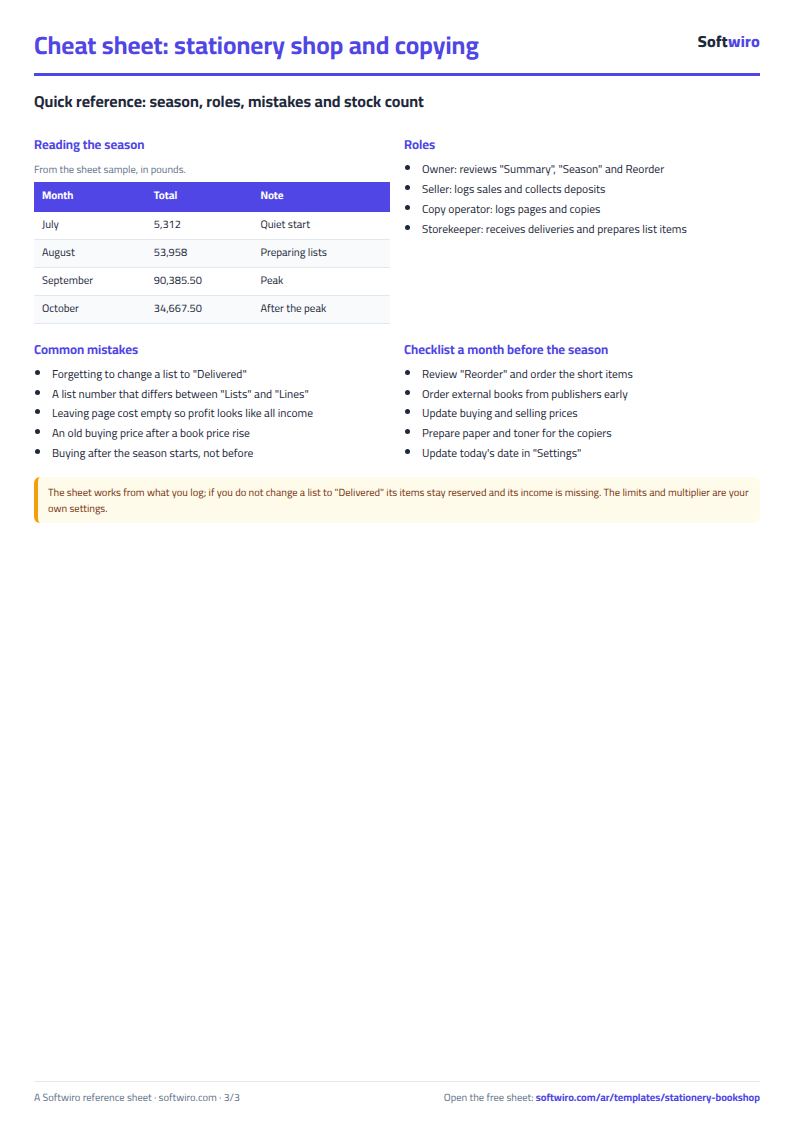
- Season: July income 5,312, August 53,958, September 90,385.50 (the peak) and October 34,667.50. In September alone lists brought 13,006 and copying 23,676.50.
Common mistakes
- Forgetting to change a list to «delivered», so its items stay reserved and its income is not counted.
- Typing a list number in the lines sheet differently from the number in the lists sheet.
- Leaving the page cost empty, so copying profit looks equal to its income.
- Leaving an old buying price after a publisher raises a book's price. The purchases sheet flags it as «السعر يختلف عن القائمة» (price differs from the list).
- Buying after the season starts rather than before, so shortfalls show while lists wait.
When to move to a system
The sheet suits a shop where one person records sales and copying. When several staff work at once, or you want a copier counter that logs pages by itself, or parents to write their own lists and pay the deposit from their phones, that is the job of a custom Softwiro build or a till system.
Your next step
Download the sheet, type your first twenty items, log one school list with its items, and open the reorder sheet a month before the season. For general stock see the general shop inventory sheet.
FAQ
What if I cancel a list whose owner paid a deposit? Set its status to «ملغاة» (cancelled): it reserves nothing and counts no income. Record the refund outside the sheet.
Do I log every customer who buys a pen? No. Add up the day's sales of each item into one row.
Does it work on a phone? Yes, in Excel, Google Sheets and LibreOffice.