You want to know which cheques fall due this week, how much you will receive and pay, and which customers' cheques bounce, without digging through a cheque book or relying on memory. The free cheque tracker sheet does it: you record each incoming or outgoing cheque, and it warns you, totals the weeks and prepares a bounced-cheque report.
The problem it solves
A cheque is a promise to pay on a later date, and as cheques multiply their dates scatter. An incoming cheque you did not deposit in time, an outgoing cheque that fell due without you knowing, a customer whose cheques bounce again and again with no figure to prove it. The result is liquidity surprises. A tidy record of each cheque's status prevents that.
How the sheet works, step by step
- In Settings you type today's date, the alert days (for example 7), the high-bounce threshold and the banks you deal with.
- In Parties (sheet "الأطراف") you type customers, suppliers and others, so they appear in a drop-down when you record a cheque.
- In Cheques (sheet "الشيكات") you record each cheque: number, direction (incoming or outgoing), party, bank, amount, issue date, due date and status.
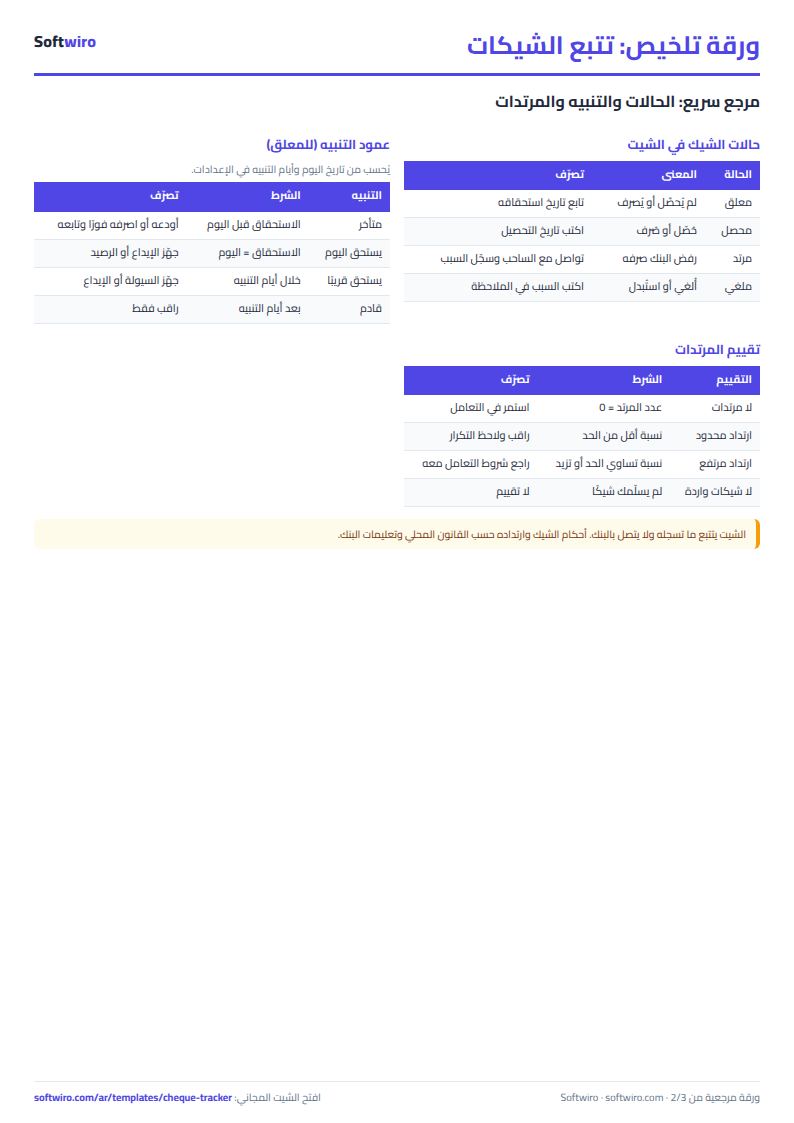
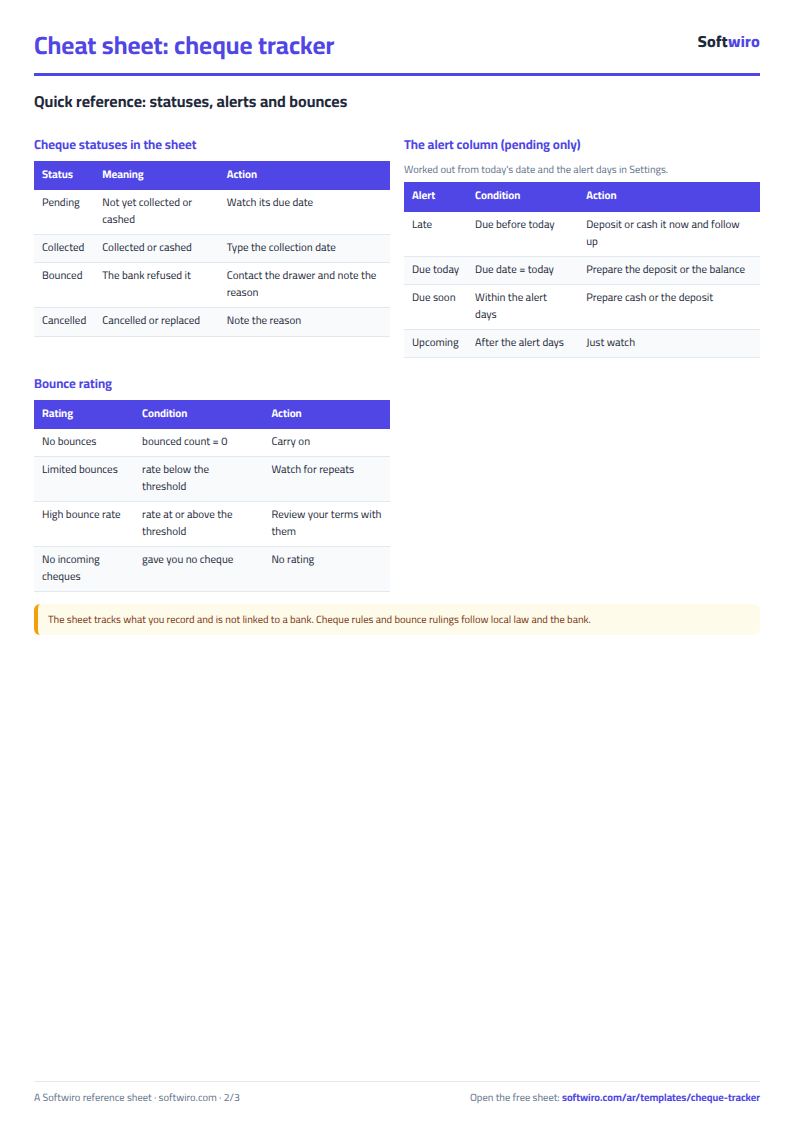
- The sheet counts the days left for pending ones and writes in the alert column: late, due today, due soon or upcoming, and colours the row. It also flags a duplicate number with the same bank and missing data.
- When an incoming cheque is collected or an outgoing one cashed you change its status to "collected" and type the date; if it bounced you choose "bounced".
- Weekly totals pending cheques by due week (weeks start on Saturday), Bounced works out the bounce rate per customer, and Summary gathers it with three charts.
What is in each sheet
- Summary: pending incoming and outgoing and their net, what falls due within the alert days, what is past due, bounced amount and rate, collected and cashed.
- Settings: today's date, alert days, bounce threshold and the bank list.
- Parties: up to 200 parties with type and phone.
- Cheques: the main log for 1000 cheques with alert and checks.
- Weekly: 12 weeks with a line for overdue and one for later, and the cumulative net.
- Bounced: a customer report with bounced amount, rate and rating.
Walk-through on the sample numbers
This is sample data, not a real company; today's date in it is 15 November 2026 and the alert is 7 days, with 25 incoming and outgoing cheques:
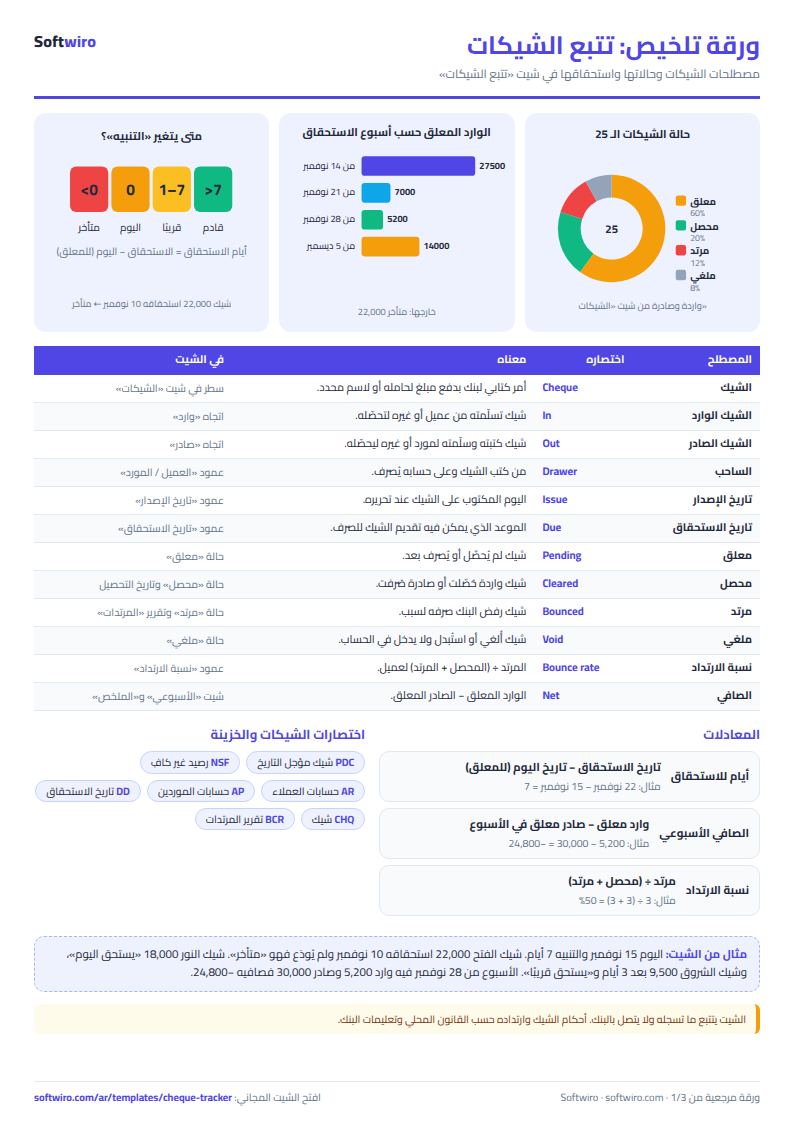
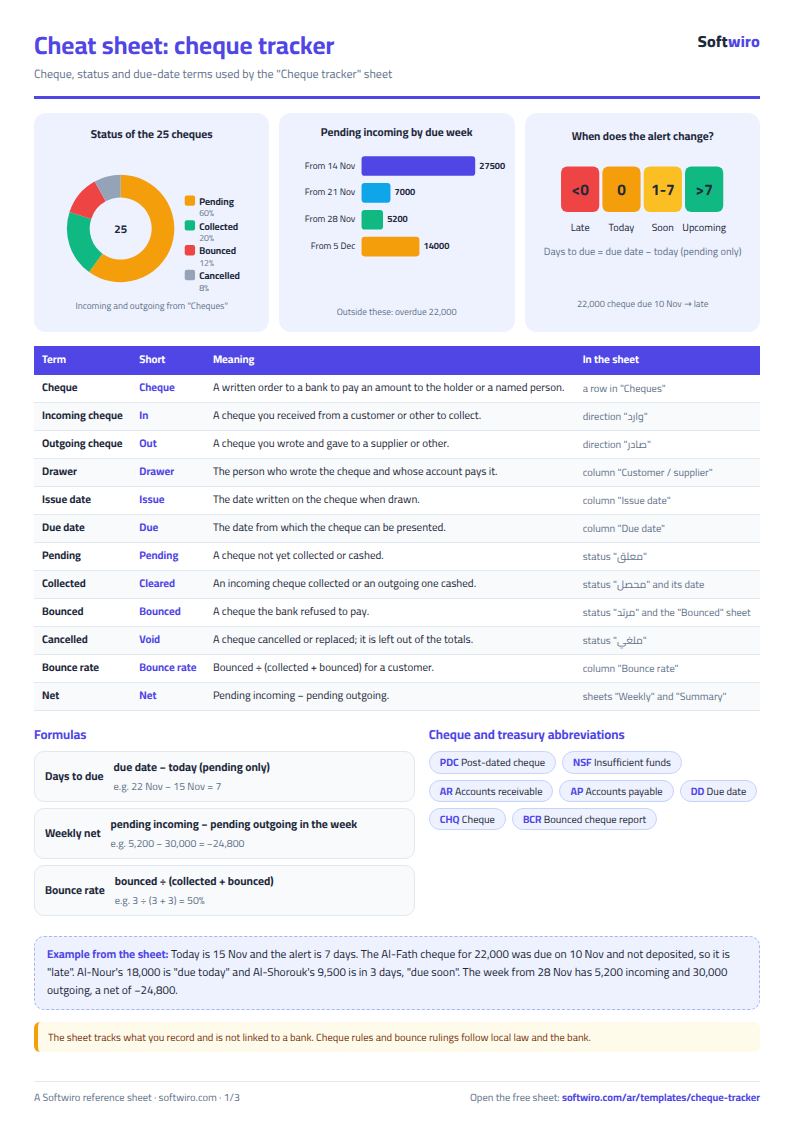
- Pending: incoming 106,700 in 8 cheques, outgoing 81,500 in 7 cheques, net expected 25,200.
- Alerts: Al-Fath's cheque for 22,000 fell due on 10 November and was not deposited, so it shows "late". Al-Nour's 18,000 is due today. Incoming due within 7 days totals 34,500 (today's, 9,500 in three days and 7,000 in seven days) and outgoing 21,000.
- Weekly: week one (starting Saturday 14 November) has 27,500 incoming and 21,000 outgoing, net 6,500. Week three (from 28 November) has 5,200 incoming and 30,000 outgoing, so its net is minus 24,800, the week to watch.
- Bounced: three incoming cheques bounced for a total of 25,500, a bounce rate of 50% (3 bounced against 3 collected). The customer with most bounces is Al-Amana Workshop with two cheques, 16,500, then Al-Fath with one, 9,000.
Practical reading: deposit the late Al-Fath cheque today, line up cash for week three because outgoing exceeds incoming by 24,800, and think about your terms with Al-Amana Workshop.
Common mistakes
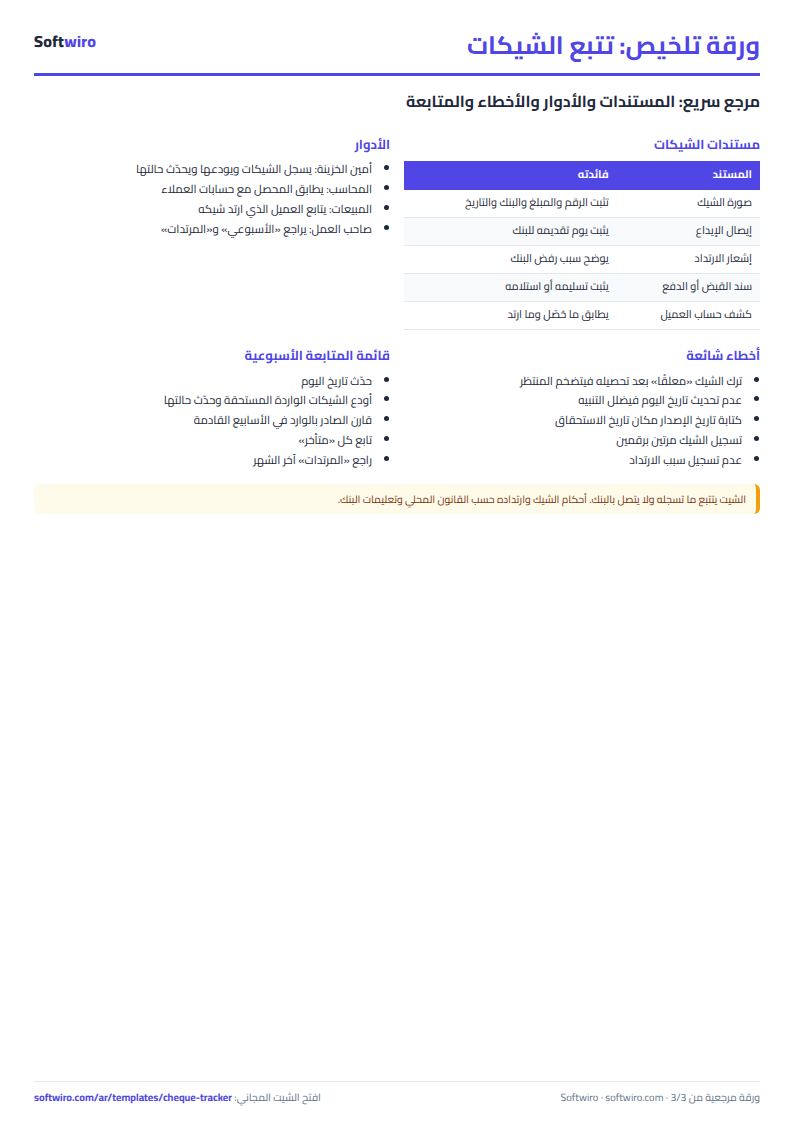
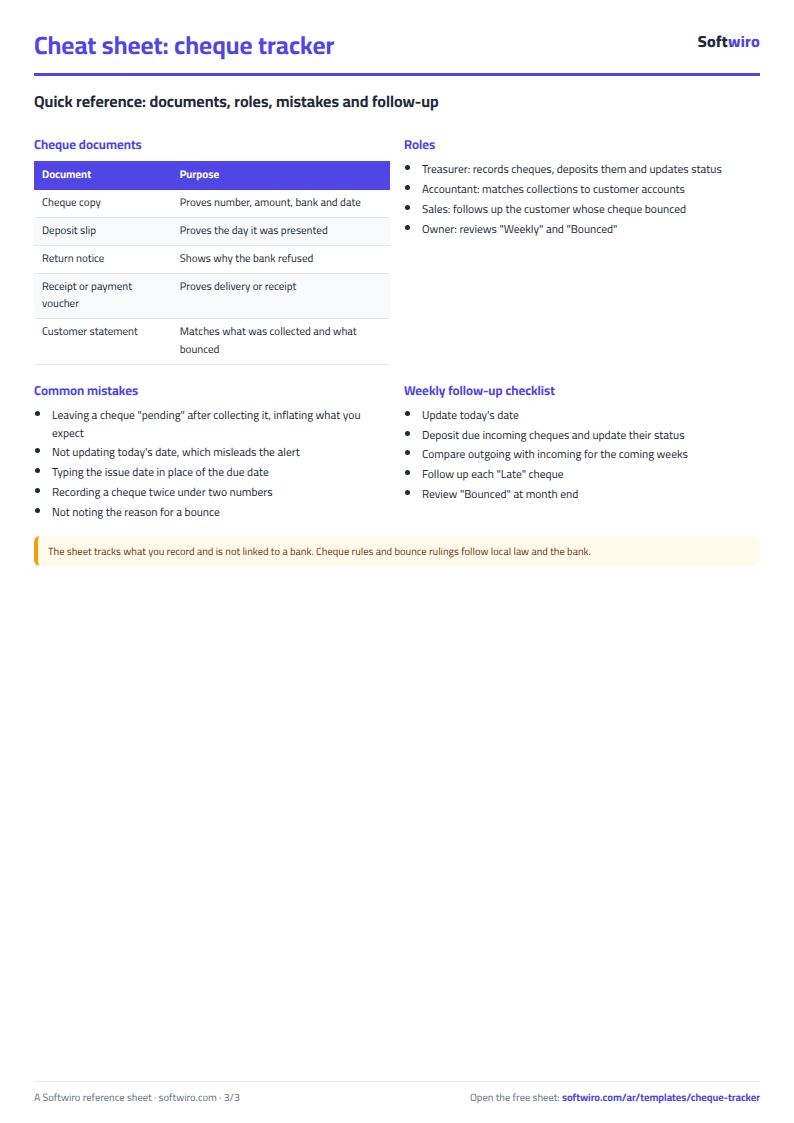
- Leaving a cheque "pending" after collecting it: it stays in the alert and weekly totals and inflates what you expect. Change its status.
- Not updating today's date: the alert and overdue are worked out from it.
- Typing the issue date as the due date: the due date is when it can be presented or cashed, not when it was written.
- Treating the bounce rate as a verdict: with few cheques it is only a comparison tool; do not rely on it alone.
- Ignoring official procedure: presentation periods and what follows a bounce depend on local law and bank instructions.
When to move to a system
The sheet is enough for dozens of cheques and one person updating the file. When cheques tie into customer accounts and invoices and treasury staff share the recording, Accountwiro records receipts against the customer's account as they happen. To forecast cash from due dates see the cash flow forecast sheet.
FAQ
Does it connect to the bank? No, it relies on what you record.
How many cheques fit? 1000 cheques and 200 parties.
Does it separate incoming from outgoing? Yes, by the direction column, each counted on its own.
Your next step
Open the sheet, type today's date and your banks, record today's pending cheques, then look at the Weekly sheet to find the first week in which outgoing exceeds incoming.