You want to review the area and volume formulas before the exam in one place: each solid's formula with its symbols, a solved example, then your own dimensions with the unit checked. The free solid geometry rules sheet does that for nine solids, with facts about lines and planes and Euler's formula. It is a general summary, not an official syllabus for any particular grade; check your school textbook.
The problem it solves
A student knows the volume of a cylinder is πr²h and then slips in applying it: using the diameter instead of the radius, mixing the slant height with the vertical height in a cone or pyramid, adding the base area once instead of twice for a prism, or writing a volume in square units. The formulas are scattered across a textbook and a notebook. The sheet puts each solid in one row and a solved example beside it.
How the sheet works, step by step
- Open المجسمات (Solids) and review the solid you are studying: symbols, lateral area, total area, volume and its solved example.
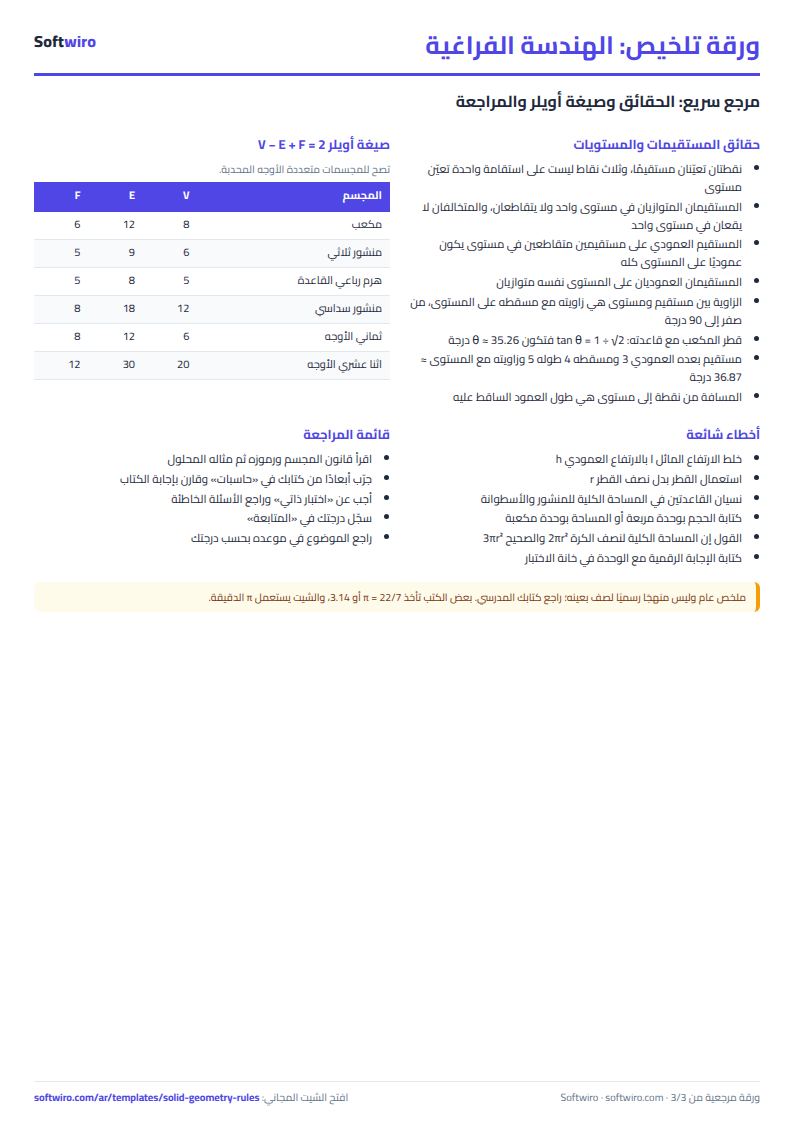
- Open حقائق وأويلر (Facts and Euler) to review facts about lines, planes and angles and the table of vertices, edges and faces.
- Pick the solid in بحث (Lookup) and its formulas and example appear.
- In حاسبات (Calculators) choose the length unit, then type the solid's dimensions and the areas, the volume and the volume in litres appear.
- Take the 40-question اختبار ذاتي (Self-test) and log your score in المتابعة (Progress).
- Open الملخص (Summary) to see each solid's volume from the examples, the growth of volume with radius, and your result.
What is in each sheet
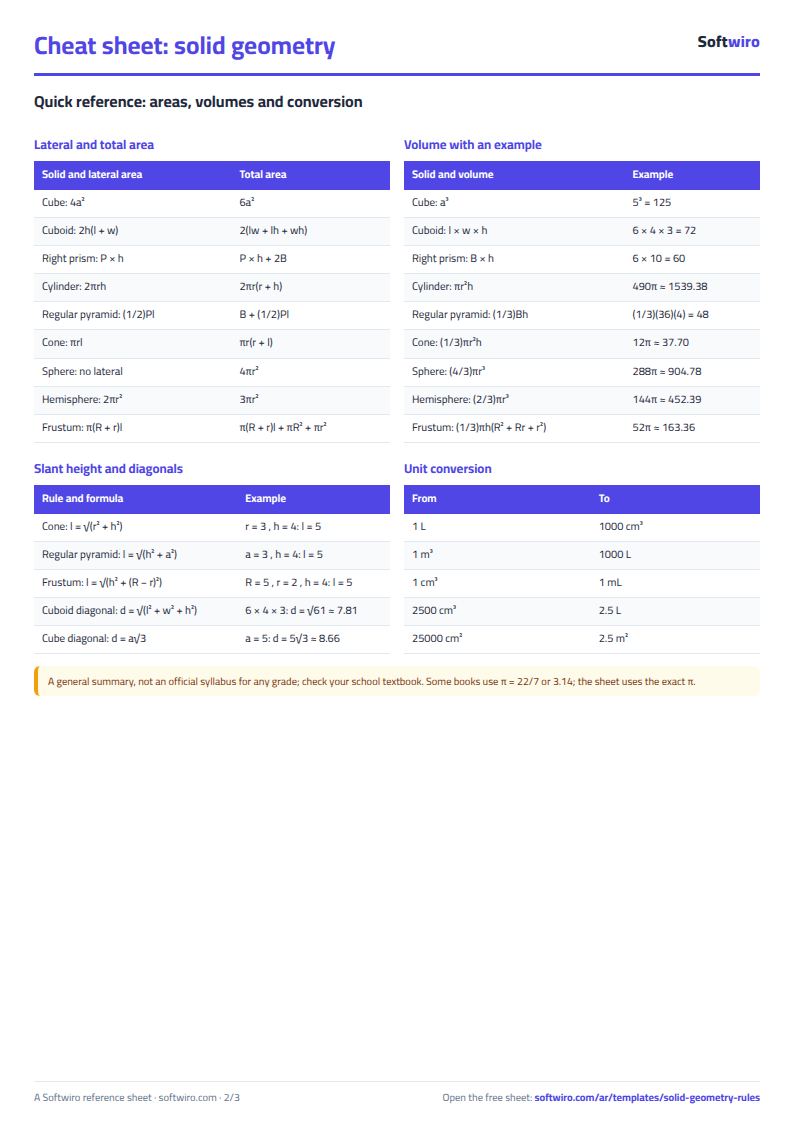
- Solids: 9 solids: cube, cuboid, right prism, cylinder, regular pyramid, cone, sphere, hemisphere and frustum of a cone.
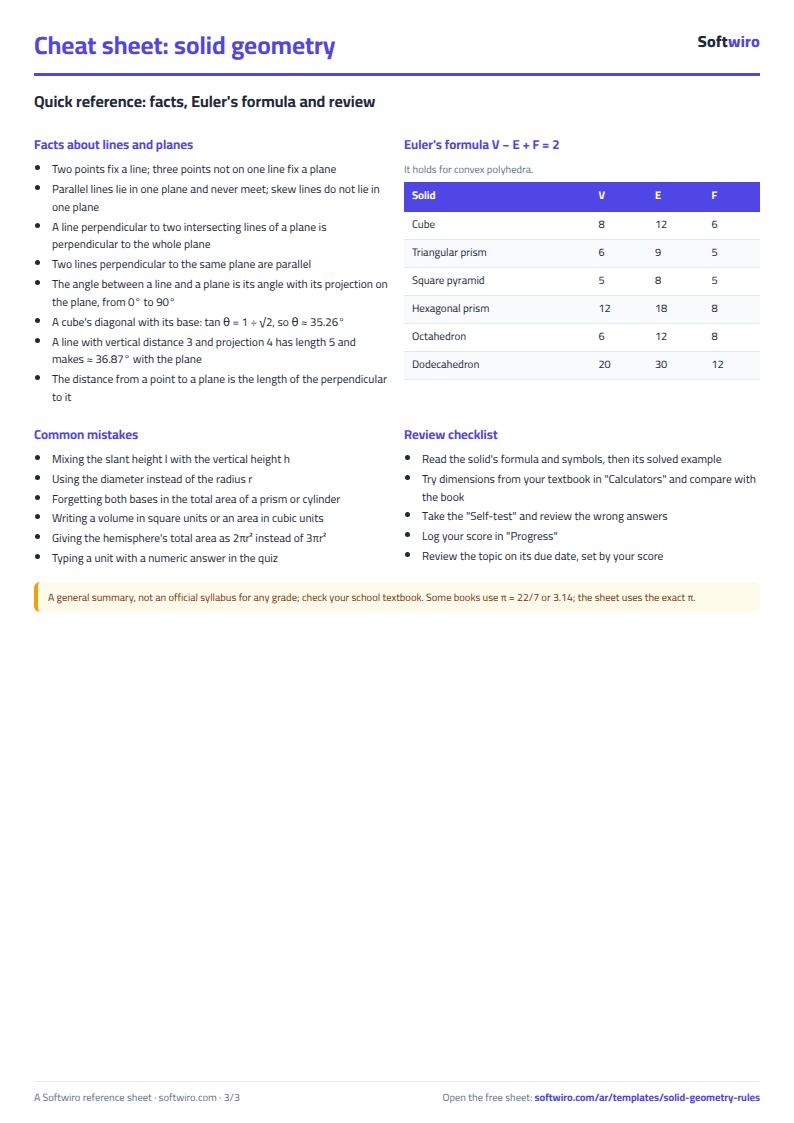
- Facts and Euler: 14 facts about lines and planes, and a table of ten polyhedra that calculates V − E + F.
- Calculators: 13 calculators, including the angle between a line and a plane and volume and area conversions.
- Self-test, Progress and Summary: questions with a hidden answer key, review dates, and your result per branch with four charts.
Walk-through on the sample numbers (sample data)
The figures below come from the sample copy inside the sheet, in cm, which is what you see before typing anything.
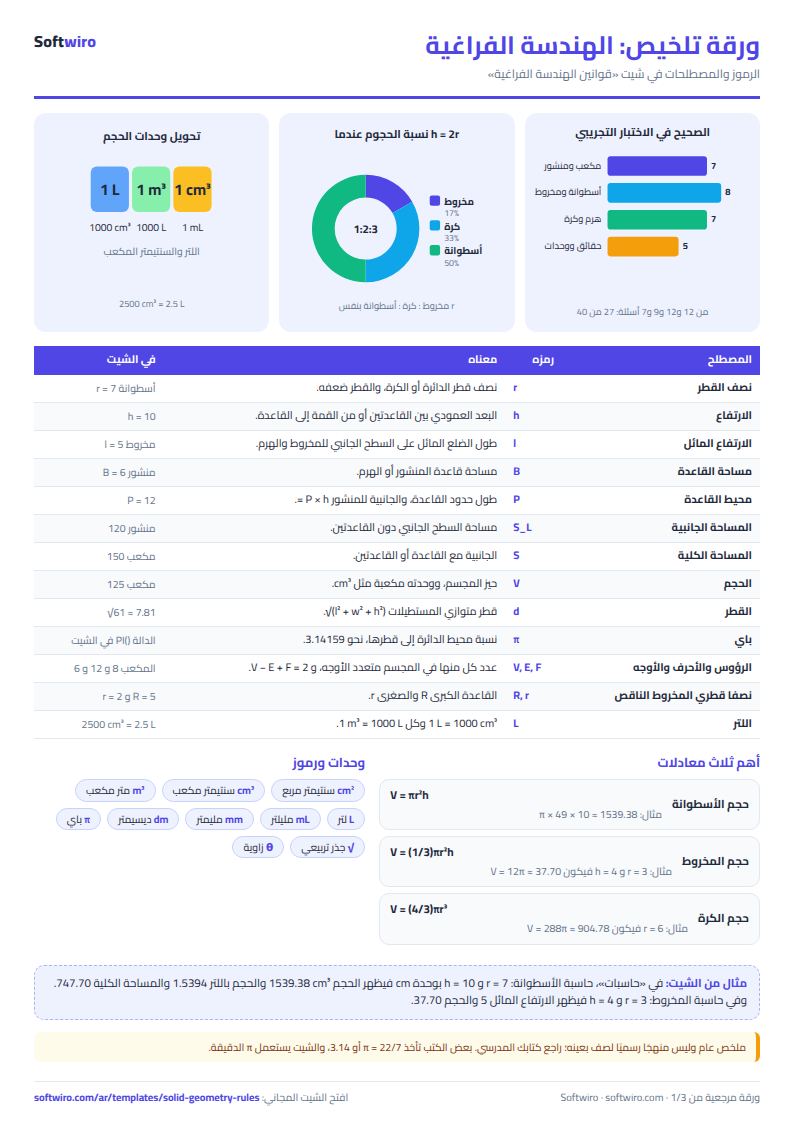
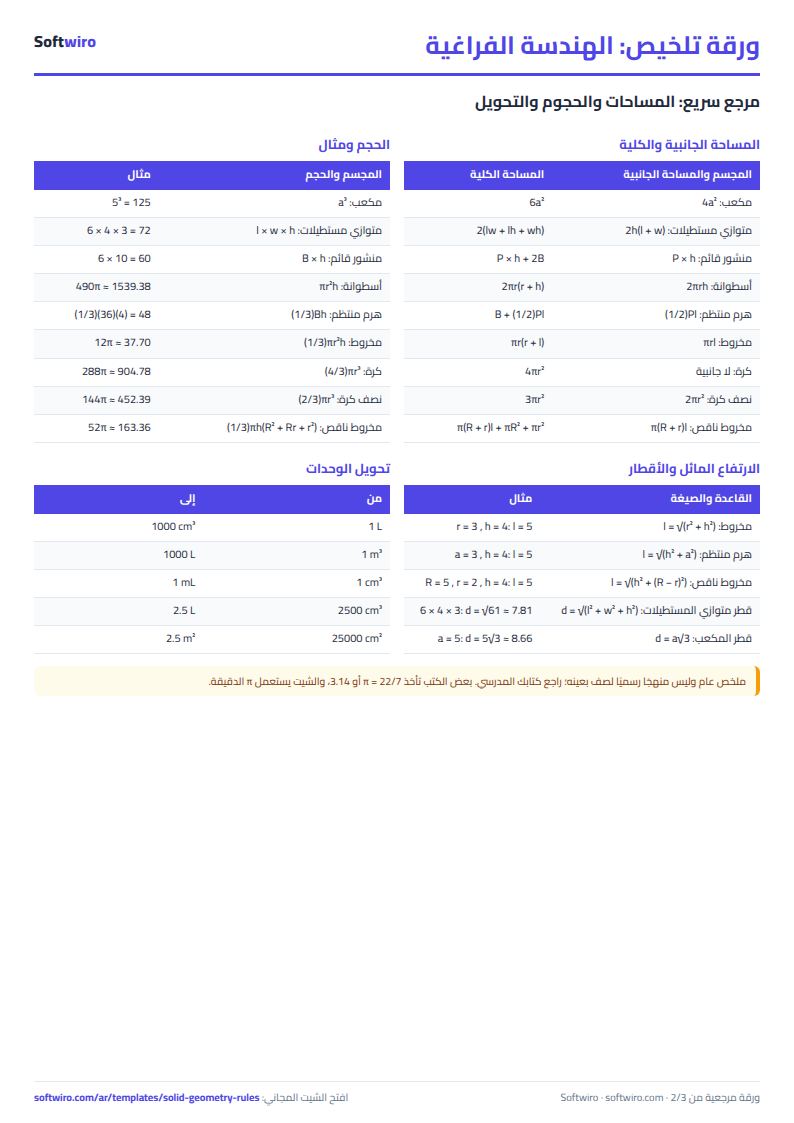
- Cube: edge 5 gives a total surface area of 150 and a volume of 125, which is 0.125 litres.
- Cuboid 6 × 4 × 3: total area 108, volume 72 and diagonal about 7.8102.
- Prism: base area 6, base perimeter 12 and height 10 give a lateral area of 120, a total area of 132 and a volume of 60.
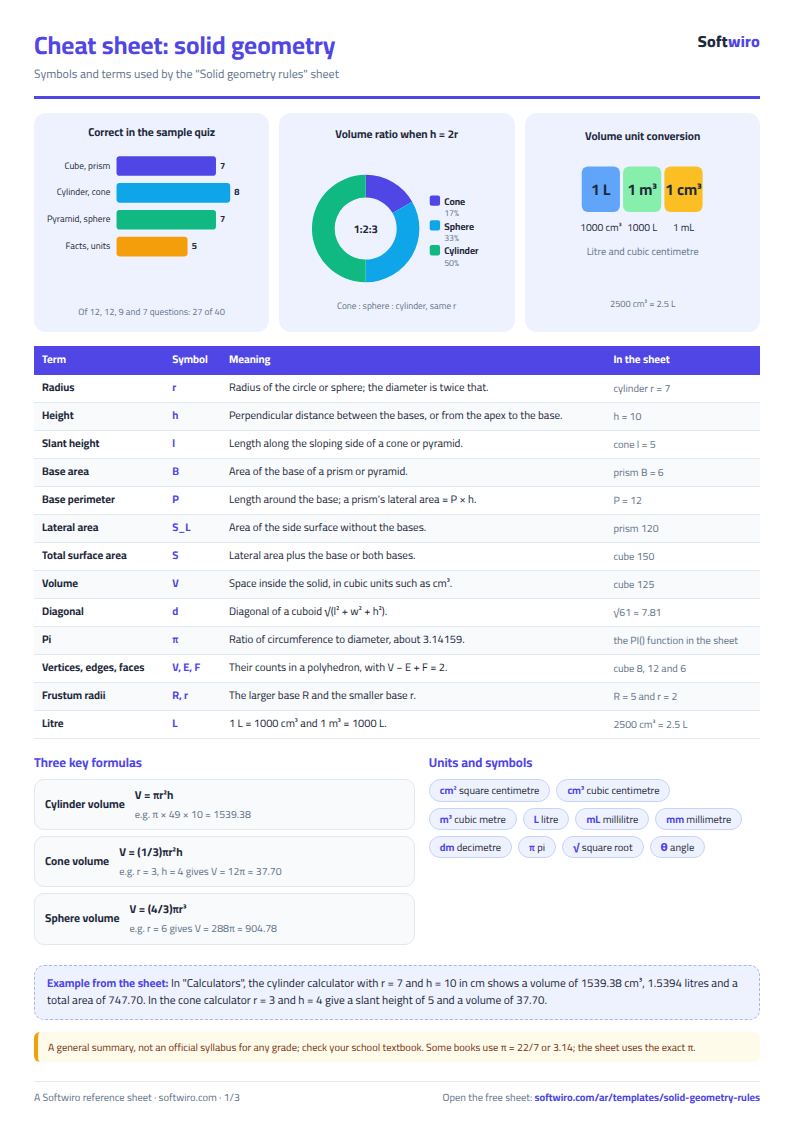
- Cylinder r = 7, h = 10: total area about 747.70 and volume about 1539.38 cm³, which is about 1.5394 litres.
- Regular pyramid with a square base of side 6 and height 4: slant height 5, total area 96 and volume 48.
- Cone r = 3, h = 4: slant height 5, total area about 75.40 and volume about 37.70.
- Sphere r = 6: surface area about 452.39 and volume about 904.78. The hemisphere has a volume of about 452.39 and a total area of about 339.29.
- Frustum R = 5, r = 2, h = 4: slant height 5, volume about 163.36 and total area about 201.06.
- Angle, conversion and Euler: a line with a vertical distance of 3 and a projection of 4 has length 5 and makes an angle of about 36.87 degrees with the plane. 2500 cm³ is 2.5 litres, and for the cube 8 − 12 + 6 = 2.
- Sample quiz: 35 of the 40 questions are answered and 27 are correct, so the score is 67.5% of all questions. By branch: cube and prism 7 of 12, cylinder and cone 8 of 12, pyramid and sphere 7 of 9, facts, Euler and units 5 of 7.
- Progress: three topics are due for review on 2026-11-15, and the average progress score is 70.0%.
Common mistakes
- Mixing the two heights: volume uses the vertical height h, while the lateral area of a cone or pyramid uses the slant height l.
- Diameter instead of radius: r is the radius and the diameter is twice that.
- Forgetting both bases: the total area of a prism or cylinder adds the area of two bases, not one.
- Units of volume: area is in square units (cm²) and volume in cubic units (cm³); every 1000 cm³ is one litre.
- The hemisphere: its total area is 3πr², the curved surface 2πr² plus the base πr².
When to move from the sheet to a system
The sheet is enough for a student revising alone or a teacher preparing a summary for a class. If you want to follow dozens of students, with an interactive drawing of the solid, step-by-step solutions and a dashboard showing the class's weak formulas, that needs a program with a login for each user, and Softwiro can build one your way. To organise study time try the study planner sheet, and to record exam dates the exam schedule sheet. These pages are in Arabic.
Next step
Download the sheet and pick one solid you have not mastered. Read its example in "Solids", enter dimensions from your textbook in "Calculators" and compare with the book's answer, take the quiz and log your score in "Progress". You then have your first written review date.
Common questions
Does the sheet match my grade's syllabus? It is a general summary, not an official syllabus for any particular grade; check your school textbook, since some books take π = 22/7.
How do I change the unit? Pick mm, cm, dm or m in the top cell of "Calculators".
Which solids does Euler's formula hold for? Convex polyhedra.