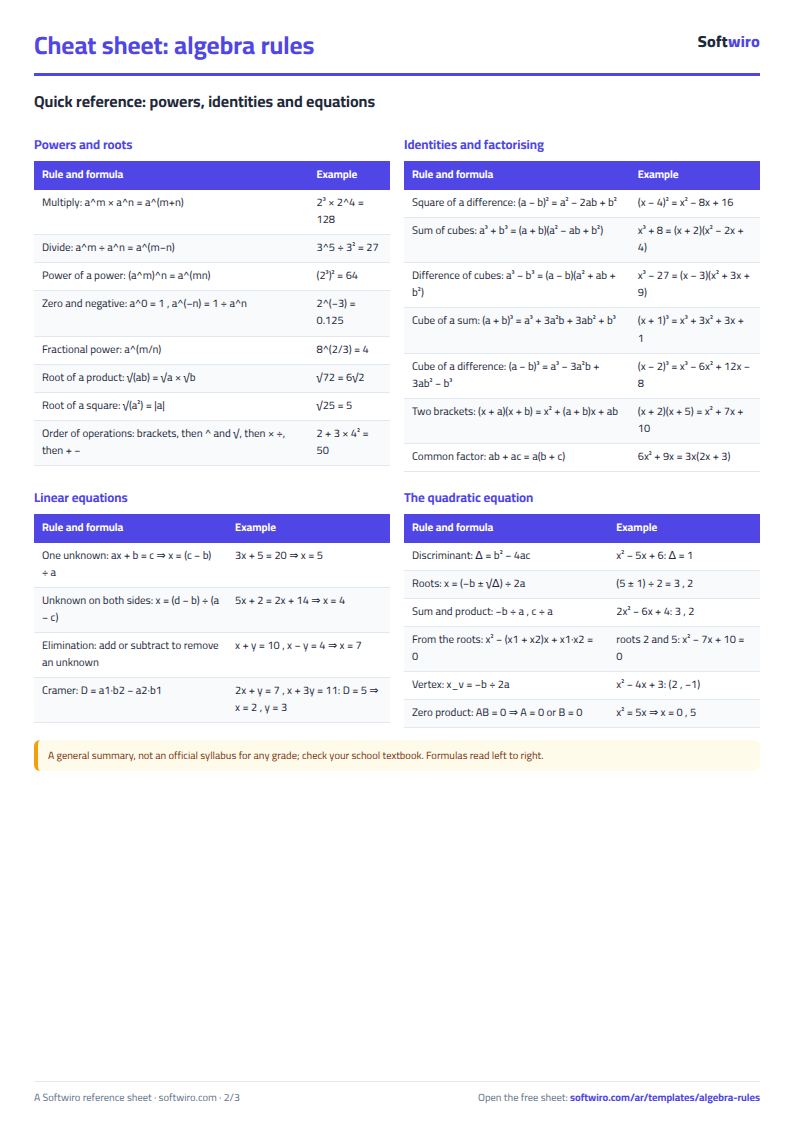
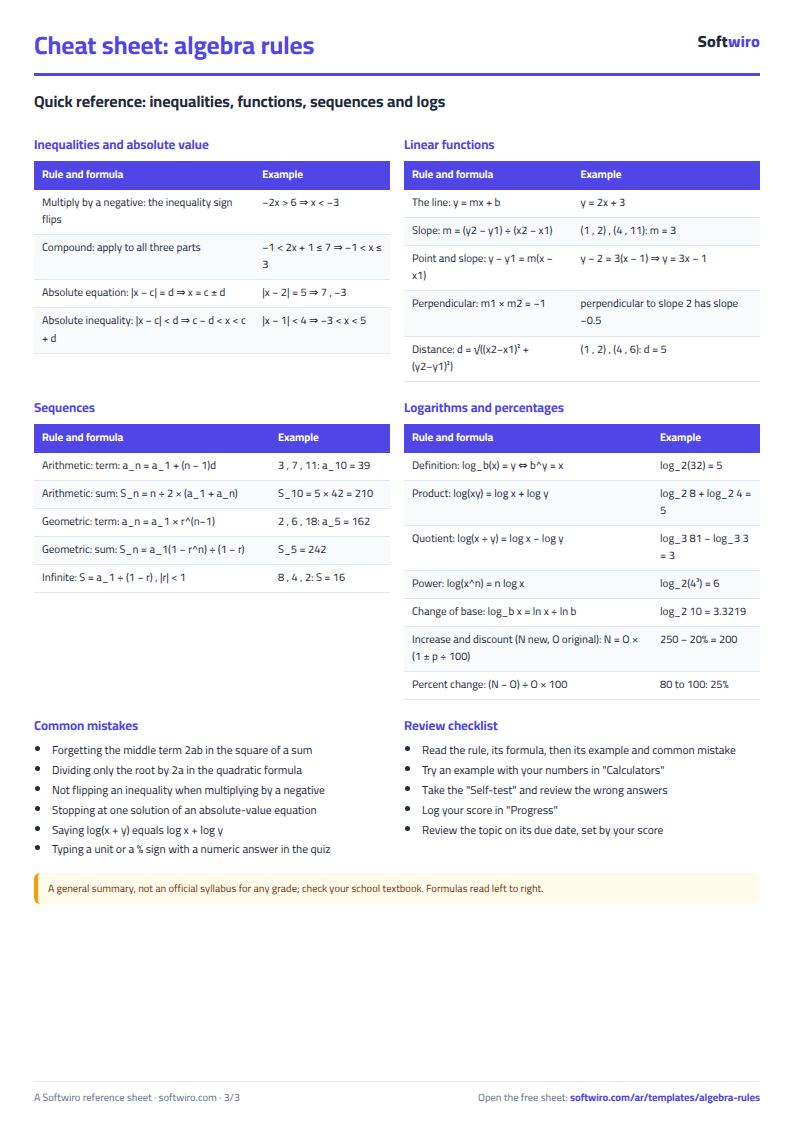
You want to review the algebra rules before the exam in one place: the rule and its formula, a solved example, the mistake most students make, then try your own numbers and test yourself. The free algebra rules summary sheet does that in 56 rules, from the order of operations to logarithms and percentages. It is a general summary, not an official syllabus for any particular grade; check your school textbook.
The problem it solves
A student memorises the formula and then slips in applying it: forgetting the middle term 2ab in the square of a sum, dividing only the root by 2a in the quadratic formula, or forgetting to flip an inequality when multiplying by a negative number. The rules are scattered across a textbook, a notebook and photos from the teacher. The sheet gathers them in one table and puts a worked example and the common mistake beside each rule.
How the sheet works, step by step
- Open قواعد الجبر (Algebra rules) and review the section you are studying: exponents and roots, identities, equations and so on. You can filter the table by the "section" column.
- If you forget a rule's name, pick it in بحث عن قاعدة (Rule lookup) and its formula, example and common mistake appear.
- Try حاسبات (Calculators): type your numbers in the white cells and the grey results appear, such as the discriminant, the two roots and the answer to a pair of simultaneous equations.
- Take the 40-question اختبار ذاتي (Self-test) and see a tick or a cross and your score.
- Log your score in المتابعة (Progress) so the sheet sets your next review date.
- Open الملخص (Summary) to see your result in each branch and the number of rules in each section.
What is in each sheet
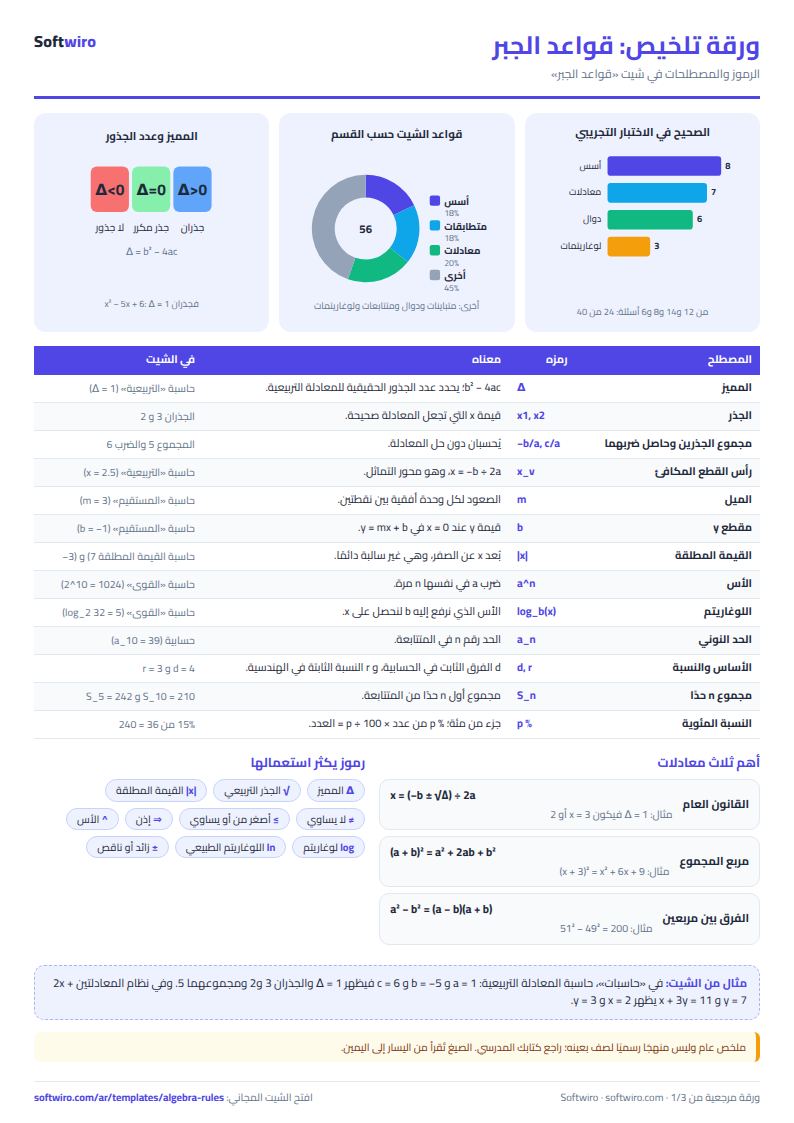
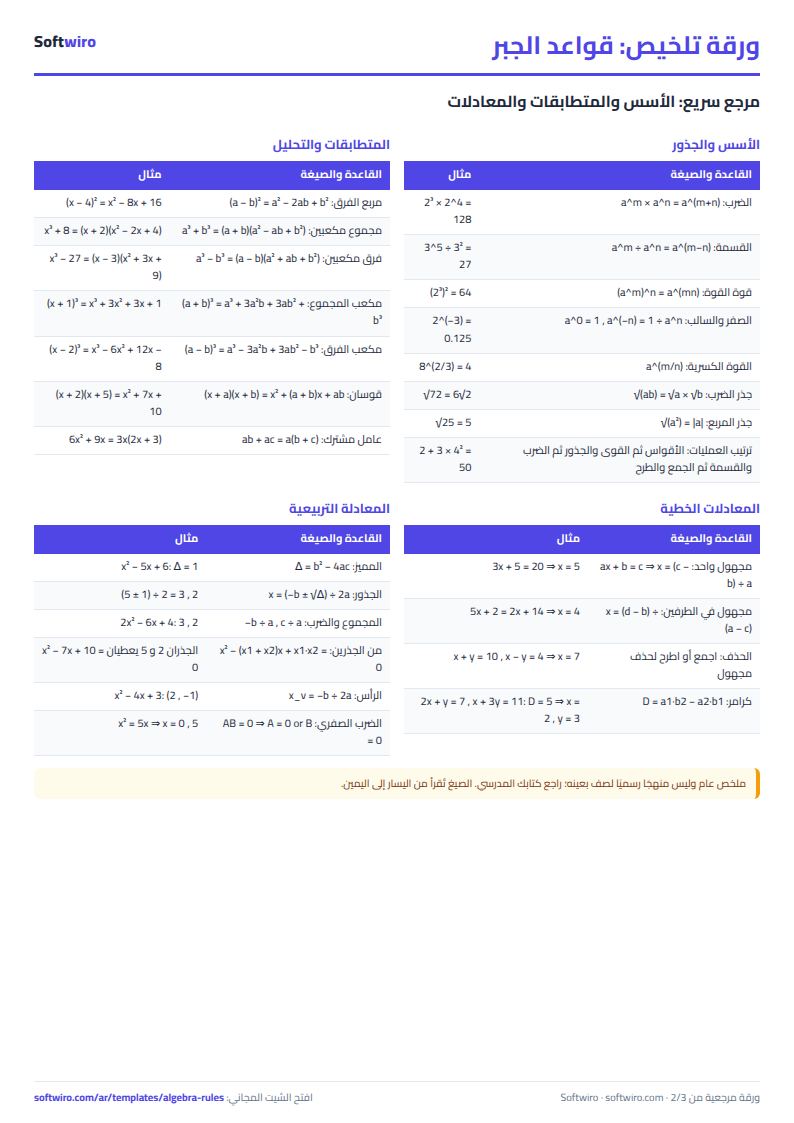
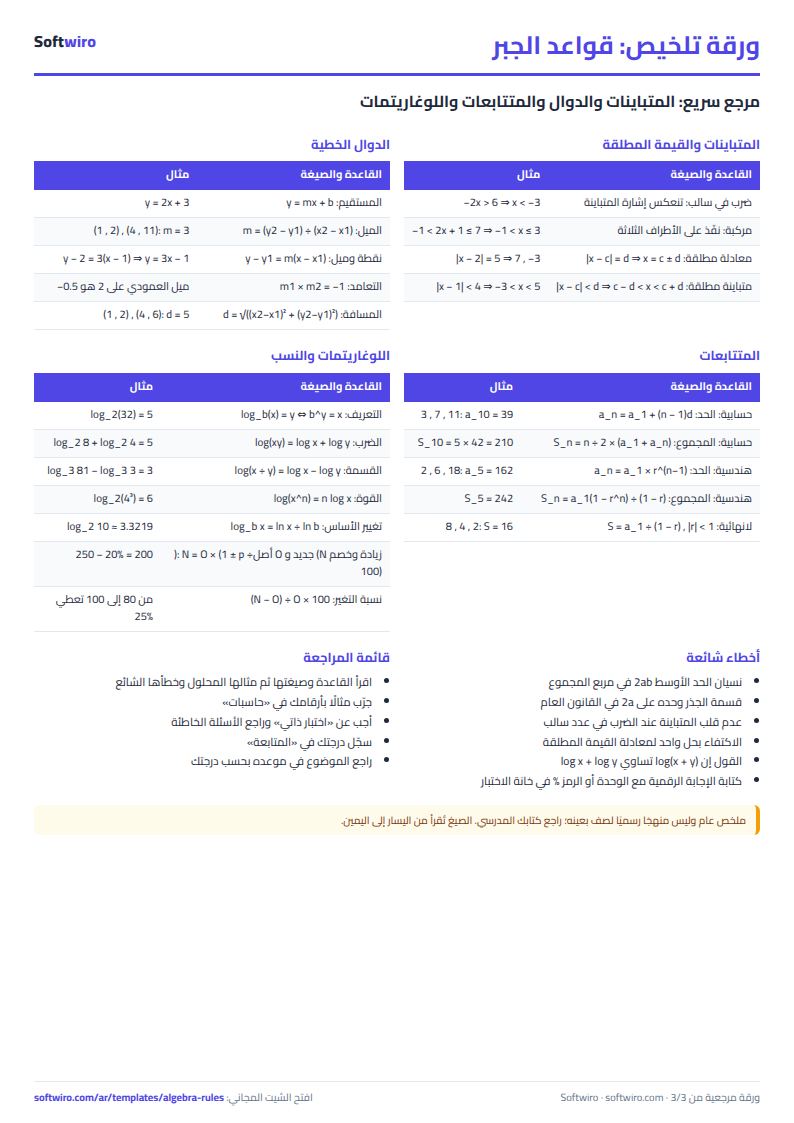
- Algebra rules: 56 rules in 8 sections: exponents and roots (10), identities and factorising (10), linear equations (4), the quadratic equation (7), inequalities and absolute value (5), linear functions (5), sequences (5) and logarithms and percentages (10).
- Rule lookup: a drop-down of rule names.
- Calculators: 10 calculators, including the quadratic equation, a 2×2 system by Cramer's rule, the line through two points and sequences.
- Self-test, Progress and Summary: questions with a hidden answer key, review dates, and your result per branch with four charts.
Walk-through on the sample numbers (sample data)
The figures below come from the sample copy inside the sheet, which is what you see before typing anything.
- Linear equation: 3x + 5 = 20 gives x = 5.
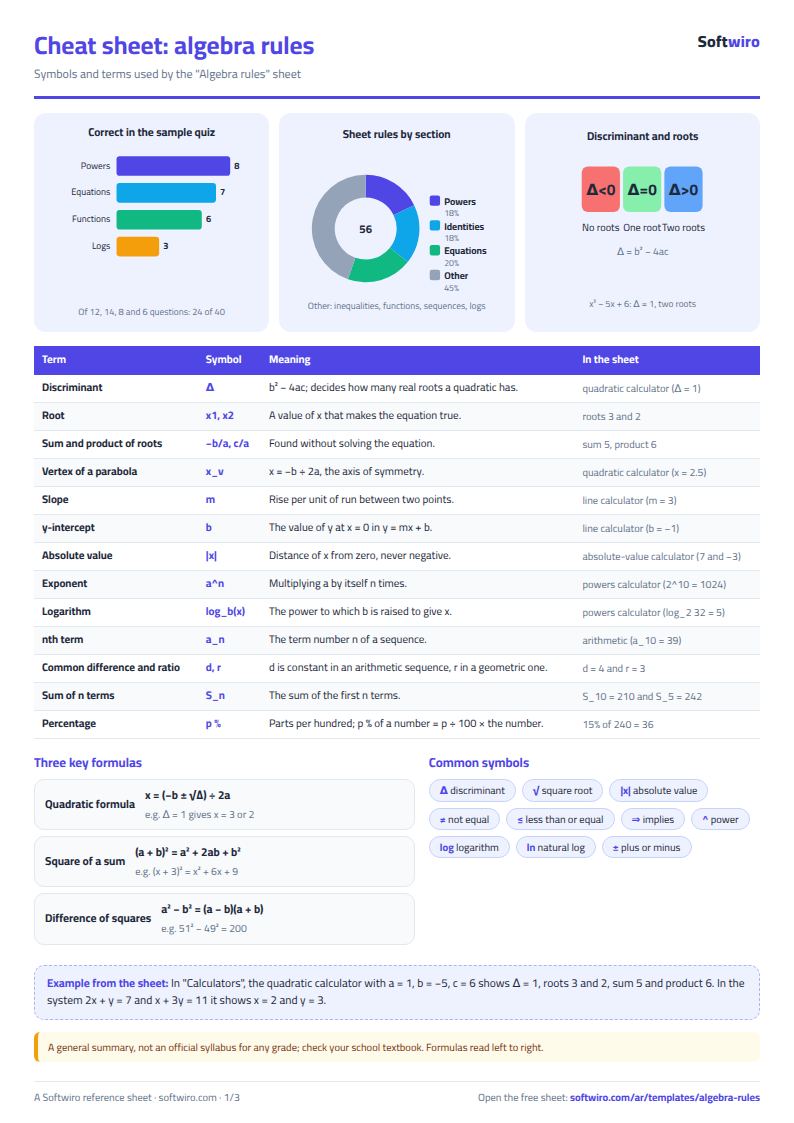
- Quadratic equation: x² − 5x + 6 = 0 has discriminant Δ = 1, so its roots are 3 and 2, their sum is 5 and their product 6, and the vertex is at x = 2.5, y = −0.25.
- Simultaneous equations: 2x + y = 7 and x + 3y = 11 give D = 5, x = 2 and y = 3.
- The line: through (1, 2) and (4, 11) has slope 3 and equation y = 3x − 1; its midpoint is (2.5, 6.5) and the distance between the points is about 9.4868.
- Sequences: the arithmetic sequence 3, 7, 11 has a tenth term of 39 and a sum of ten terms of 210. The geometric sequence 2, 6, 18 has a fifth term of 162 and a sum of five terms of 242.
- Powers and logarithms: 2^10 = 1024, the fourth root of 81 is 3, and log_2(32) = 5.
- Percentages: 15% of 240 is 36, a 15% increase gives 276, and the change from 80 to 100 is 25%.
- Sample quiz: 36 of the 40 questions are answered and 24 are correct, so the score is 60% of all questions. By branch: exponents and identities 8 of 12, equations and inequalities 7 of 14, functions and sequences 6 of 8, logarithms and percentages 3 of 6.
- Progress: three topics are due for review on 2026-11-15, and the average progress score is 71.1%.
Common mistakes
- Forgetting the middle term: (a + b)² = a² + 2ab + b², not a² + b².
- Adding exponents when they should be multiplied: (2³)² = 2^6 = 64, while 2³ × 2^4 gives 2^7 = 128 by adding the exponents.
- Not flipping the inequality: −2x > 6 gives x < −3, not x > −3.
- Stopping at one solution: |x − 2| = 5 has two solutions, 7 and −3.
- Mixing up logarithm laws: log(x + y) is not log(x) + log(y); addition of logarithms belongs to a product only.
When to move from the sheet to a system
The sheet is enough for a student revising alone or a teacher preparing a summary for a class. If you want to follow dozens of students, with a large question bank, step-by-step solutions and a dashboard showing the class's weak rules, that needs a program with a login for each user, and Softwiro can build one your way. To organise study time try the study planner sheet, and to record exam dates the exam schedule sheet. These pages are in Arabic.
Next step
Download the sheet and pick one rule you have not mastered. Read its example and common mistake in "Algebra rules", solve a similar example in "Calculators" with your own numbers, take the quiz and log your score in "Progress". You then have your first written review date.
Common questions
Does the sheet match my grade's syllabus? It is a general summary, not an official syllabus for any particular grade; check your school textbook, since wording and the order of topics can differ.
What does ^ mean in the formulas? It is the exponent sign: 2^7 means 2 to the power 7.
What shows if the discriminant is negative? The phrase "لا جذور حقيقية" (no real roots) appears in both root cells.