You run a farm, or you collect crop residues from the land of a village, and you want to know how many tons of rice straw, cotton and corn stalks you collected, how much of it went to compost, treated feed or baling instead of the fire, and what a ton cost and earned. The free agricultural waste management sheet keeps it all in one workbook: sources, collection, processing batches, compost piles and sales, then a monthly table and a summary with charts. (The template page is in Arabic.)
The problem it solves
Many people note truck weights in a notebook, transport costs on a slip and bale sales in a chat message. At the end of the season it is hard to answer: did we collect half of what was expected or more? Which route earns and which loses? Is a compost pile overdue for turning? Here each fact is typed once and the rest is calculated. A general reminder: open burning is harmful to air and health, and the obligations around it follow local law.
Steps, from opening the file to the report
- Settings: enter today's date, the compost maturing time (45 days in the sample), the longest gap between turnings (14), the machine hour cost (250 EGP) and the first month of the report.
- Types: review the waste types and estimate tons per feddan from your own experience. The sample uses rice straw 2.5, cotton stalks 1.2, corn stalks 3 and sugarcane leaves 4. They are illustrative, not measurements.
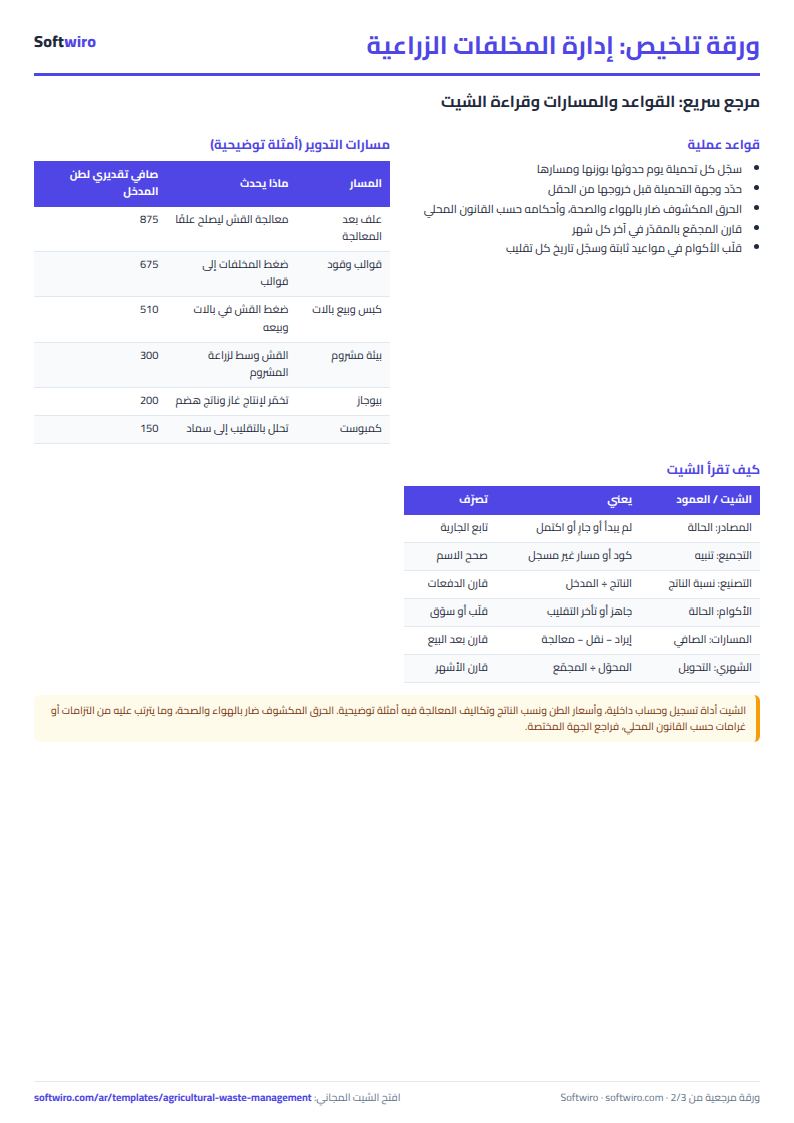
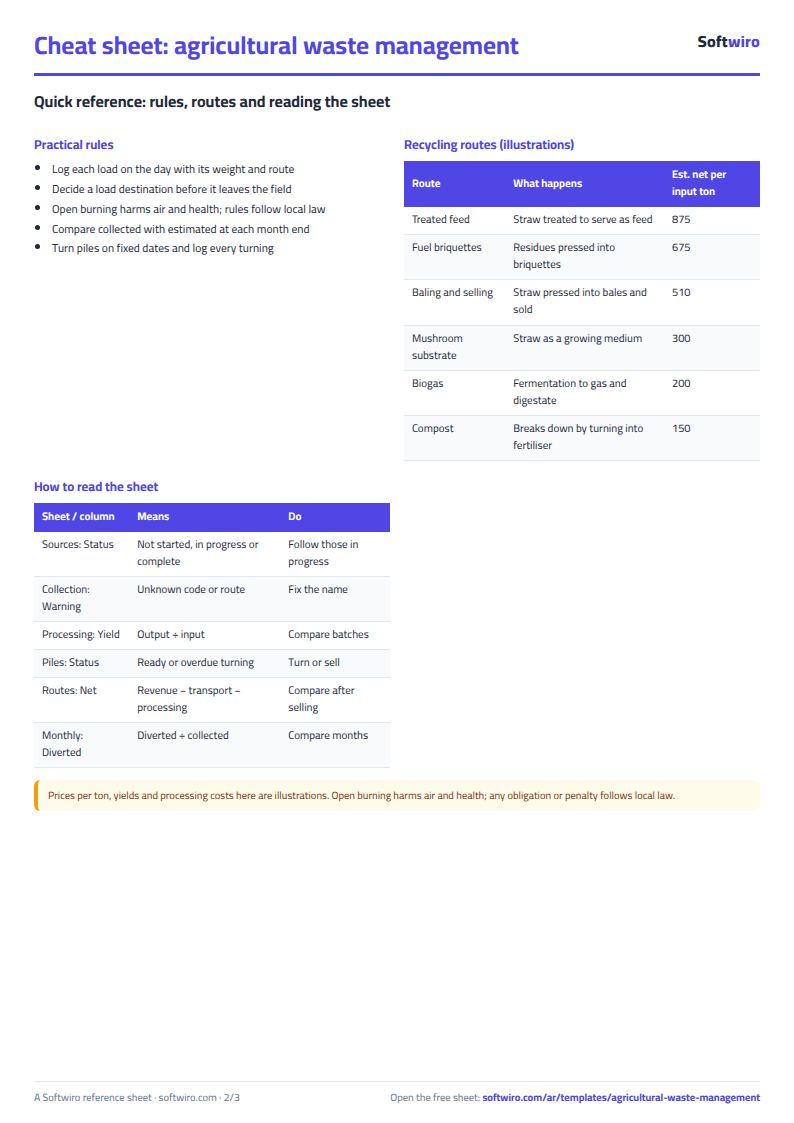
- Routes: review the routes: compost, treated feed, baling and selling, biogas, mushroom substrate, fuel briquettes, and a "burn or leave untreated" route marked "no" in the diverted column.
- Sources: one row per farm or plot: code, area, main type and feddans, which gives the estimate in tons.
- Collection: one row per load with date, source, type, tons, transport cost and route.
- Processing and piles: log baling and processing batches (input, output, labour, machine hours) and compost piles with turning dates.
- Sales: log what you sold at the price per ton.
- Open Monthly and Summary.
What each sheet does
"Sources" compares collected with estimated for each source and says not started, in progress or complete. "Routes" puts the illustrative price, yield and processing cost next to the actuals: what was collected, what moving and processing it cost, what it earned. "Piles" works out the maturing date and the days since the last turning and flags late ones. "Monthly" gives each month collected, diverted, cost, revenue and net. "Summary" brings it together with charts.
A walk-through on the sample numbers
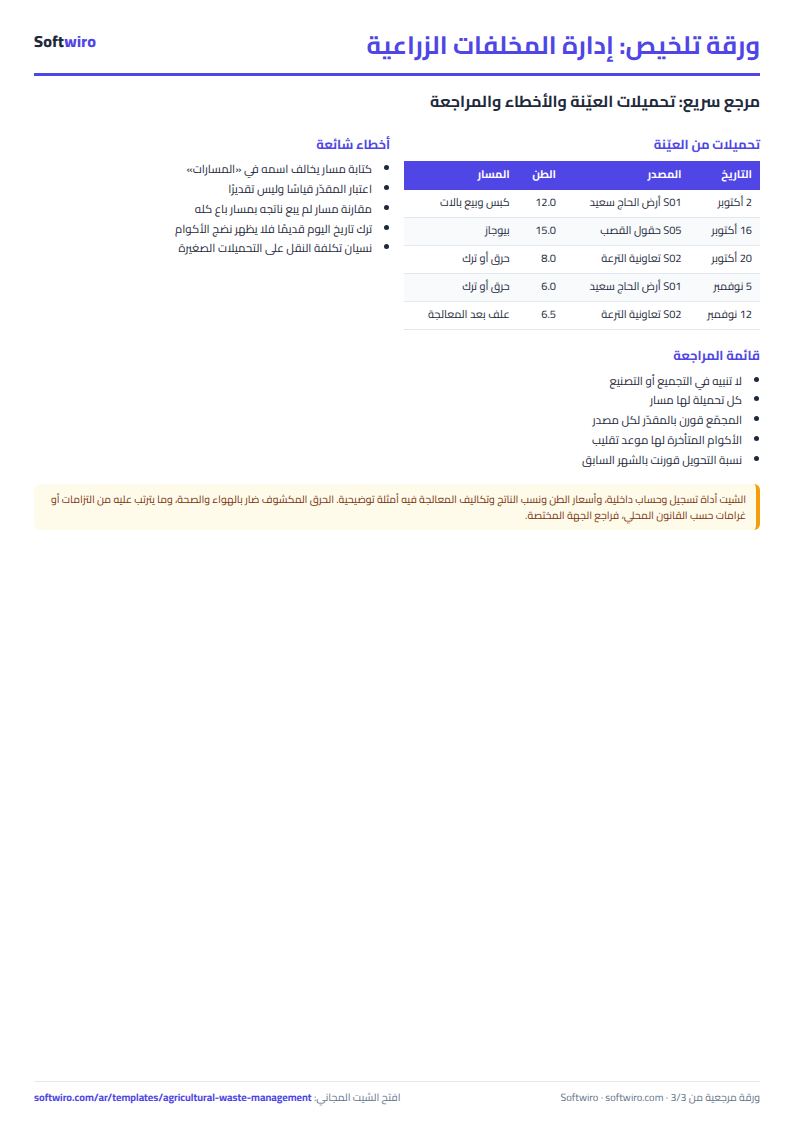
These are made-up sample numbers. The sample has seven sources over 152 feddans and 26 loads between 2 October and 12 November 2026:
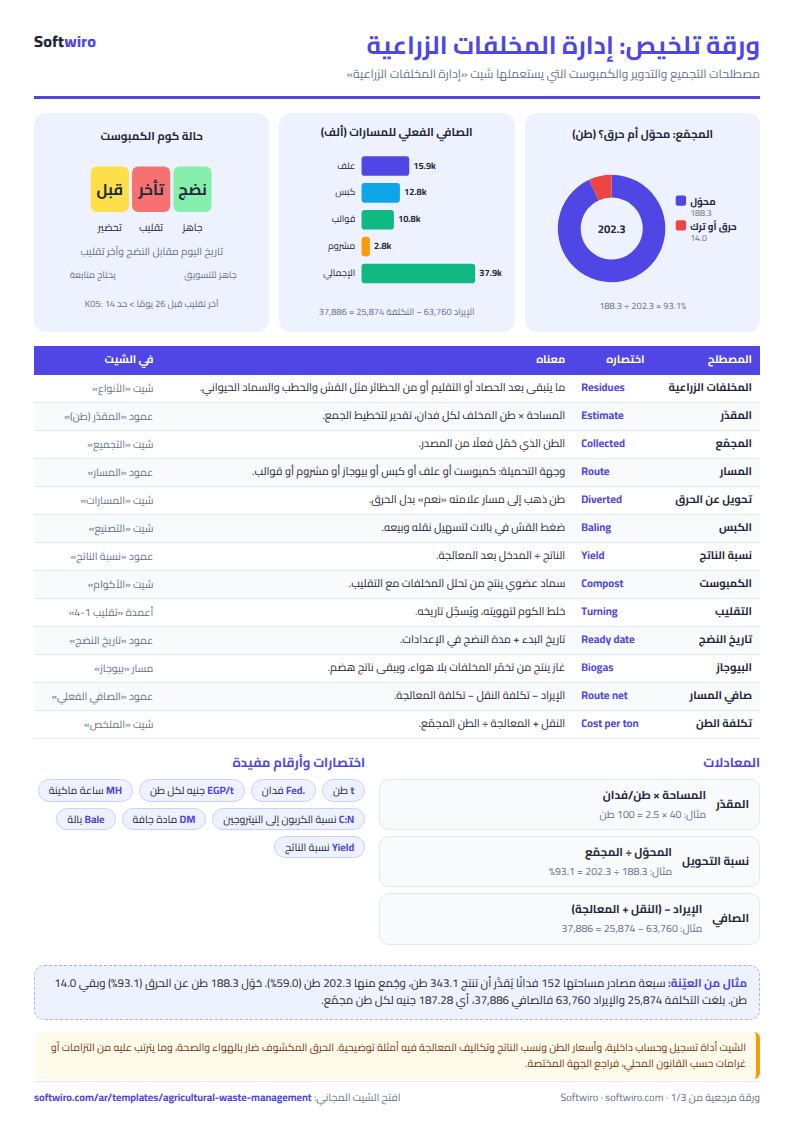
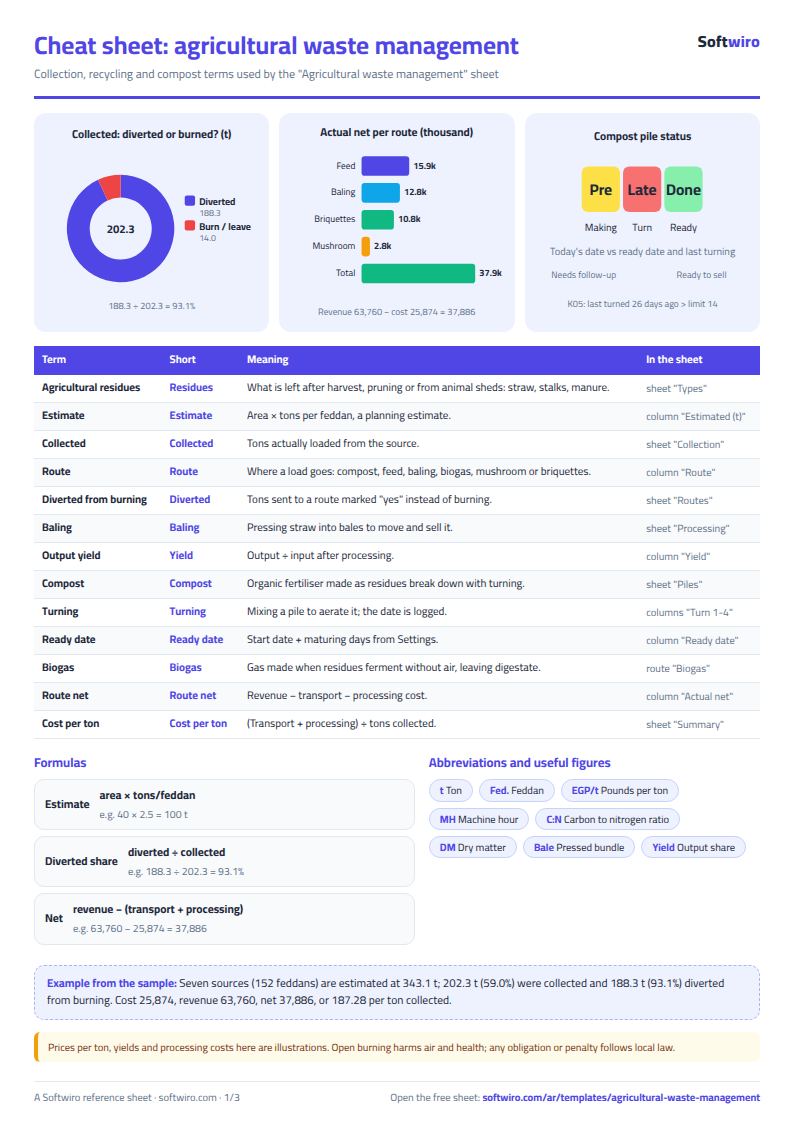
- Collected vs estimated: 343.1 tons estimated, 202.3 tons collected, 59.0%. Rice straw alone: 93.5 tons of 162.5 estimated.
- Diverted from burning: 188.3 tons of 202.3, or 93.1%; 14.0 tons (two loads) went to burning or were left untreated.
- Processing: 11 batches took in 117.5 tons and gave 95.9 tons, an average yield of 81.6%, using 40.5 machine hours. Batch B01 took 21 tons and gave 18.8; it cost 900 labour + 6 hours × 250 = 2,400.
- Piles: five piles; K03 is ready (12 tons gave 6.2 tons of compost) and K05 is late because it was last turned 26 days ago against a limit of 14.
- Money: transport 6,199 and processing 19,675 make a total cost of 25,874 against revenue of 63,760, a net of 37,886. Per ton collected that is 127.90 cost, 315.18 revenue and 187.28 net.
- Month by month: October collected 141.0 tons (94.3% diverted) with revenue 27,800; November collected 61.3 tons (90.2%) with revenue 35,960.
- Routes: the best net is treated feed (15,885), then baling (12,800), then briquettes (10,835). Compost and biogas show a negative net because most of their output is not sold yet, not necessarily because they lose.
Common mistakes
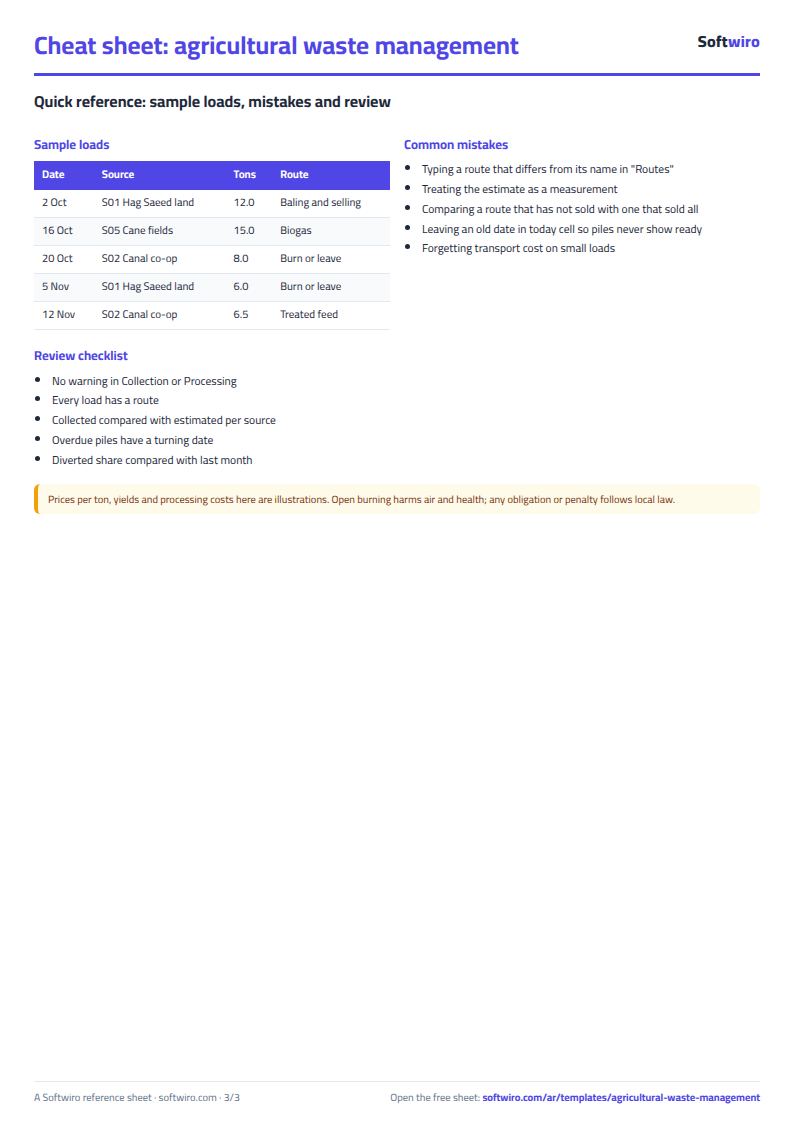
- Typing a route that differs from its name in "Routes", which shows "route not found".
- Treating the estimate as a measurement; it is for planning collection.
- Comparing the net of a route that has not sold its output with one that has.
- Leaving an old date in today's cell, so piles never show as ready on time.
- Forgetting transport cost on small loads.
When to move to a system
When several supervisors log from the field, or you need scale-ticket photos, buyer receipts and reports for a funder, a custom system serves you better than a file one person edits at a time.
Try it now
Open the sheet and try it online, or download the Excel file, clear the samples and enter your first source and first load this week. For other farm accounts see the crop season expenses sheet. If you want something tailored, request it here.