You close the shop at the end of the day and want to know exactly: does the drawer hold what it should? If not, how big is the difference, whose shift was it, and is it a one-off or a shortage that keeps coming back. The free daily cash drawer count and reconciliation sheet works out the expected cash, compares it with your real count, and keeps a log of days so the comparison stays in front of you. (The template page is in Arabic.)
The problem it solves
At closing time the cashier stands in front of the drawer, counts in a hurry, compares with a slip of paper, and someone says "a small difference" or "we will make it up tomorrow". The difference is not recorded, its cause is not known, nobody notes whose shift it was, and when it repeats nobody notices. The common confusion between what goes into the drawer and what does not (card and credit sales) creates imaginary differences, while an expense paid from the drawer and never written down creates a real one.
How the sheet works, step by step
- In Settings type the first day of the month, the tolerance, the repeated-shortage window and the expense categories.
- In Cashiers type the names of whoever works the drawer, and in Expenses record each expense with where it was paid from.
- At the end of each day add a row to the Day log: date, cashier and opening float, then the count of each denomination, then sales, collections, refunds and withdrawals from the register report.
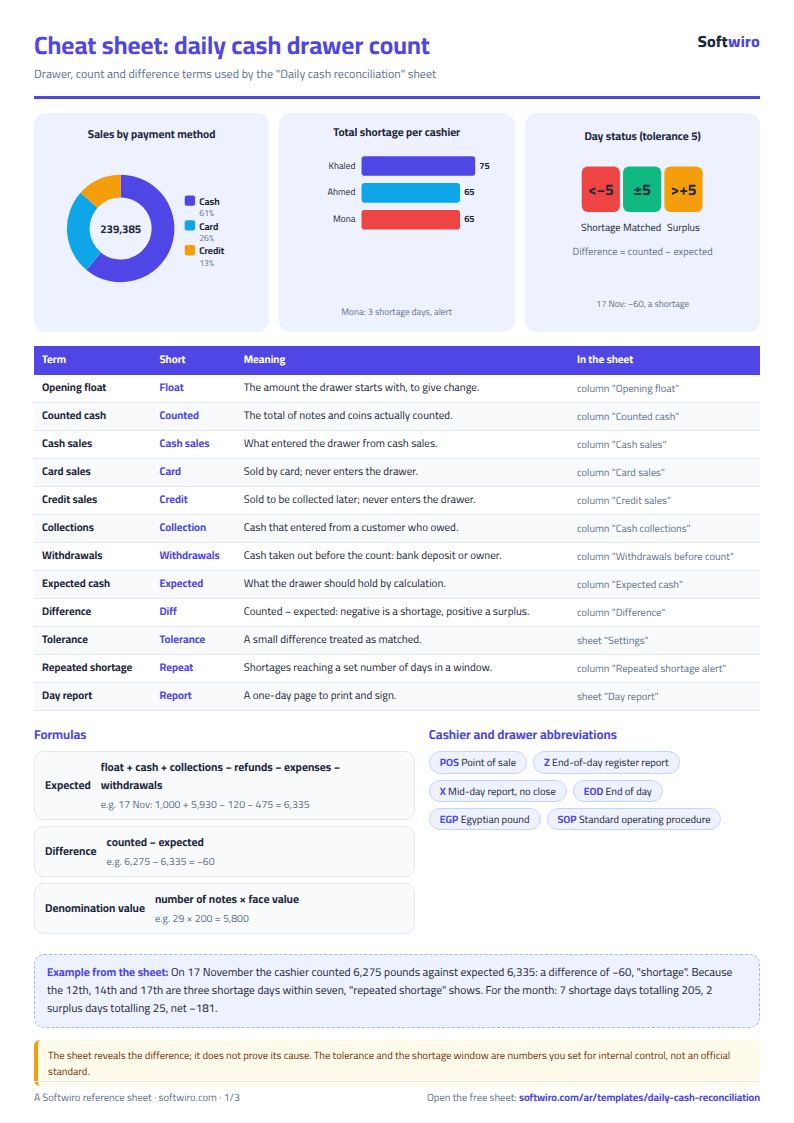
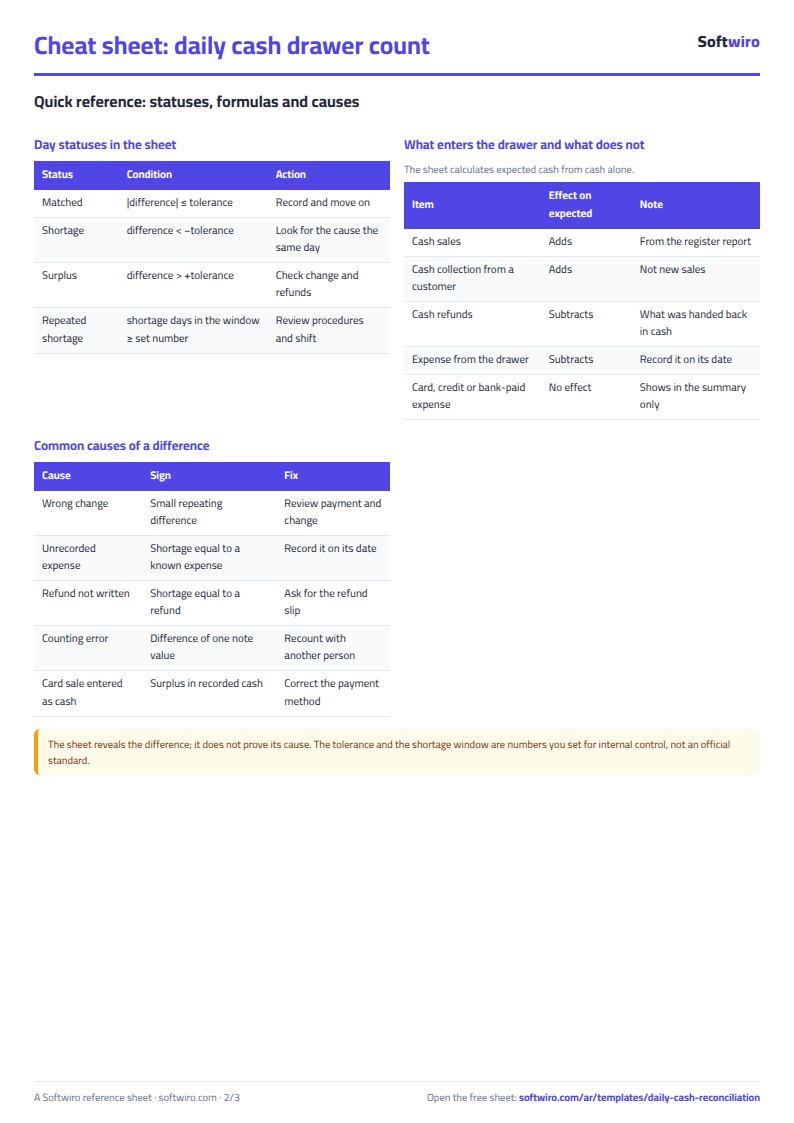
- The sheet calculates the counted cash, then expected = float + cash sales + collections - refunds - drawer expenses - withdrawals, then difference = counted - expected.
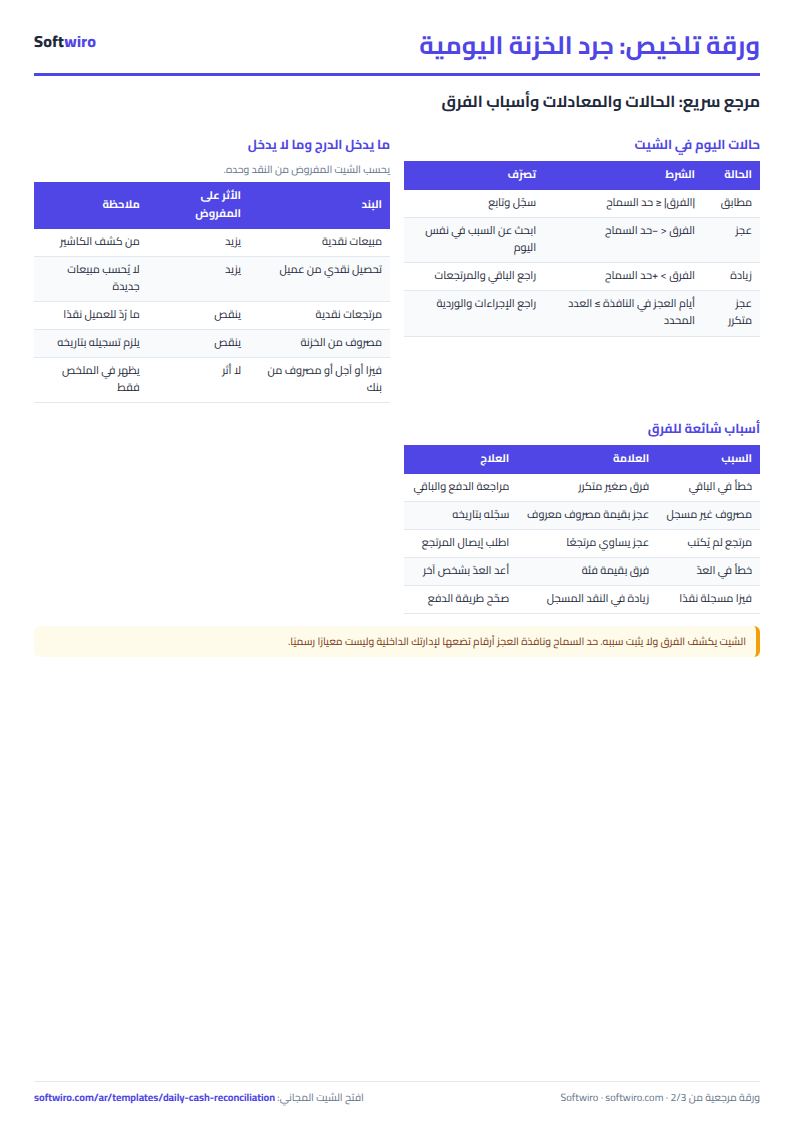
- The status shows: "matched" when the difference stays within tolerance, otherwise "shortage" or "surplus". If the number of shortage days in the window reaches the number you set, "repeated shortage" appears.
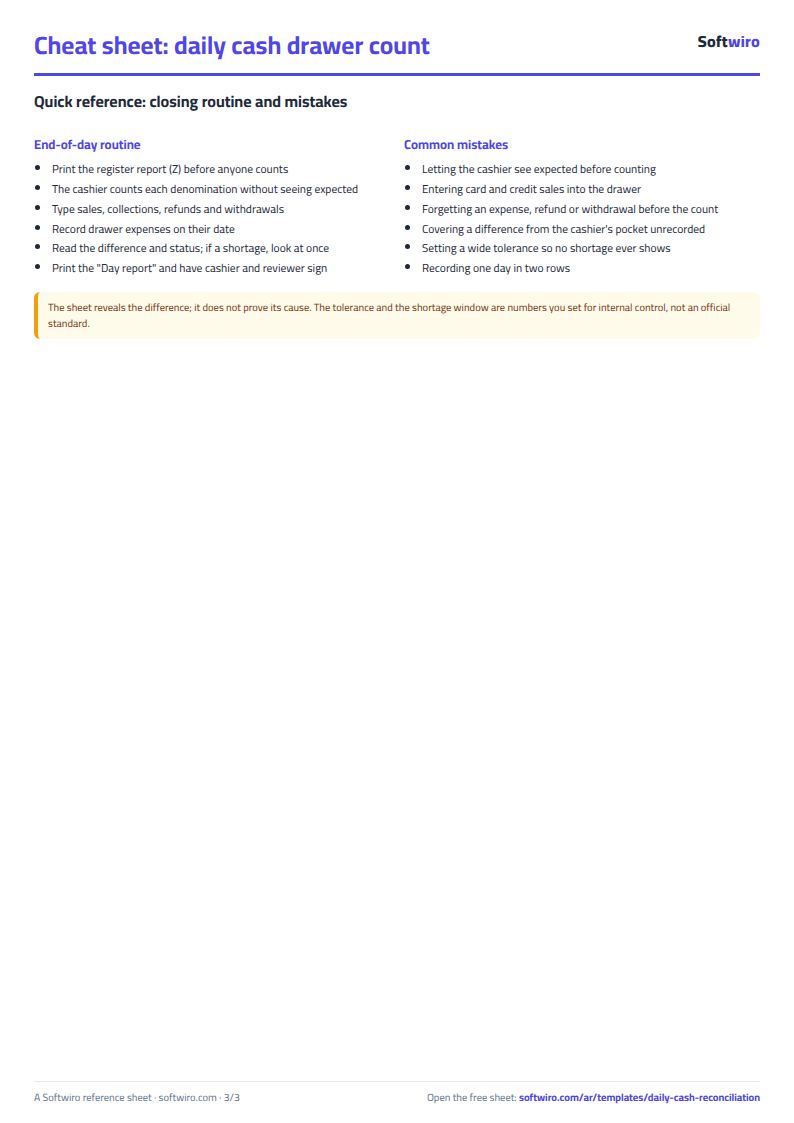
- Print Day report for the cashier and reviewer to sign, and read Summary and Cashiers.
What is in each sheet
- Summary: the month's numbers and four charts: sales per day, the daily difference, payment methods and drawer expenses by category.
- Day log: a row per day for up to 120 days, with a check for a repeated date or an unlisted cashier.
- Day report: a printable page for any date.
- Expenses: up to 400 expenses; only those paid from "the drawer" reduce the expected cash.
- Cashiers: each cashier's month.
- Settings: your limits and categories.
Walk-through on the sample numbers (sample data)
The numbers below are sample data for an imaginary shop over 21 days of November 2026, not a real business.
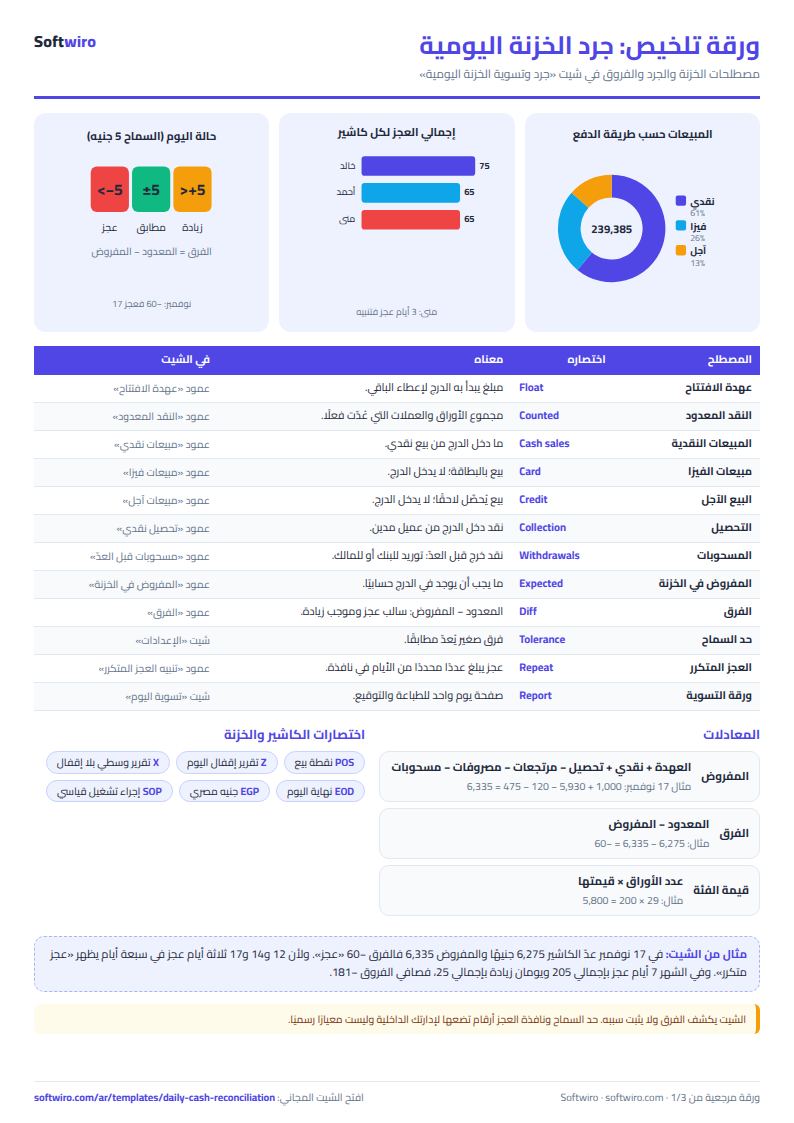
- The month: sales of 239,385 pounds: cash 145,945, card 61,340 and credit 32,100, averaging 11,399.29 a day. Drawer expenses were 4,985.
- Differences: 12 matched days, 7 shortage days totalling 205, and 2 surplus days totalling 25, so the net difference is -181. About 33.3% of days have a shortage.
- 17 November (cashier Khaled Youssef): the count is 29 notes of 200, 3 of 100, 3 of 50, one of 20 and one of 5, which is 6,275. Expected is 1,000 + 5,930 - 120 (refunds) - 475 (expenses) = 6,335. The difference is -60, status "shortage", and "repeated shortage" shows because the shortage days from the 11th to the 17th are the 12th, 14th and 17th.
- 5 November: counted 9,380 against expected 9,420, a difference of -40, "shortage".
- First repeated-shortage alert: 9 November, because the 5th, 6th and 9th are three shortage days within seven. The month has 9 alert days.
- Cashiers: Ahmed Samir worked 7 days with a net -53 (2 shortage days totalling 65); Mona Adel 7 days, net -58 (3 shortage days totalling 65, so "repeated shortage at cashier" shows); Khaled Youssef 7 days, net -70 (2 days totalling 75).
Common mistakes
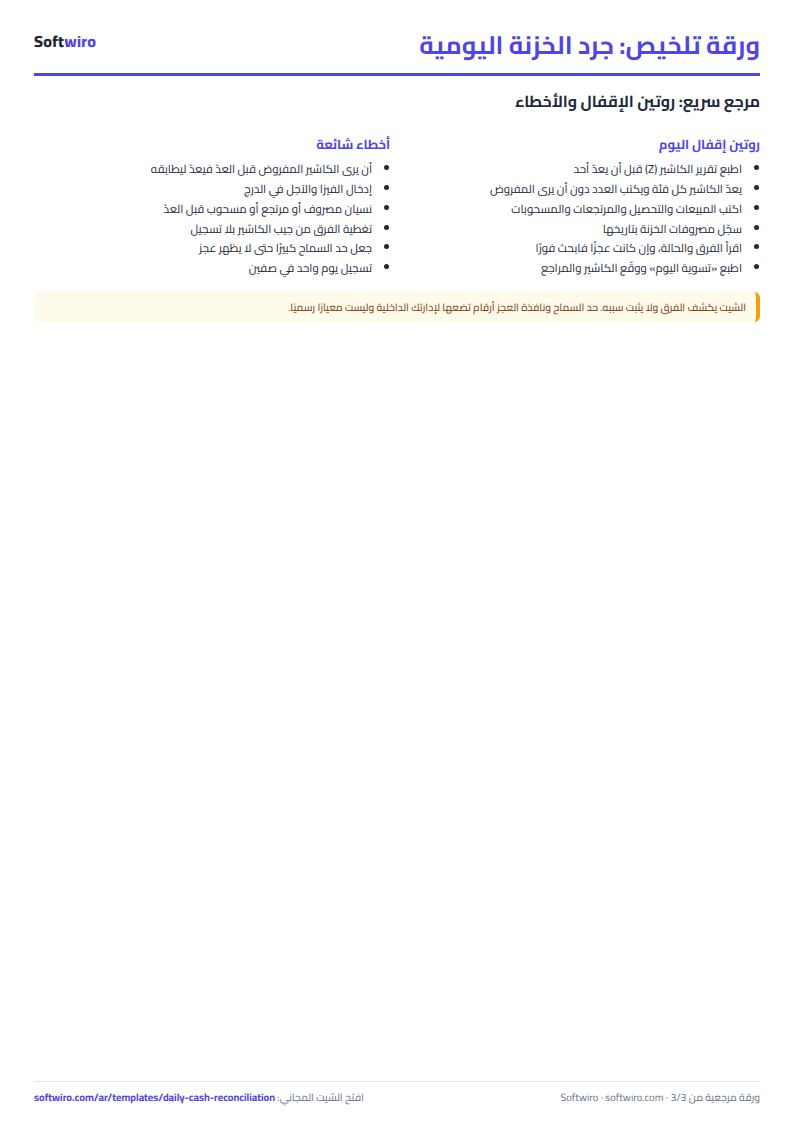
- Letting the cashier see the expected figure before counting, so the count is bent to match.
- Entering card and credit sales into the drawer, which shows a shortage that does not exist.
- Not recording an expense paid from the drawer, or recording it under another date.
- Forgetting refunds or withdrawals (a bank deposit or an owner draw) made before the count.
- Covering a difference from the cashier's pocket or tomorrow's drawer without recording it.
- Setting the tolerance so wide that no shortage ever shows. It is a number you set for internal control, not an official standard.
When the sheet is not enough
The sheet depends on someone counting and typing sales from the register report by hand, and on honest entry. When you have several branches and shifts and need sales to come from the invoices themselves, Softwiro can build you a custom program, or Accountwiro can help by recording invoices and payments as they happen. If you track every movement in a daily cash log, read the daily cash and expenses sheet.
FAQ
Do I type the expected cash myself? No, the sheet calculates it from your numbers; you only count and enter sales.
What do I do about a small shortage every day? Record it as it is. If it repeats it will show as "repeated shortage" so you look for the cause rather than hide it.
Can the denominations change? The denomination values sit in row 3 of the Day log, so you can change them if the currency changes.
Your next step
Clear the examples and record the first day: count the drawer tonight before seeing any figure, then type the sales and read the difference.