You are an accounting student or an accountant in a company, and you want to recall quickly which standard covers what: inventories, fixed assets, leases or revenue? You want to try the numbers on an example before opening the text of a standard, and to test yourself before an exam or a meeting with your auditor. The free IFRS summary sheet puts all of that in one file: a reference table, a lookup by number, simple calculators and a self-test.
An important note: this is a general teaching reference that does not replace the official standards. Every line in it is a short paraphrase, not text copied from a standard. For application, read the official text and follow what the competent authority in your country decides.
The problem: many numbers and similar names
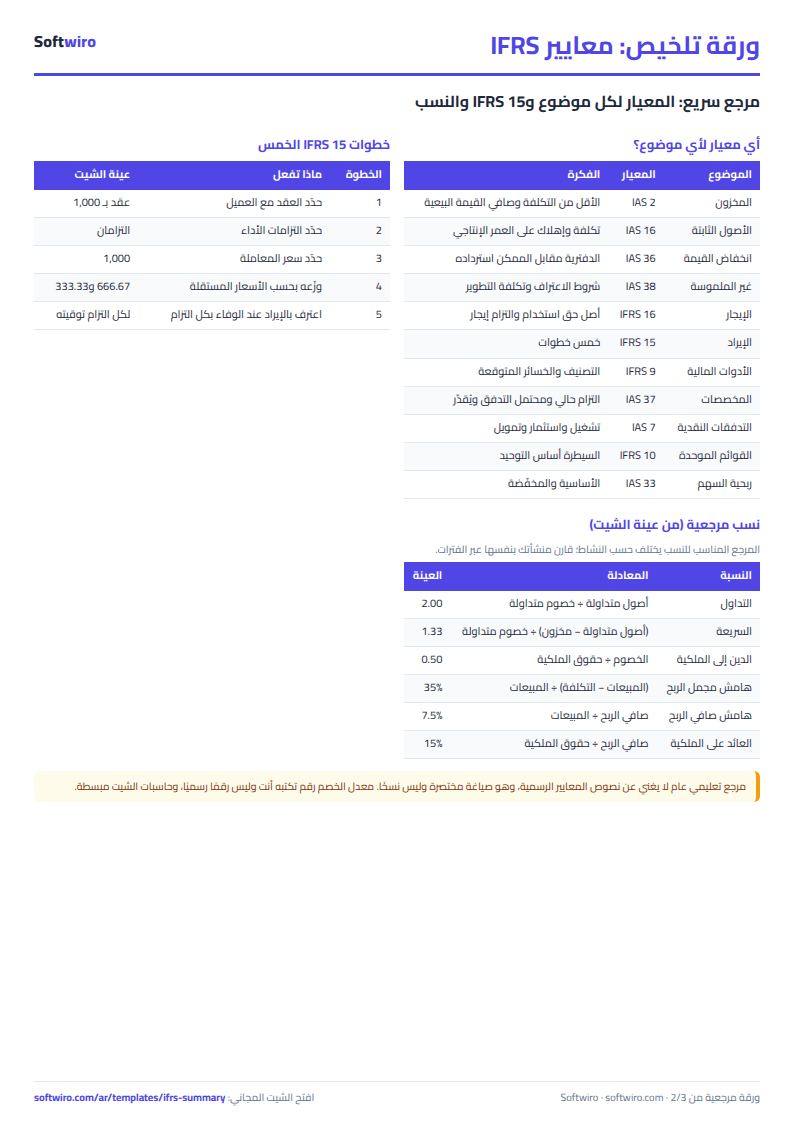
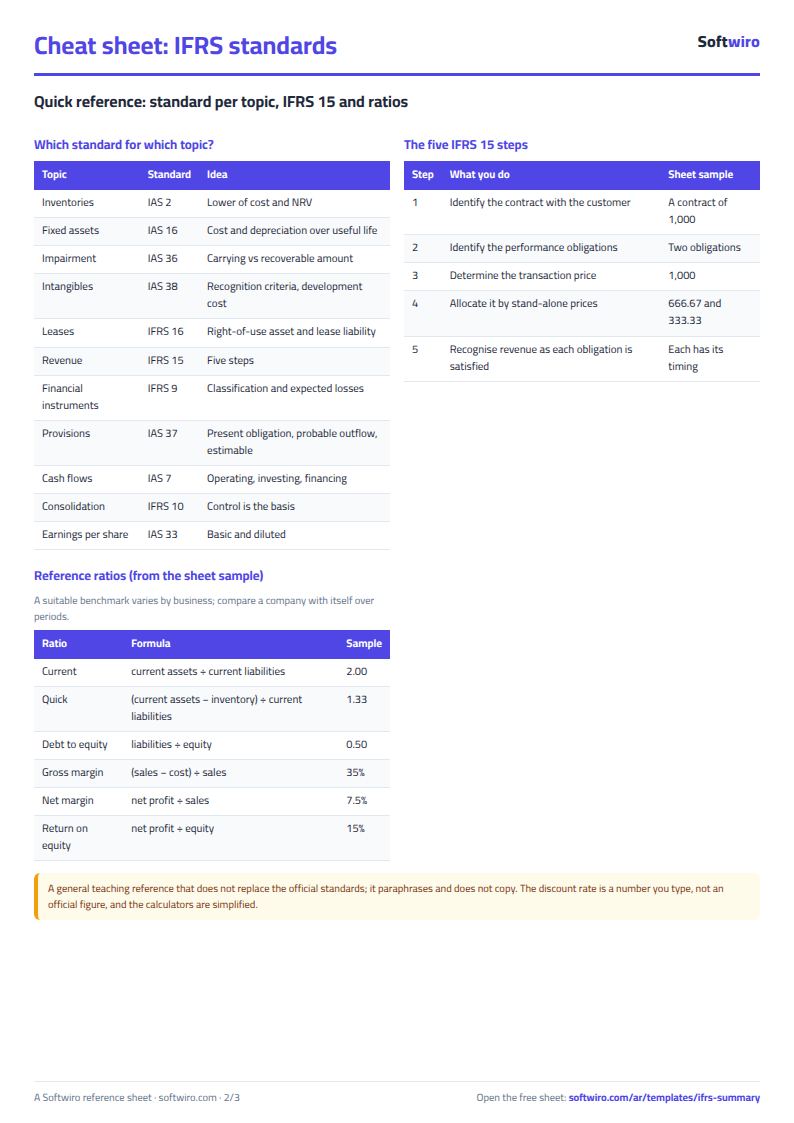
IFRS and IAS are dozens of standards whose numbers say nothing about their subject: IAS 2 for inventories, IAS 16 for fixed assets, IAS 36 for impairment and IAS 38 for intangible assets. Anyone revising for an exam or explaining to a colleague needs a table linking the number to the subject and a one-line idea, and a worked example that makes the idea stick.
How the sheet works, step by step
- Open Reference (the sheet is named «المرجع») and go through the standards by section: presentation and reporting, assets and measurement, financial instruments and liabilities, revenue and insurance, groups and investments, and applying the standards.
- Type a standard number in Lookup or pick it from the list, and its Arabic and official names and its idea appear.
- Try Calculators: change the white cells (such as cost or the discount rate) and the results change.
- Answer the Self-test: pick the right standard or type the result, and a tick or a cross appears.
- Record your score in Progress so the sheet tells you when to review, and open the Summary for the charts.
What each sheet gives you
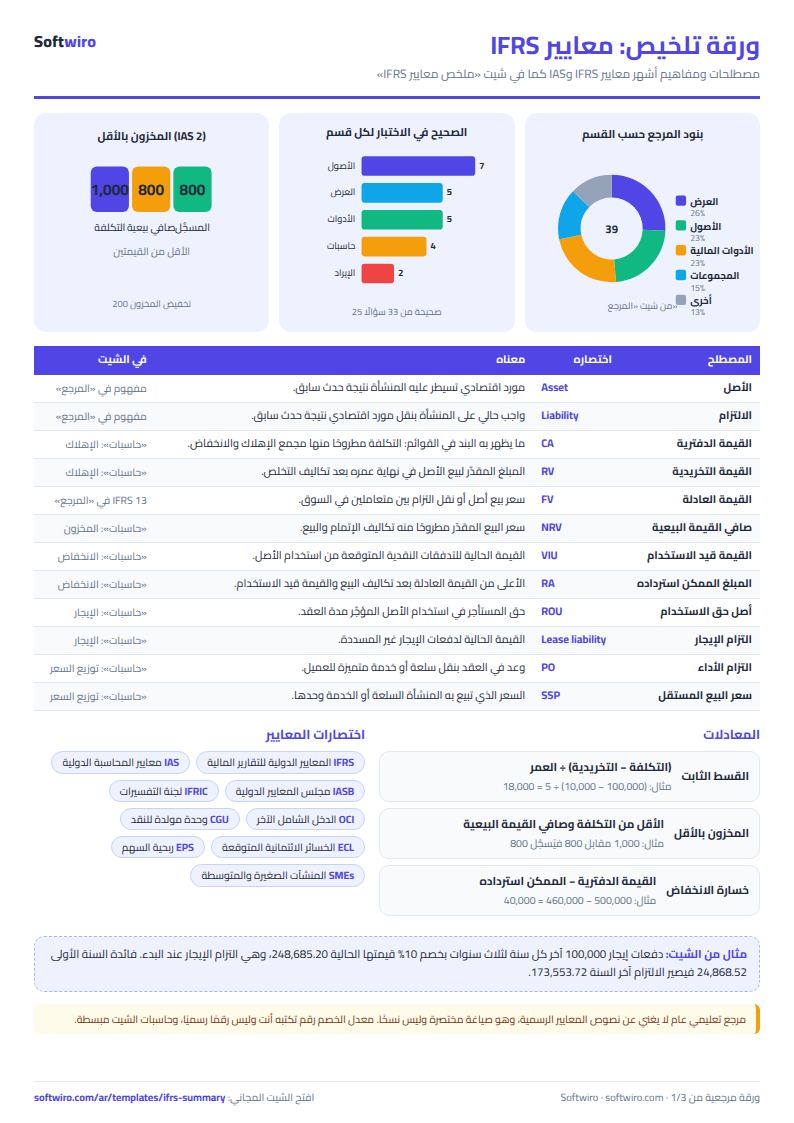
- Reference: 39 items (15 IFRS, 22 IAS, the Conceptual Framework and the SMEs standard).
- Calculators: depreciation, present value, a lease, inventory, impairment, price allocation, ratios and earnings per share.
- Self-test: 33 questions with a hidden answer key and an instant score.
- Progress and Summary: the next review date, the number of items per section and your score per section.
A walk-through on the sample numbers
The figures below come from the sample data in the sheet, which is fictional.
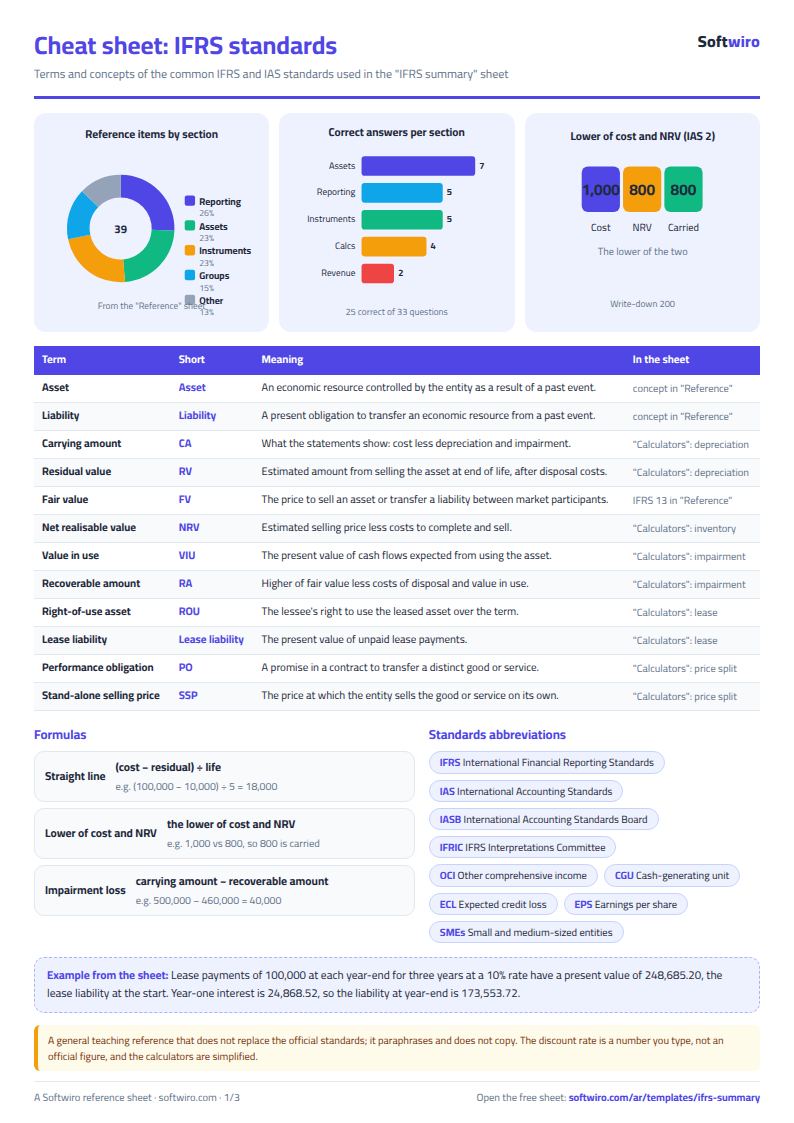
- Depreciation (IAS 16): an asset costing 100,000 with a residual value of 10,000 and a life of 5 years: straight-line depreciation is (100,000 - 10,000) ÷ 5 = 18,000 a year, and its carrying amount after 3 years is 46,000.
- Inventory (IAS 2): cost 1,000; expected selling price 1,200 less 250 to complete and 150 to sell gives a net realisable value of 800. The figure in the statements is the lower one, 800, so inventory is written down by 200.
- Impairment (IAS 36): carrying amount 500,000, fair value less costs of disposal 420,000, value in use 460,000. The recoverable amount is the higher, 460,000, so the impairment loss is 40,000.
- Lease (IFRS 16): payments of 100,000 at the end of each of three years at a 10% discount rate (typed by the user) give a present value of 248,685.20, the lease liability at the start. First-year interest is 24,868.52, so the liability at the end of year one is 173,553.72, and right-of-use depreciation is 82,895.07 a year. This is a simplified formula that assumes the asset equals the liability.
- Revenue (IFRS 15): a contract of 1,000 with two obligations whose stand-alone prices are 800 and 400: the first gets 1,000 × 800 ÷ 1,200 = 666.67 and the second 333.33.
- Earnings per share (IAS 33): profit 48,000, preference dividends 6,000 and 14,000 weighted shares: (48,000 - 6,000) ÷ 14,000 = 3.00.
- The self-test: 33 questions, 30 answered and 25 correct, so the score is 75.8% of all questions.
Common mistakes
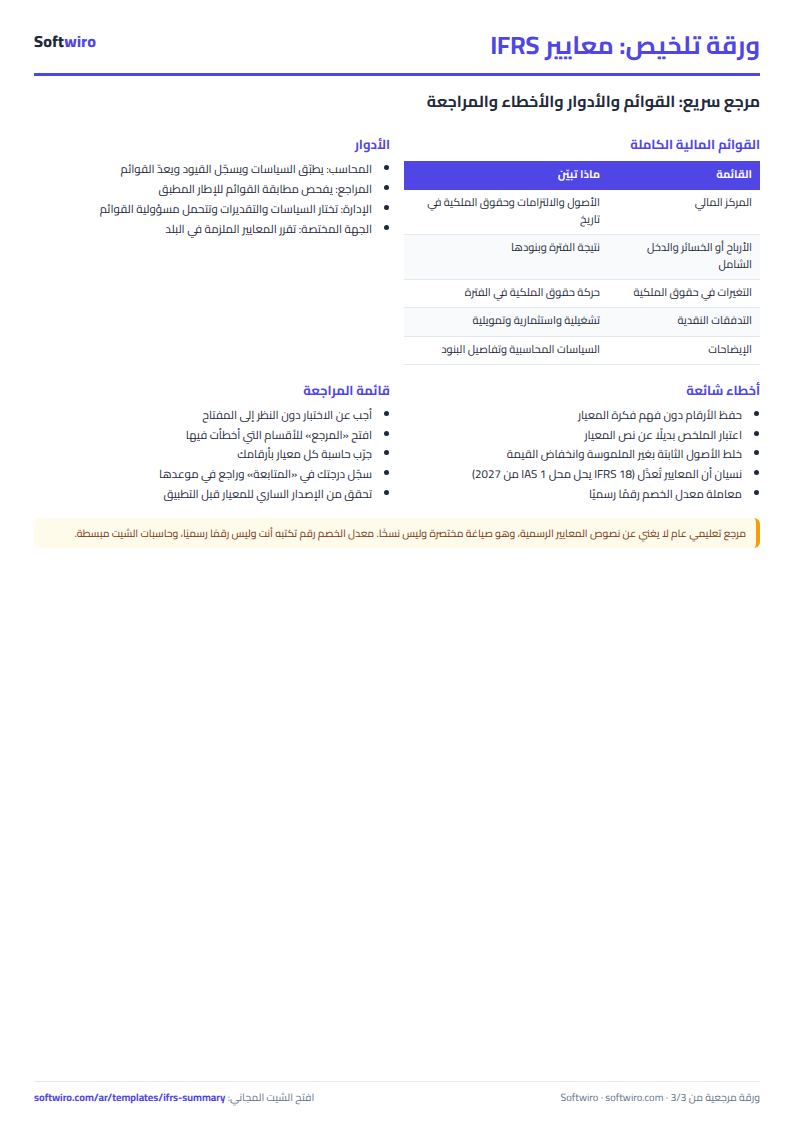
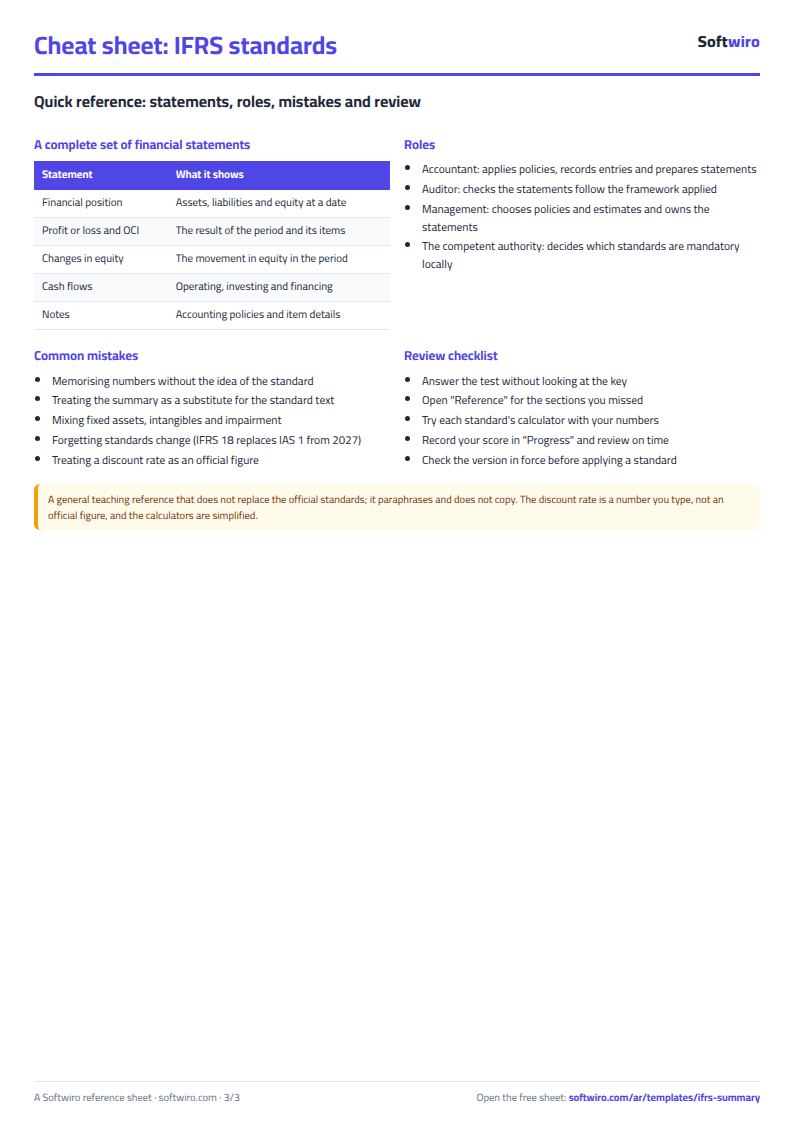
- Memorising numbers without the idea, then forgetting the standard when the question gives a description instead of a number.
- Treating the table as a substitute for the text of the standard in practice.
- Confusing IAS 16 (fixed assets) with IAS 38 (intangibles) and IAS 36 (impairment).
- Forgetting that standards change, as IFRS 18 will replace IAS 1 for periods beginning on 1 January 2027.
- Using a lease discount rate with no basis. It is a number you type for your own case, not an official figure.
When to move to a system
This sheet is for learning and revision. If you want to keep a company's books with a double entry that posts automatically, financial statements drawn from the entries and period closing, that is the job of ProfAcc. For depth on entries and ratios use the accounting rules and equations sheet, and for your company's asset depreciation schedule use the fixed assets depreciation sheet.
Your next step
Download the sheet and answer the 33 questions without looking at the key. Then open the sections you got wrong in the Reference sheet and record your score in Progress. In twenty minutes you will know which standards need review.
Common questions
Is it an official syllabus for a specific course? No, it is a general summary; use your textbook and lectures.
Can I change the questions? Yes. The test holds 45 questions and you can change the questions and their keys in the hidden columns.
Do the calculators work on a phone? Yes, in Excel, Google Sheets and LibreOffice.