You run a car wash and you want to know, without scattered notebooks: how much you made this month after shampoo, wax and labour; which hour and which day are busiest; how many washes are left on each subscriber's card; what each worker is owed; and which material is about to run out. The free car wash management sheet answers these from one log where you type every wash, and from your packages and prices, which you write once. The template is in Arabic.
The problem it solves
In a car wash the accounts are scattered: the cashier picks a price by car size, the cards are on a paper where the remainder gets lost, the worker asks about his commission at month end, shampoo is bought when it has run out rather than before, and nobody knows what one wash costs. Revenue looks big and you cannot see where it went. The sheet ties each wash to its package, size and worker, so the price, the commission and the material cost come out together.
How the sheet works, step by step
- In Settings you type today's date, the summary month, the card validity in days, and the car sizes with a material factor for each.
- In Materials you type each material, its price per litre, opening stock, what arrives and its minimum.
- In Packages you type each package, its price for each size and the millilitres of each material one wash uses.
- In Workers you set each worker as commission (a percentage) or daily wage with his days worked.
- In Cards you record each subscription card with its number of washes, price and start date.
- In Washes you record each wash: date, time, plate, size, package, worker, discount and payment method, and the card number if the customer paid with a card.
- You open Revenue and Summary to see daily revenue, profit and the busy hours.
What each sheet does
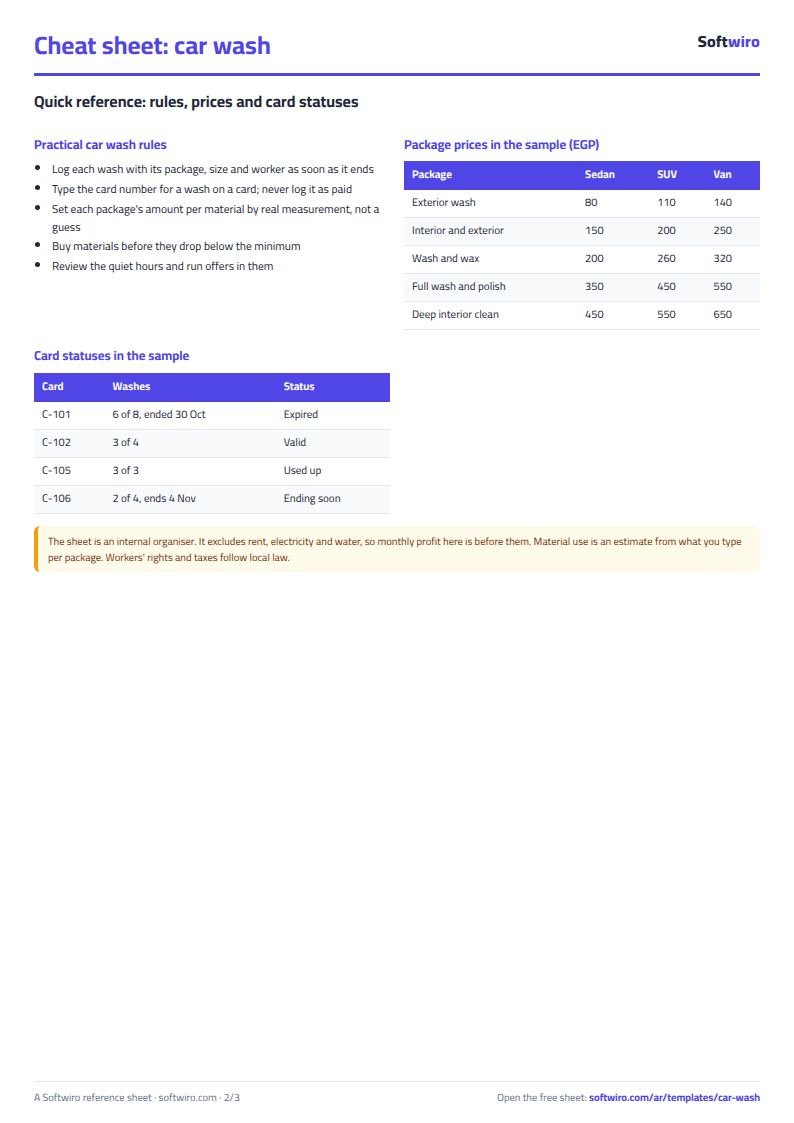
- Packages: the price for each size, the material cost of a sedan wash and its profit before labour.
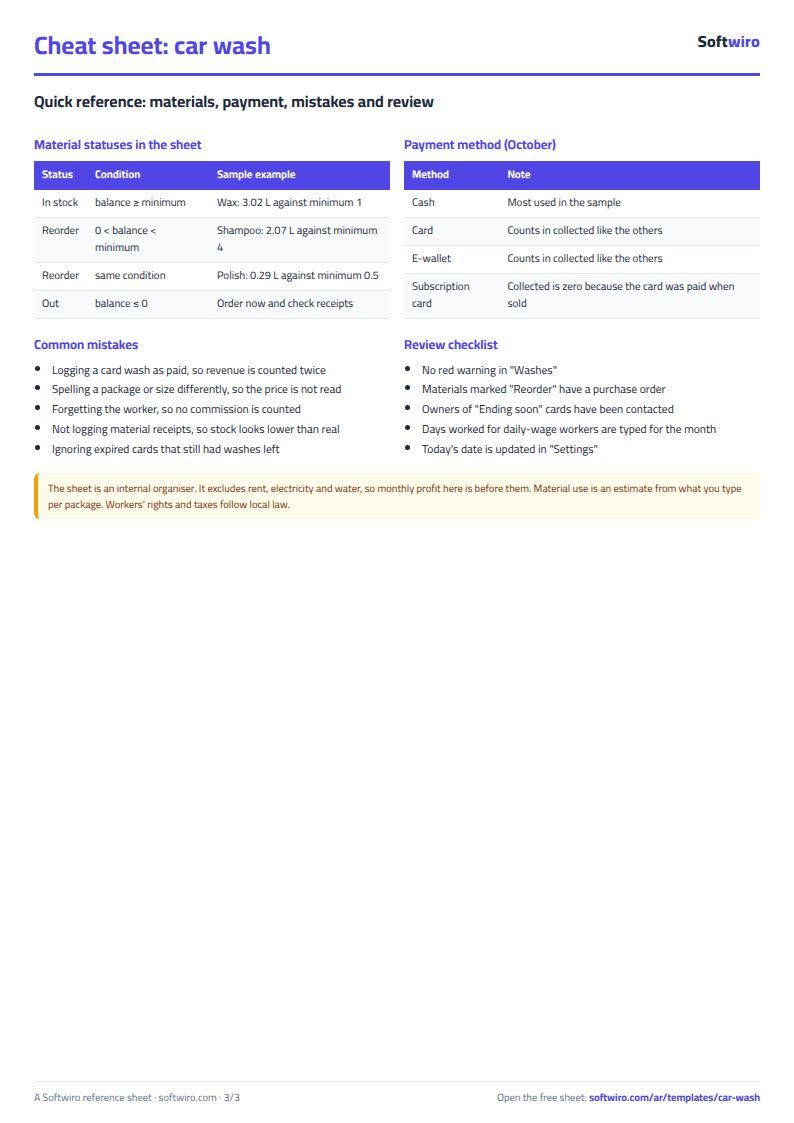
- Materials: use, balance, status (in stock, reorder or out) and the cost of what was used in the month.
- Cards: expiry date, used, remaining and status.
- Workers: the month's washes, what the worker collected, his commission, his daily wage and his total due.
- Washes: list price, collected, material cost and worker commission, with a warning for a missing package or an expired card.
- Revenue and Summary: daily and cumulative revenue, busy hours and weekdays, costs and profit, and five charts.
Walk-through on the sample numbers
These numbers are sample data, not a real car wash. Today is 2 November 2026 and the summary month is October.
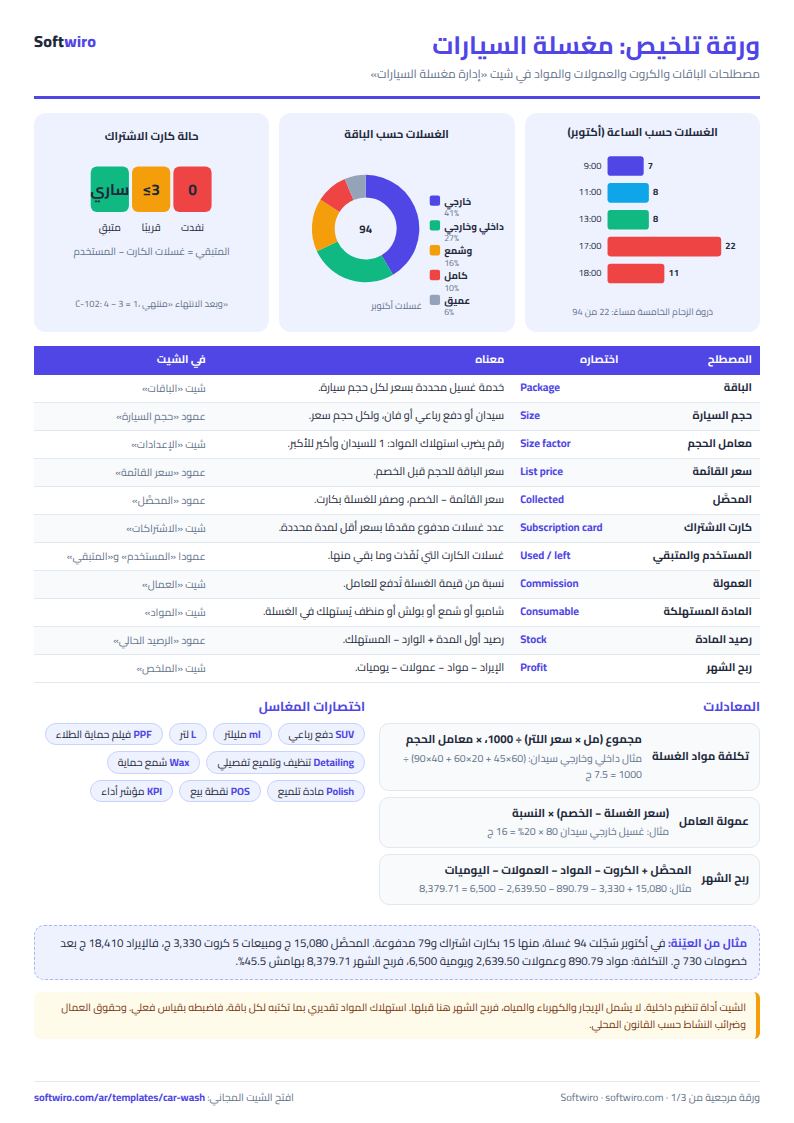
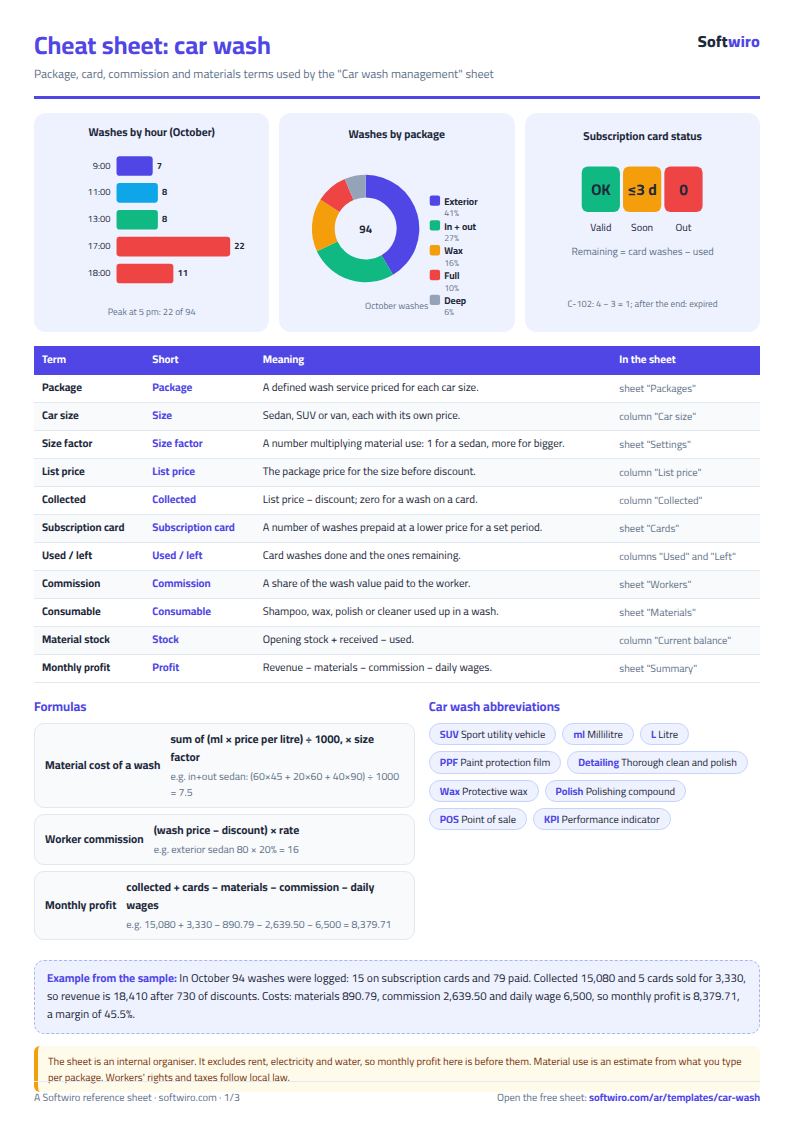
- An "interior and exterior" wash for a sedan costs 150 and uses 60 ml shampoo, 20 ml glass cleaner and 40 ml interior cleaner, so its material cost is (60×45 + 20×60 + 40×90) ÷ 1000 = 7.5. For an SUV the factor 1.3 raises the use by the same proportion.
- Hassan's 20% commission on an "exterior wash" for a sedan priced at 80: 16.
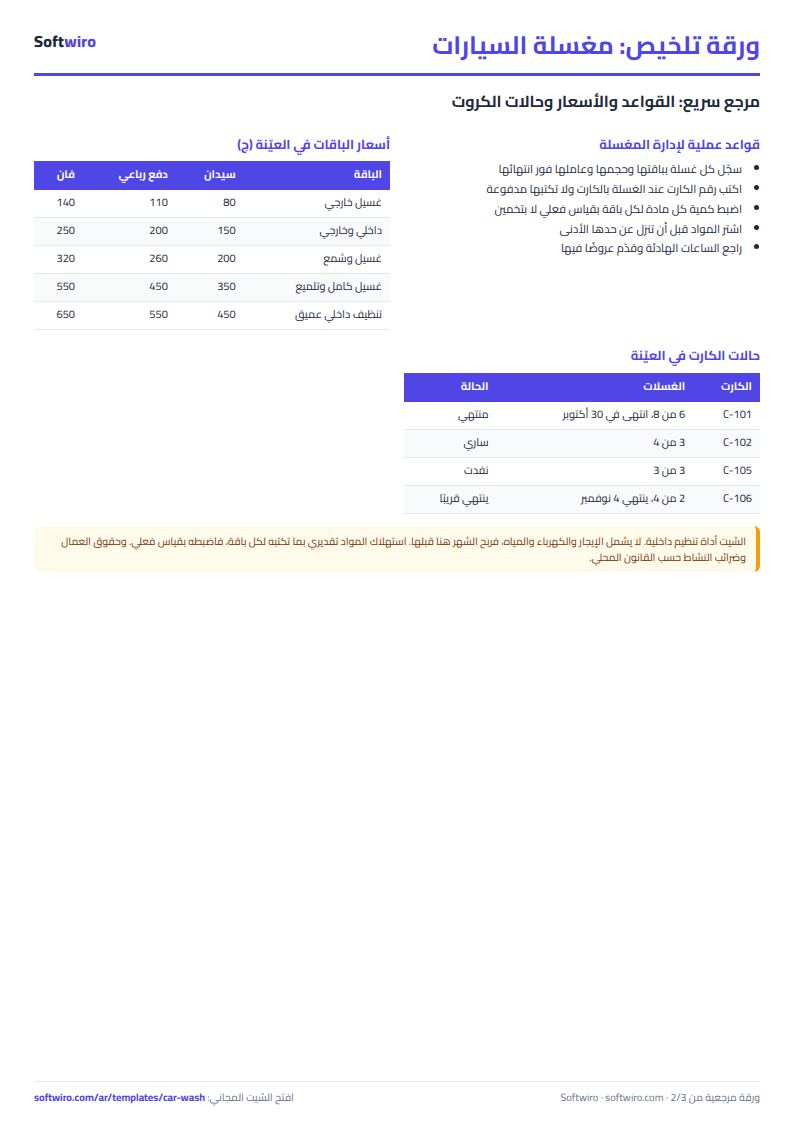
- Card C-102 holds 4 washes and 3 are used, so 1 remains and its status is "valid". Card C-105 has used all 3, so it shows "used up"; C-101 has used 6 of 8 but ended on 30 October, so it shows "expired"; and C-106 ends in two days, so it shows "ending soon".
In October 94 washes were logged: 15 on subscription cards and 79 paid. Collected was 15,080, an average of 190.89 per paid wash, and five cards sold for 3,330, so revenue is 18,410 after discounts of 730. Costs: materials 890.79, commissions 2,639.50 and Karim's daily wage 6,500 (250 × 26 days), a total of 10,030.29, leaving a monthly profit of 8,379.71, a margin of 45.5% before rent and electricity.
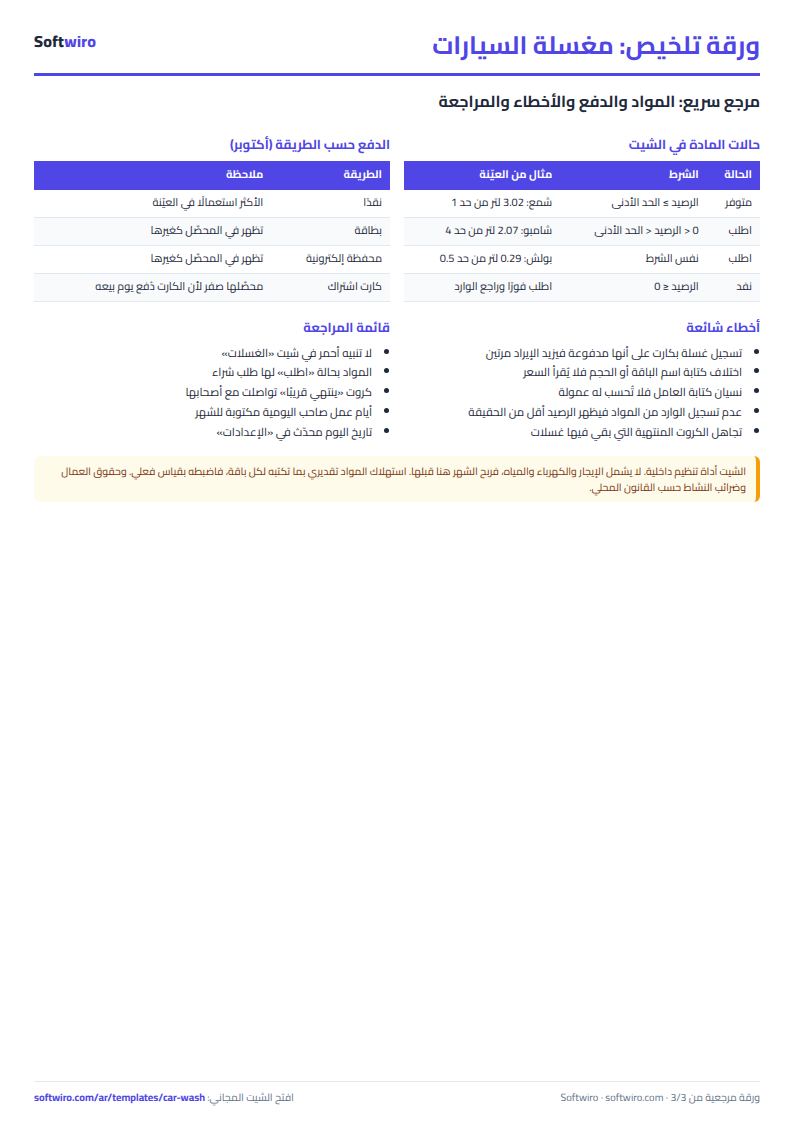
The busiest hour is 5 pm with 22 washes, the busiest day is Saturday with 26 washes, and the best day for collections was 17 October with 1,550. For materials, shampoo shows "reorder" with 2.07 litres against a minimum of 4, and polish shows "reorder" with 0.29 litres against 0.5.
Features and why they matter
- The price comes from package and size: the cashier does not guess.
- A card is not counted as revenue twice: its price is revenue on the day it is sold, and its washes show in the count, the cost and the commission.
- Use is worked out for every wash, so the sheet knows the shampoo and wax balance without a daily count.
- Commission or daily wage: each worker on his own pay system.
- Busy hours and days: to place your offers in the quiet hours.
- It works in Excel 2016 and later, Google Sheets and LibreOffice, free and without sign-up. It holds 20 packages, 100 cards and 3000 washes.
Common mistakes
- Logging a wash on a card as paid in cash, which counts revenue twice and leaves the card's remainder too high.
- Spelling a package or size differently from the sheet, so a warning shows and no price is read.
- Forgetting to enter materials received, so the balance looks lower than real.
- Setting a package's material amount by guess rather than by measurement.
- Forgetting the days a daily-wage worker worked in the month.
Remember the profit here excludes rent, electricity and water, and that workers' rights and taxes follow local law.
When to move to a system
When you open more branches or cashiers, or want a digital card that deducts itself and shows the customer what is left on his phone, or bookings made by customers themselves. To follow commission the same way in another business see the beauty salon bookings sheet, and for job orders and parts in workshops the car workshop sheet.
Your next step
Download the car wash management sheet, type your packages and prices in Packages, then log the first day's washes. After a week open Revenue to see your busy hours before you decide your workers' shifts.