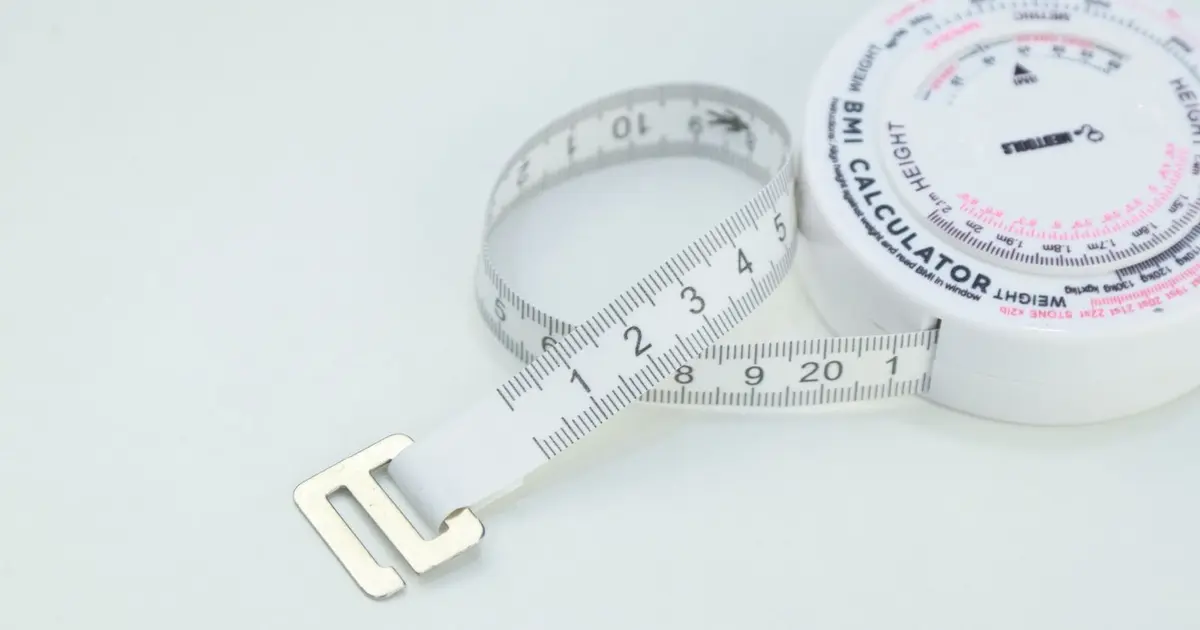
How BMI is calculated
BMI = weight in kilograms ÷ height in metres squared. Illustrative example: 78 kg and 165 cm (1.65 m). Height squared is 1.65 × 1.65 = 2.7225, so BMI = 78 ÷ 2.7225 = 28.7, in the overweight band. If you enter feet, inches and pounds, the calculator converts to cm and kg first (1 inch = 2.54 cm, 1 lb = 0.4536 kg).
The categories
- Below 18.5: underweight.
- 18.5 to under 25: healthy weight.
- 25 to under 30: overweight.
- 30 or more: obesity, split into class 1 (30 to under 35), class 2 (35 to under 40) and class 3 (40 or more).
Your healthy weight range and how far you are from it
There is no single ideal weight, only a range. The calculator multiplies your height squared by 18.5 and by 24.9. For 165 cm: 2.7225 × 18.5 = 50.4 kg and 2.7225 × 24.9 = 67.8 kg, so the range is 50.4 to 67.8 kg. At 78 kg you are about 10.2 kg above the upper end.
The limits of BMI
- BMI is a screening measure and does not diagnose anything on its own. It cannot tell muscle from fat, so a muscular athlete can be classed as overweight with little body fat. It also says nothing about where fat is carried, which is why waist circumference is used too.
- A WHO expert consultation (2004) proposed public health action points of 23 and 27.5 for Asian populations, because risk can rise at a lower BMI. The NHS uses 23 and 27.5 for South Asian, Chinese, other Asian, Middle Eastern, Black African and African-Caribbean backgrounds. These sources give no thresholds specific to Egyptians, so ask your doctor.
- The calculator does not apply in pregnancy or under 18. Children are assessed on growth charts.
Common mistakes
- Typing the height in metres in the cm box (1.65 instead of 165).
- Mixing up pounds and kilograms.
- Judging health from one number.
One number is not the whole picture. In MyClinic (Sehaty) the patient’s medical file holds their history and prescriptions are issued to it electronically, and the health passport carries a QR code for emergencies and a summary of health data, so your doctor can read your weight alongside the rest.
Read about the digital health passport · See MyClinic · Request a demo
Sources
- CDC: adult BMI categories (18.5, 25, 30 and obesity classes)
- WHO: obesity and overweight fact sheet (BMI definition; children use growth references)
- NHS: overweight and obesity (muscle; thresholds of 23 and 27.5 for some backgrounds)
- WHO Expert Consultation, Lancet 2004;363:157-63 (action points 23 and 27.5 for Asian populations)
Questions
How do I calculate BMI?
Divide your weight in kilograms by your height in metres squared. 78 kg at 1.65 m: 78 ÷ 2.7225 = 28.7.
What is a normal BMI?
18.5 to under 25 is a healthy weight. Below is underweight, 25 and above is overweight and 30 and above is obesity.
How do I find my ideal weight for my height?
There is no single number, only a healthy range. The calculator works it out from BMI 18.5 to 24.9 and shows how far you are from it.
Is BMI accurate for athletes?
Not always. BMI cannot tell muscle from fat, so a muscular athlete can be classed as overweight. Ask your doctor.
Can children or pregnant women use it?
No. It is for adults aged 18 and over; children are assessed on growth charts by age and sex. It does not apply in pregnancy, so ask your doctor or midwife.
Do you store my height and weight?
No. The calculation runs in your browser and nothing is sent to a server. To return to it, copy the link to your calculation.
Read the guide
More free tools
- Calorie calculator: BMR and daily calories: Work out your BMR and the daily calories to maintain your weight, with gentle options to lose or gain slowly, and a safe minimum. Adults only. Free.
- Due date calculator: pregnancy weeks and trimester: Work out your estimated due date from your last period or conception date, with your weeks of pregnancy, trimester and key dates. Free, no sign-up.
- Ovulation calculator: fertile window and next cycles: Find your estimated ovulation day, fertile window and next period, plus the next three cycles, from your last period, to plan a pregnancy. Free.
- Pharmacy margin calculator: profit and discount: Work out profit per unit, markup and margin for a pharmacy from cost and selling price or a target margin, plus what a discount does to profit. Free.
- Reorder point and safety stock calculator for pharmacies: Reorder point calculator: find safety stock and a suggested order quantity for a pharmacy from daily sales and lead time, with an expiry warning. Free.
- Clinic no-show cost calculator: Work out your clinic’s no-show rate, the revenue lost each month and year to missed appointments, what reminders could recover, and the break-even cost. Free.
- Garment cost calculator: Work out the cost of one garment from fabric, trims, labour, overheads and rejects, and the selling price for the margin you want. Free, no sign-up.
- Fabric consumption calculator: Work out fabric per piece in metres and kilograms from the marker length and the pieces it holds, plus the plies and fabric needed for a whole order. Free, no sign-up.
- Break-even calculator for a garment factory: Work out how many pieces a month cover your factory’s fixed costs, the output a target profit needs, and your margin of safety at current output. Free, no sign-up.
- Worker output and piece-rate calculator: Work out a worker’s or a line’s daily output from the standard time of a piece, the piece rate that pays a target wage, and actual efficiency from real output. Free, no sign-up.
- VAT calculator: Add VAT to a price or take it out of a VAT-inclusive one, for one item or several, at Egypt’s 14%, Saudi Arabia’s 15%, the UAE’s 5% or any rate you enter. Free, no sign-up.
- Study schedule maker: Enter your subjects, their exam dates and how many study sessions a day you can do, and get a day-by-day study schedule ready to print or save as PDF. Free, no sign-up.