Anyone who trains hard knows that training is half of the result and the plate is the other half: how many calories your body needs, how much protein, and whether today you ate what you planned, or less, or more. The free athlete nutrition and macros sheet works out your daily targets from your own data, turns your meals in grams into macros, and compares each day with your target.
The problem it solves
Many athletes hear "start with 3000 calories" or "2 grams of protein" without a calculation that fits their weight, activity and goal, and then log food on paper or in their head, so they never know what they really ate. Here you enter your data once and the targets appear; you type each meal by weight and the sheet adds up the day on its own.
Steps from opening the file to the result
- Settings: enter weight, height, age and sex, then pick your activity level and goal (maintain, bulk or cut) and the last day you want to review. Your daily targets appear automatically.
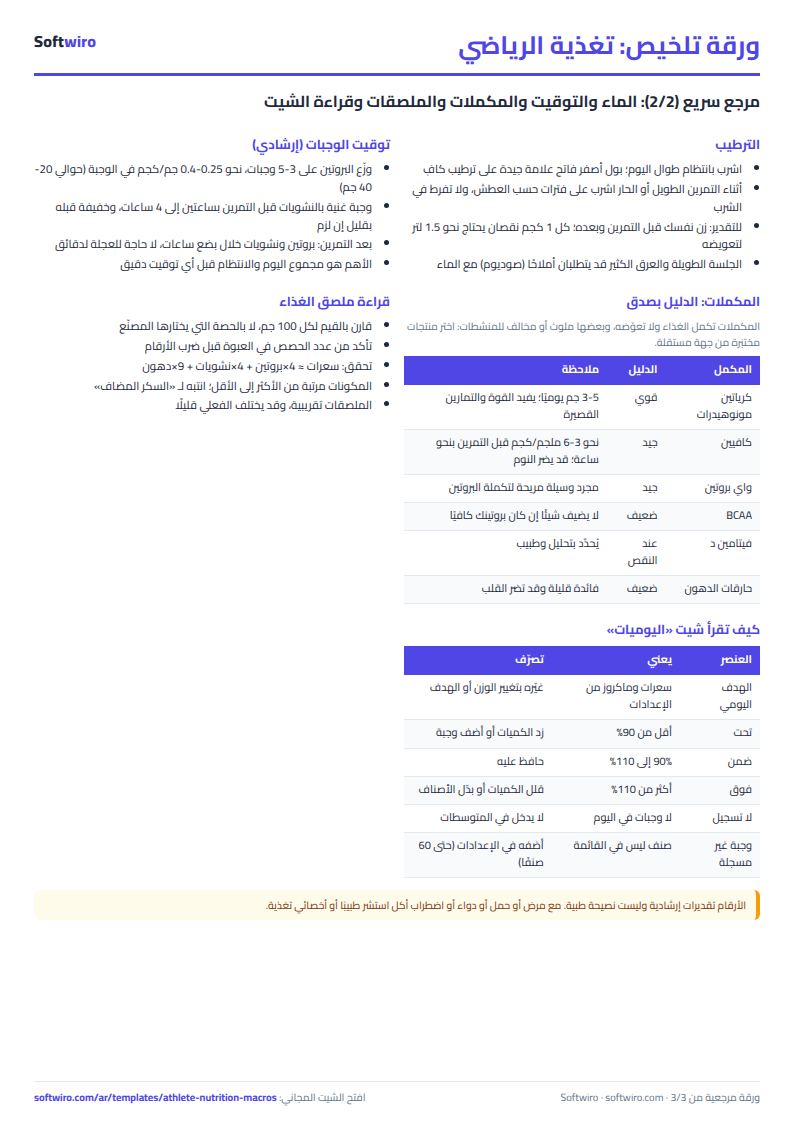
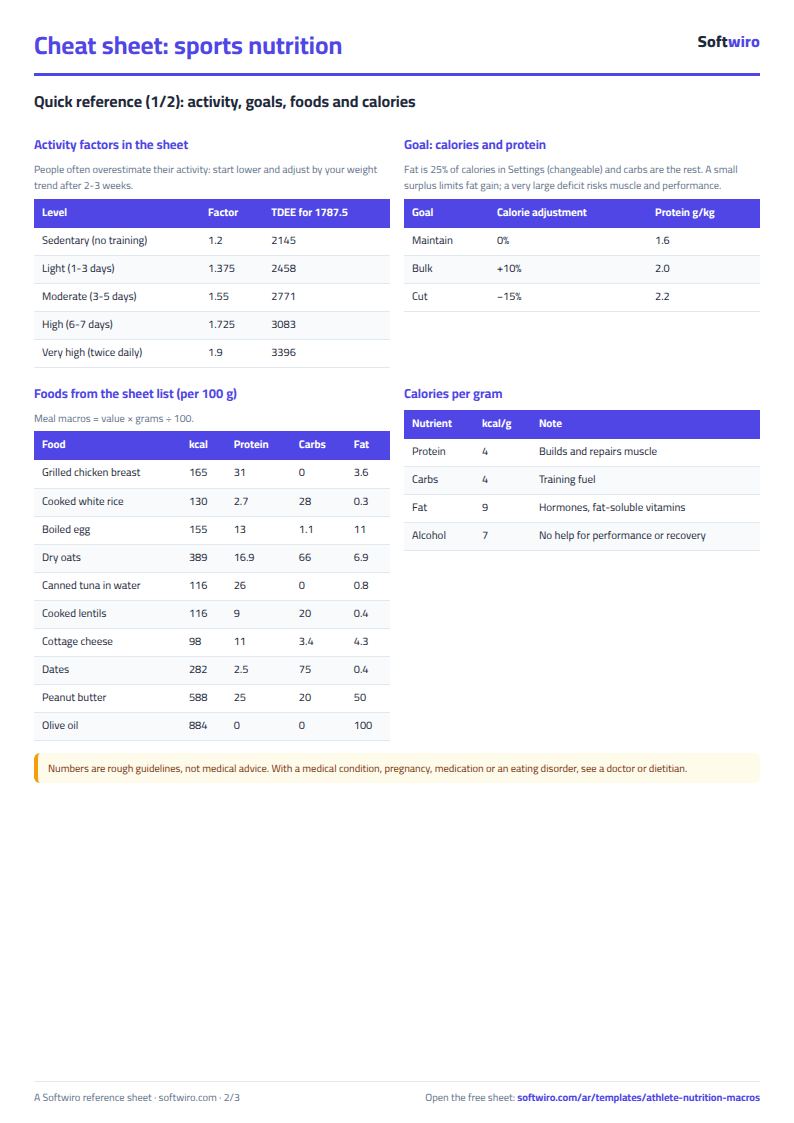
- Check the food list in Settings (up to 60 items): calories, protein, carbs and fat per 100 g. Edit the values or add your own foods.
- Meals: one row per food: date, meal type, food from the list and weight in grams. Its macros are worked out automatically.
- Open Daily to see the last 14 days, each day's percentage of its target and its status: under, within or over.
- Adjust your plan: if you stay "under" for several days in a row, add to your meals; if you stay "over", cut the amounts or change foods.
Worked example (sample data from the sheet)
The data is sample data, not a real athlete: a man weighing 82 kg, 178 cm tall, 30 years old, training 3-5 days a week with a bulking goal, and the last day in Daily set to 12 November 2026.
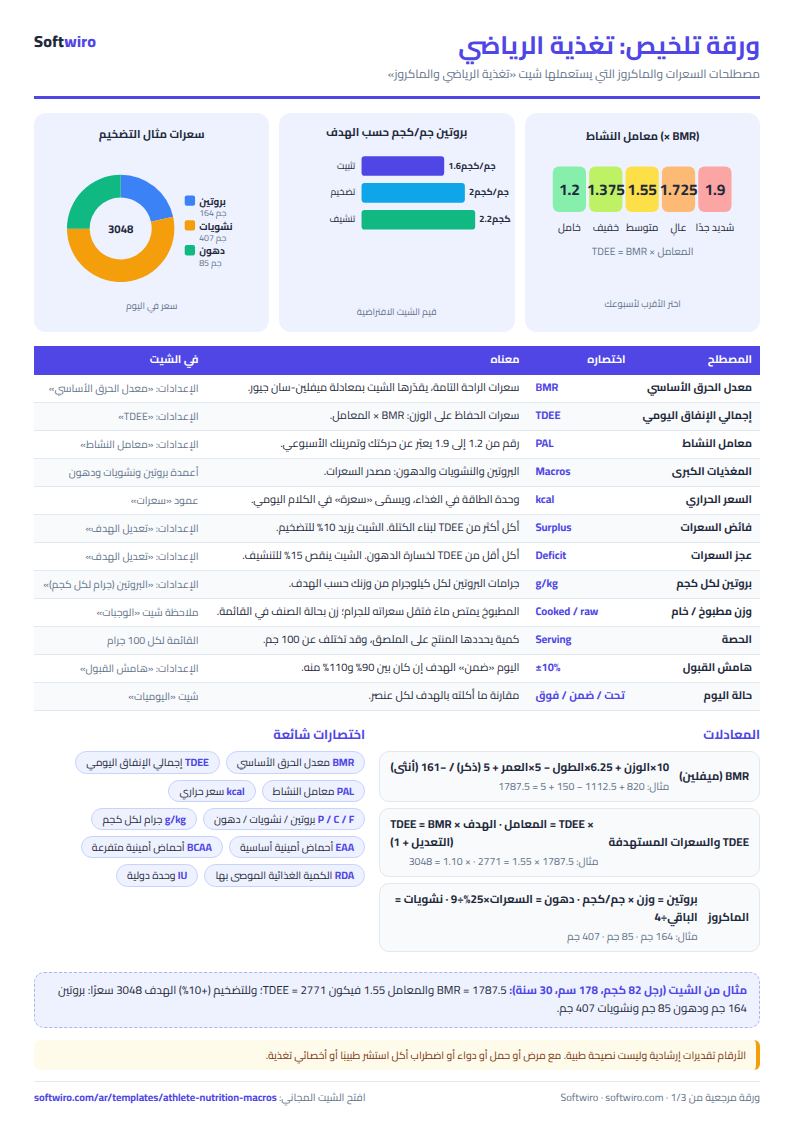
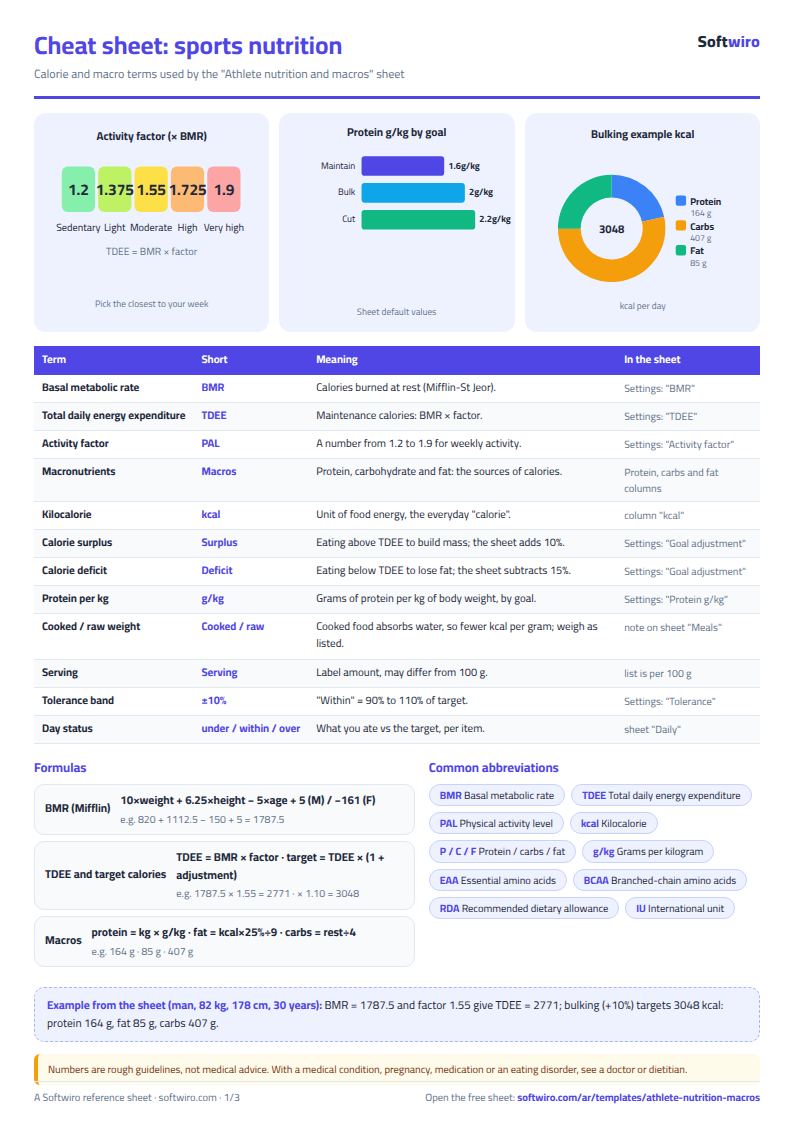
- Basal metabolic rate: 10 × 82 + 6.25 × 178 − 5 × 30 + 5 = 1,787.5 kcal.
- Maintenance calories: 1,787.5 × 1.55 = 2,771 kcal.
- Target calories: 2,771 + 10% for bulking = 3,048 kcal a day.
- Protein: 82 × 2.0 = 164 g. Fat: 25% of 3,048 ÷ 9 = 85 g. Carbs: (3,048 − 4 × 164 − 9 × 85) ÷ 4 = 407 g.
Over the last 14 days (30 October to 12 November):
- A normal day (such as 12 November): oats, milk, banana and eggs for breakfast; chicken and rice with olive oil for lunch; yogurt, dates and peanut butter as a snack; tuna and pasta for dinner. It totals 3,148 kcal (103% of target), 208.5 g protein, 390 g carbs and 85 g fat, so its status is "within".
- 2 November: much less food, 1,914 kcal (63%), so "under".
- 5 November: 3,788 kcal (124%), so "over".
- 8 November: only the first three meals were logged, so the day shows 1,976 kcal (65%), "under". The lesson is that "under" can mean you forgot to log, not that you ate little.
- 3 November: no meals logged, so it shows "no logging" and stays out of the averages.
- 7 November: a restaurant dinner was logged as "restaurant meal (not logged)", which is not on the list, so "food not found" appears beside it and its macros were not counted.
- Summary: 13 days with logging: 8 "within", 3 "under" and 2 "over". Average calories 2,978, which is 98% of target; average protein 197 g (about 120% of its target), carbs 367 g and fat 81 g.
Notice that protein runs above its target on most days because the foods on the list are rich in it. That is exactly what the sheet reveals: you eat your calories, but split differently from the plan.
How the numbers are worked out
- Basal metabolic rate (Mifflin-St Jeor) = 10 × weight + 6.25 × height − 5 × age + 5 for men or − 161 for women.
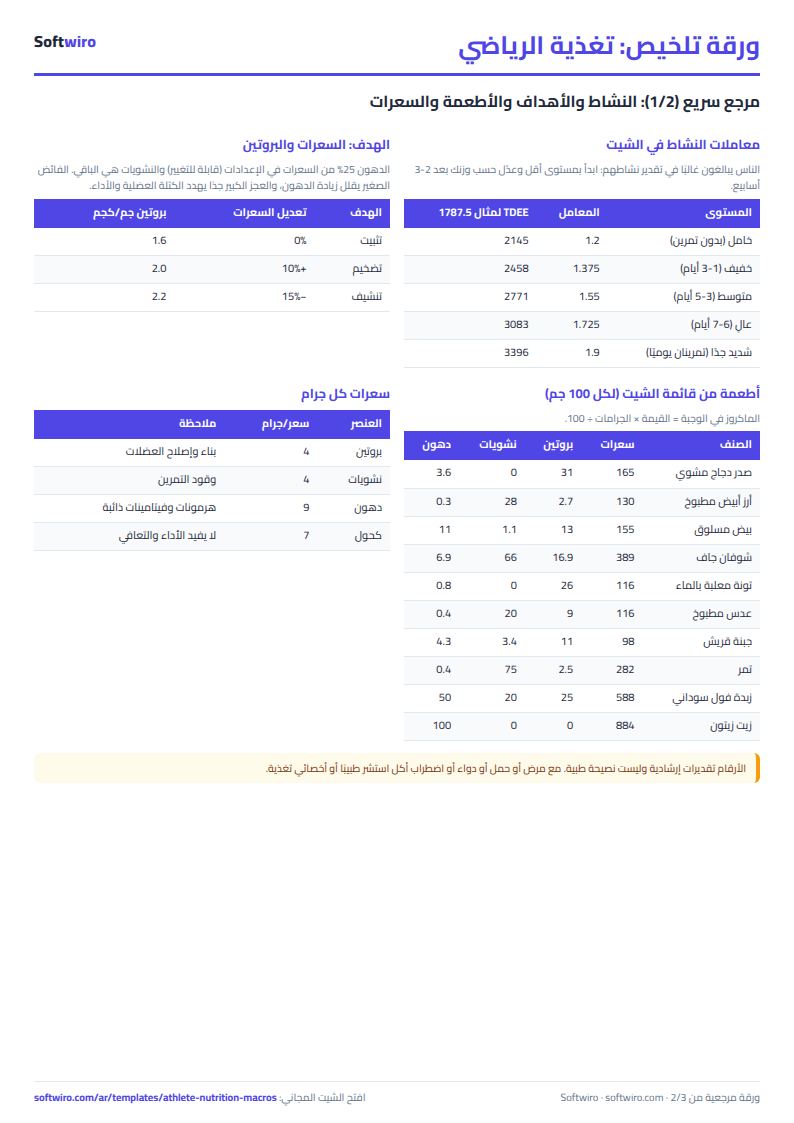
- Maintenance calories = rate × activity factor (from 1.2 for sedentary to 1.9 for very intense). Target calories = maintenance × (1 + adjustment): +10% bulk, −15% cut, zero to maintain.
- Protein = weight × 1.6 to maintain, 2.0 to bulk or 2.2 to cut. Fat = 25% of calories ÷ 9. Carbs = the remaining calories ÷ 4.
- A food's macros = its value per 100 g × weight ÷ 100.
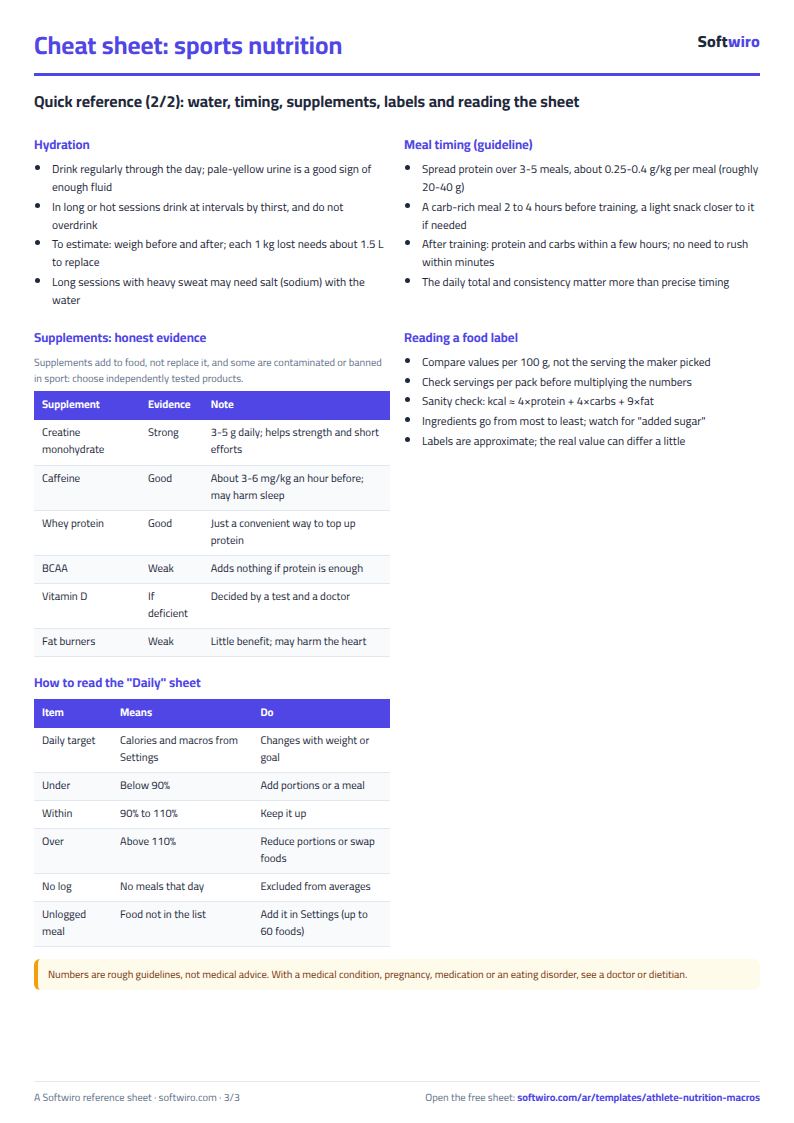
- Status: under 90% of target is "under", over 110% is "over", anything between is "within". You can change the margin in Settings.
Limits you should know
- These are rough estimates, not medical advice. The formulas are averages and your body may burn more or less. If you have an illness, are pregnant, take medication, or want to lose a lot of weight, consult a doctor or dietitian.
- The food values in the list are approximate and vary by brand and cooking method; do not mix up the weight of food cooked and raw.
- The sheet does not track your weight and does not adjust your calories if your weight stalls or changes fast; that is your decision or your coach's.
- It shows only 14 days ending on the date you type, and holds 1500 meal rows and 60 foods.
- It does not scan barcodes, search a food database or remind you about meals.
Tips
- Pick the food from the list instead of typing it; one wrong letter takes it out of the calculation.
- Weigh food on a kitchen scale for at least two weeks; after that your eye estimates are much better.
- Do not judge a single day; look at the average and at the number of "under" and "over" days before changing the plan.
- Add the foods you really eat with values from the package label, because a ready-made list cannot cover everything in your kitchen.
Try it
Open the sheet and try it online, or download it for Excel. If you want something made for you or your team, ask for it here.